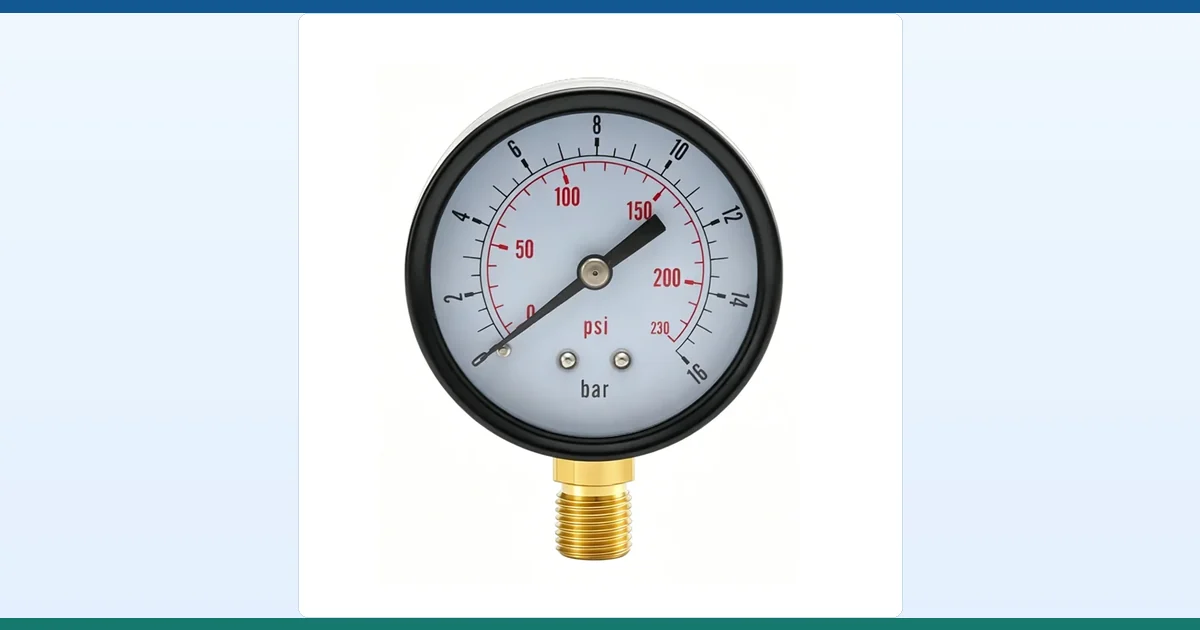
EN 837-1 is a common European reference for Bourdon tube pressure gauges. Procurement should connect the standard number with dial size, range, accuracy, safety case, connection, materials and inspection documents.
What EN 837-1 actually covers for Bourdon tube pressure gauges
EN 837-1 pressure gauge standard is a European reference for Bourdon tube indicating pressure gauges, vacuum gauges and compound gauges. In public catalogue summaries, its scope is described around circular, spiral or coiled Bourdon tube gauges, nominal sizes from 40 to 250 mm, and pressure ranges up to 1600 bar for gauge pressure measurement. That scope matters because it tells buyers what the standard is meant to control: dial size, pressure range, scale marking, accuracy class, construction details, safety features and tests for mechanical indicating gauges.
It does not turn one catalogue photo into a complete process specification. A gauge can be made to EN 837-1 and still be unsuitable for oxygen, sour gas, high-temperature steam, corrosive chemicals, slurry, severe pulsation or a hazardous area if those conditions are absent from the RFQ. Treat EN 837-1 as a baseline for the instrument design, then add process-specific requirements for wetted material, connection, case safety, fill fluid, accessories, certificates and inspection records.
For source context, compare the public EN 837-1 scope summary with the ASME page for ASME B40.100 pressure gauges and gauge attachments. For procurement, the important point is to state which standard, which edition, which service conditions and which records must be supplied.
Compare Pressure Gauge Accuracy Classes →→How to translate EN 837-1 into an RFQ instead of a slogan
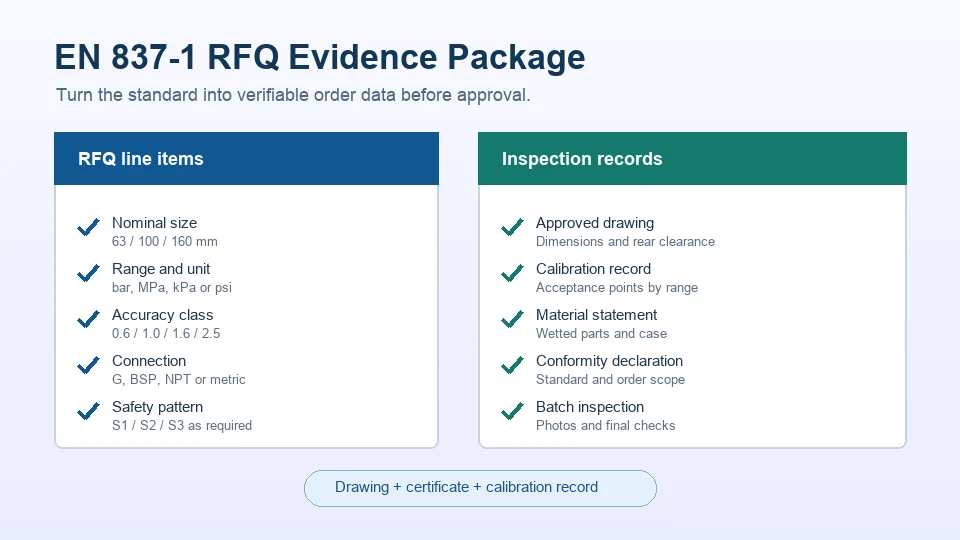
Writing “EN 837-1 compliant” is too broad. The supplier still has to know the dial size, range, unit, accuracy class, connection, mounting position, wetted parts, case pattern and documentation. A distributor also has to know whether the gauge is for utility water, compressed air, steam, hydraulic oil, oxygen, refrigerant, corrosive chemical or dirty process media.
| RFQ item | What EN-style wording should become | Risk if left vague |
|---|---|---|
| Nominal size | 40, 50, 63, 100, 160 or 250 mm; front or panel readability. | The dial is too small for inspection distance or too large for the panel. |
| Range and unit | bar, MPa, kPa, psi or dual scale; vacuum or compound range if needed. | Normal pressure sits at the bottom of the dial, or peaks exceed the range. |
| Accuracy class | Class 0.6, 1.0, 1.6, 2.5 or project-specific tolerance. | A low-cost gauge passes appearance checks but not process readability. |
| Connection | G, BSP, NPT or metric thread; bottom or back connection; sealing face. | Thread leakage, adaptor stacking, cracked sockets or site rework. |
| Safety design | S1, S2, S3 or project safety pattern; rear blow-out clearance. | Failure energy may be directed toward the operator or blocked by the panel. |
For Manogauge orders, also specify whether the product family is a stainless steel pressure gauge, liquid-filled gauge, diaphragm seal gauge, capsule gauge or differential pressure gauge. EN 837-1 language should not hide the product type.
Range, accuracy class and readability need to be checked together
Accuracy class is normally tied to full-scale span, not to the instantaneous reading. A class 1.6 gauge with a 0-10 bar range and a class 1.6 gauge with a 0-100 bar range do not give the same absolute tolerance. Oversizing the range to “be safe” can make normal readings too compressed for operators to use.
For steady service, normal pressure is often targeted in the middle part of the scale, commonly around 50-75% of full scale. Pulsating service, pump shutoff head, compressor discharge pressure, hydraulic spikes and pressure relief settings must be reviewed before choosing the printed range. Where the pointer vibrates or spikes are expected, consider a liquid-filled case, snubber, restrictor, pressure limiter, remote mounting line or transmitter, but do not use a snubber where clogging would hide real pressure.
For supporting reading, see the pressure gauge accuracy class selection guide and the pressure gauge snubber selection guide.
Request an EN 837-1 Gauge RFQ Reviewエンジニアが24時間以内に返答→S1, S2 and S3 safety patterns: what the symbols are trying to control
Safety pattern is the part of EN-style pressure gauge selection most often simplified incorrectly. The hazard is not only an inaccurate pointer. If a Bourdon tube ruptures inside the case, compressed gas, steam, hot liquid or fragments can escape. Safety construction is intended to give that energy a safer direction and add a barrier between the pressure element and the window side.
In practical RFQ language, S1 is associated with a blow-out device, S2 adds safety-pattern protection without the same solid-front barrier concept as S3, and S3 is commonly understood as the higher-protection solid-front safety pattern with a rear blow-out path. Public application notes and manufacturer guidance describe these features as rear pressure relief, laminated or safety glass and, for S3, a solid baffle wall. The buyer should still confirm the exact interpretation with the applicable standard edition and supplier drawing.
Do not specify S3 automatically for every low-risk water line, and do not omit it automatically for gas, oxygen, high pressure, steam, toxic or hazardous service. The required safety pattern depends on medium phase, stored energy, pressure, temperature, mounting orientation, rear clearance and where the operator stands.
Installation details can make a correct gauge behave incorrectly
EN 837-1 does not rescue a poor installation. A rear blow-out back needs open space; it should not be pressed against a flat panel unless the panel design provides a proper relief path. A bottom-entry gauge should not carry pipe stress. A back-entry gauge mounted through a panel needs enough clearance, support and access for replacement.
Temperature protection is separate from the standard number. Steam service may need a siphon or cooling leg. Thermal oil or hot process liquid may need a capillary, cooling element or diaphragm seal. Pulsation may need damping, but any damping device can clog in dirty service — in utility services such as compressed air systems, monitoring line pressure helps detect leaks and compressor efficiency loss. Corrosive or viscous media may need 316L, special alloys, PTFE-lined parts or an isolating diaphragm seal. For thread compatibility, review the pressure gauge thread connection guide.
This is also where documentation should match reality: the installed gauge, accessory, valve, seal and thread adaptor should all be listed in the purchase and maintenance record.
EN 837-1 versus ASME B40.100, CE and PED in export orders
EN 837-1 and ASME B40.100 are both common in global pressure gauge sourcing, but they are not identical purchase shortcuts. EN-style orders often use metric nominal sizes, bar or MPa scales and G or metric connections. ASME-oriented projects often use inch dial sizes, psi scales and NPT connections, and ASME B40.100 also covers gauge attachments such as diaphragm seals, snubbers and pressure limiting valves.
CE or PED wording is a different question from EN 837-1 construction. Whether a gauge or assembly falls under a directive, what category applies, and what declaration is needed depends on the product, pressure, volume, medium and market. Do not write “EN 837-1 + CE + PED” as one generic line unless the supplier has confirmed exactly what documents can be issued for that model and order.
For OEM exports, the RFQ should state target market, required scale units, connection standard, label language, certificate package, packaging, inspection level and whether the customer needs a certificate of conformity, calibration certificate, material certificate or batch inspection report.
Inspection evidence: what to ask a supplier before mass production
A careful buyer does not only ask whether a gauge is “standard”. Ask what can be checked before shipment. A useful pre-production package may include drawing, range table, material list, calibration method, inspection plan and sample photos. For repeat OEM orders, keep the approved drawing and compare future lots against it.
| Evidence | What it confirms | When it matters most |
|---|---|---|
| Drawing | Dial size, connection, mounting, case dimensions and rear clearance. | Panel-mounted gauges, OEM skids and limited-space equipment. |
| Calibration record | Accuracy class and acceptance points for the ordered range. | Test benches, process control, regulated maintenance records. |
| Material statement | Socket, Bourdon tube, diaphragm, gasket and case materials. | Corrosive media, food/pharma, oxygen, seawater, chemicals. |
| Conformity declaration | Which standard or project requirement the supplier claims for the lot. | Export, customer audits and incoming inspection. |
Manogauge manufactures industrial pressure gauges in Zhejiang under an ISO 9001 quality system, but every order still needs its own evidence set. Do not assume that one certificate covers a different range, material or connection.
Detailed RFQ checklist for EN 837-1 pressure gauges
A complete RFQ for the EN 837-1 pressure gauge standard should make the engineering decision visible. Include the following items before asking for a quote.
- Service: medium, concentration, phase, temperature, cleaning method, corrosion and viscosity.
- Pressure data: normal pressure, maximum pressure, vacuum possibility, startup peak, pulsation and relief setting.
- Dial and performance: nominal size, range, unit, dual scale, accuracy class, pointer stability and viewing distance.
- Process connection: thread family, size, bottom or back entry, sealing surface, valve or manifold.
- Materials: socket, Bourdon tube, diaphragm seal if any, gasket, case, window and fill fluid.
- Safety: S1/S2/S3 or project pattern, rear blow-out clearance, solid-front need and operator position.
- Accessories: siphon, snubber, pressure limiter, capillary, cooling element, remote line or isolation valve.
- Documents: drawing, certificate of conformity, calibration certificate, material certificate, inspection record and packaging requirement.
Used this way, EN 837-1 becomes a practical purchasing checklist rather than a short standard number. It helps compare suppliers, reduce thread and range errors, and define what the selected pressure gauge can and cannot prove in service.
For gauges ordered with calibration documentation, see the companion guide: pressure gauge calibration traceability — covering certificate requirements, ISO/IEC 17025 scope, uncertainty statements and acceptance criteria.
Related products
- Stainless Steel Pressure Gauge - Radial (ZX-01-R) — 0–100 MPa
- General Pressure Gauge - Radial (ZX-08-R) — 0–40 MPa
Часто задаваемые вопросы
What does EN 837-1 cover for pressure gauges?
EN 837-1 covers Bourdon tube indicating pressure gauges, vacuum gauges and compound gauges, including nominal size, range, scale, accuracy, construction, safety features and tests. It does not by itself prove media compatibility or suitability for every installation.
Does EN 837-1 compliance mean the gauge is safe for oxygen or hazardous service?
No. Oxygen cleanliness, hazardous-area approval, toxic media, sour gas, high temperature and corrosion must be specified separately. EN 837-1 safety pattern language helps with case construction, but it does not replace a project hazard review.
What is the difference between S1, S2 and S3 safety patterns?
In practical RFQ language, S1 is associated with a blow-out device, S2 adds safety-pattern protection, and S3 is commonly used for solid-front safety construction with a rear blow-out path. Confirm the exact interpretation with the standard edition and supplier drawing.
How should I select range under EN 837-1 practice?
Normal steady pressure should usually sit in the readable middle part of the dial, often around 50-75% of full scale. Startup peaks, pump shutoff pressure, pulsation, relief settings and vacuum possibility must also be checked.
What should an EN 837-1 pressure gauge RFQ include besides the standard number?
Include medium, temperature, pressure data, range, unit, accuracy class, dial size, connection, wetted material, case material, safety pattern, accessories, certificate requirements and inspection records.