圧力計の仕様選定では、性能、安全性、コストのバランスを取ることが求められます。過剰な精度は不必要なコスト増につながり、一方で不十分な精度はプロセス制御やプラントの安全性を損なう可能性があります。最適な選定は、国際的な精度規格、用途特有の要求事項、そして経時的に計器性能を低下させる環境要因を明確に理解することにかかっています。本技術概要では、産業用途に適した圧力計の精度等級を選定するための体系的なフレームワークを提供し、信頼性の高い計測と運用の完全性を確保します。
精度規格の理解:ASME B40.100とEN 837-1
圧力計の精度とは、指示値が真の圧力値にどれだけ一致しているかを示すものです。アナログ式(ブルドン管)圧力計では、これは通常、フルスケール(測定範囲)に対するパーセンテージで表されます。この分類を規定する主要な国際規格が2つあります。北米のASME B40.100と欧州のEN 837-1です。両規格とも、目盛板全体にわたる最大許容誤差を定めた精度等級(Accuracy Grade/Class)を定義しています。
フルスケール精度と指示値精度を区別することが極めて重要です。ほとんどすべての産業用アナログ圧力計は、フルスケール精度で規定されています。例えば、0-100 barのレンジで精度1.0%の圧力計の場合、最大許容誤差は*目盛板上のどの点においても*±1 barとなります。これは、レンジの下限に近づくほど相対誤差が大きくなることを意味します(例:10 barの指示値における±1 barの誤差は、読み取り値に対して10%の誤差に相当します)。このため、常用圧力は常にゲージレンジの中央3分の1(スパンの約25%~75%)に設定すべきです。この範囲で、規定された精度が最も効果的に機能します。
対照的に、デジタル圧力計で一般的な指示値精度は、特定の読み取り値に対するパーセンテージとして誤差を定義します。これにより、測定範囲全体でより一貫した相対精度が得られますが、機械式圧力計の標準ではありません。
圧力計カタログを見る →143以上の工業用ゲージを見る→各規格における精度等級の対応
エンジニアは、ASMEまたはEN規格のいずれかを参照する仕様書にしばしば遭遇します。基本原則は似ていますが、等級の表記が異なります。グローバルな調達や機器の仕様決定において、これらの同等性を理解することは不可欠です。ASME B40.100は文字体系(例:1A, 2A, B)を使用し、EN 837-1はパーセント誤差に対応するクラス番号(例:1.0, 1.6)を使用します。
以下の表は、一般的な精度等級とその代表的な用途を直接比較したものです。
| ASME B40.100 等級 | EN 837-1 クラス | 精度 (% of Span) | 代表的な用途 |
|---|---|---|---|
| 4A | 0.1 | ±0.1% | 試験用・標準用圧力計 |
| 3A | 0.25 | ±0.25% | 精密測定、校正用 |
| 2A | 0.5, 0.6 | ±0.5%, ±0.6% | 重要プロセス制御 |
| 1A | 1.0 | ±1.0% | 一般的なプロセス監視 |
| A | 1.6 | ±1.6% | 汎用、OEM機器 |
| B | 2.5 | ±2.5% | ユーティリティ(空気、水) |
| C, D | 4.0 | ±4.0% | 低コスト指示計、レギュレーター |
Manogaugeは、すべての主要な産業等級に準拠した計器を製造しており、準拠規格に関わらず、プロジェクト仕様への適合と互換性を保証します。
用途に応じた精度等級の選定
要求される精度は、完全にその用途の測定誤差に対する許容度によって決まります。
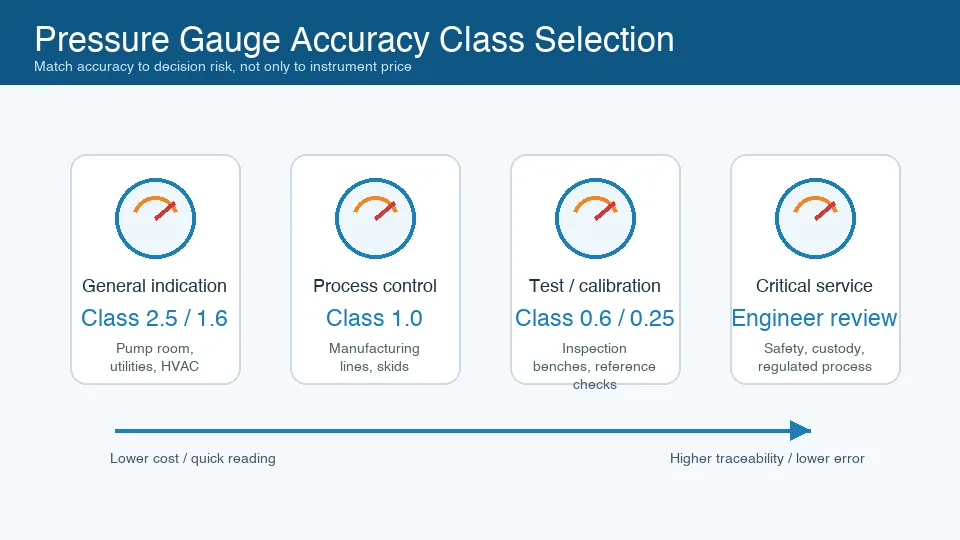
- 等級4A~2A (±0.1%~±0.5%): これらの高精度圧力計は、精密な測定が不可欠な用途で指定されます。これには、テストスタンド、校正ベンチ、取引計量、そして圧力がトリップロジックの重要パラメータとなる安全計装システム(SIS)などが含まれます。プロセスにおける不確かさを最小限に抑え、安全性や規制遵守を確保する必要があるため、その高いコストは正当化されます。
- 等級1A / クラス1.0 (±1.0%): これは、標準的な産業プロセス監視で最も一般的に指定される精度です。ポンプ吐出圧、反応容器圧力、油圧システム圧力などのプロセスをオペレーターが制御・監視するための信頼性の高い指示値を提供します。高精度計器のコストをかけることなく、安定したプロセス制御に十分な精度です。
- 等級A / クラス1.6 (±1.6%): この等級は、圧力計がシステム状態の一般的な指標として機能する多くのOEMや産業用途において、コスト効率の高いソリューションを提供します。フィルターの差圧監視、空圧ライン圧力、タンクレベルなど、正確な値よりもおおよその運転状態を知ることが重要な場合に適しています。
- 等級B以下 (≥ ±2.5%): これらの圧力計は、基本的な圧力指示のみが必要な一般ユーティリティ向けです。一般的な用途には、エアレギュレーター、水道ライン、その他重要でない機器が含まれます。
使用環境が実用精度を低下させる要因
圧力計の銘板に記載されている精度は、管理された静的な実験室条件下での性能です。現場では、いくつかの要因が追加の誤差を生じさせ、実効精度を低下させる可能性があります。
- 温度: 周囲温度とプロセス流体温度の両方が精度に影響します。ブルドン管(通常は316Lステンレス鋼またはりん青銅)の弾性係数が温度によって変化し、指示値のずれを引き起こします。ASME B40.100によれば、基準校正温度(68 °F / 20 °C)から25 °F(14 °C)ずれるごとに、最大でスパンの±0.4%の追加誤差が生じる可能性があります。対策: ダイアフラムシールとキャピラリーチューブを使用して、極端なプロセス温度から圧力計を隔離するか、周囲温度の変動を緩和するために液体封入ケースを指定します。
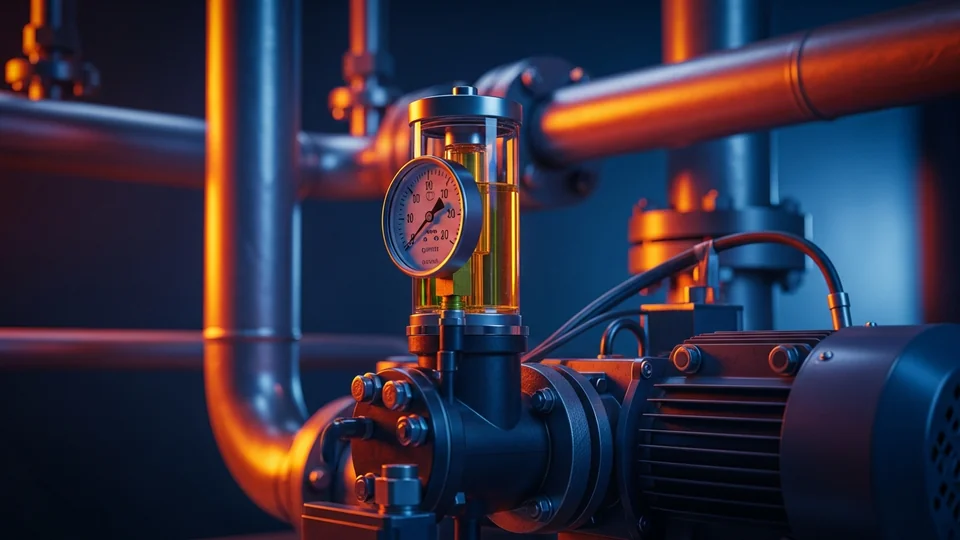
- 振動: ポンプ、エンジン、コンプレッサーからの高周波振動は、指針のふらつきを引き起こし、圧力計の読み取りを困難にし、内部の歯車機構の摩耗を加速させます。これは、早期故障や精度低下につながります。対策: 液体封入ケース(グリセリンまたはシリコン)は、指針の振動を抑制し、機構部を潤滑することで、耐用年数を大幅に延ばし、読み取りやすさを維持します。
- 脈動と圧力サイクル: 容積式ポンプなどから生じる急激な圧力サイクルは、ブルドン管に金属疲労を引き起こし、永久的なゼロ点シフトや最終的な故障につながる可能性があります。対策: 圧力計の上流に圧力スナッバーまたはニードルバルブを設置して、脈動を減衰させます。常用圧力が目盛の中央に来るようなレンジを選定することも、ブルドン管へのストレスを軽減します。
校正周期とライフサイクル管理
精度は永続的なものではありません。すべての機械式圧力計は、機械的摩耗、疲労、環境ストレスにより、時間とともにドリフト(ずれ)が生じます。設置された計器の性能を検証するためには、校正プログラムが不可欠です。
校正の頻度は、用途の重要度と使用条件の厳しさによって決まります。一般的な開始点は次のとおりです。
- 重要用途(安全、プロセス制御): 6ヶ月周期。
- 一般産業用途: 12ヶ月周期。
- 非重要指示計: 定期プラントシャットダウン時、または指示値に疑いがある場合に検証。
校正記録は、計器の性能トレンドを明らかにします。一貫して大幅な調整が必要な圧力計は、交換の候補となります。有効な校正を保証するためには、使用する標準器は、被試験デバイスよりも少なくとも4倍正確でなければなりません(4:1の試験不確かさ比)。定期的な校正は、単なるベストプラクティスではなく、プロセス安全管理やISO 9001のような品質管理システムの中核をなす要素です。
Key takeaways
- 最適な精度と寿命を得るため、常用圧力がフルスケールの25%~75%の範囲に入る圧力レンジを選定する。
- 一般的な監視には1.0% (ASME 1A)または1.6% (ASME A)の精度を使用し、重要なプロセス制御や安全システムには0.5% (ASME 2A)以上の精度を確保する。
- 大きな振動や脈動がある用途では、計器の内部機構を保護し、読み取りやすさを確保するために液体封入式圧力計を指定する。
- -20°C未満または+65°Cを超える流体温度から圧力計を隔離するには、ダイアフラムシール、サイホン管、またはキャピラリーを使用して熱誤差を防ぐ。
- 用途の重要度に基づいて定期的な校正スケジュールを導入し、実用精度を検証して計器のライフサイクルを管理する。
Related products
- General Pressure Gauge - Radial (ZX-08-R) — 0–40 MPa
- Stainless Steel Pressure Gauge - Radial (ZX-01-R) — 0–100 MPa
Часто задаваемые вопросы
What accuracy class should I select for general industrial monitoring?
For general-purpose process monitoring (tank levels, pipeline pressures, utility systems), accuracy class 1.6 per EN 837-1 (±1.6% of full scale) is standard and adequate. Specify class 1.0 only when tighter tolerances are required for control or safety interlock circuits.
How do I calculate actual measurement error from accuracy class?
Multiply the full-scale range by the accuracy class percentage. Example: a 0–10 bar gauge at class 1.6 has a maximum error of ±0.16 bar across the entire scale. At mid-scale (5 bar), this represents a ±3.2% relative error — important when specifying gauges for process control near set points.
Why should the working pressure be 25–75% of the gauge's full-scale range?
Operating below 25% of full scale produces inaccurate readings because Bourdon tube deflection is minimal. Operating above 75% causes metal fatigue, reducing gauge life and accuracy. The 25–75% rule optimizes both accuracy and service life. For pulsating pressures, restrict to 25–65% of full scale.
What is the difference between accuracy class and total error band?
Accuracy class (the EN 837-1 class) covers only the maximum scale deviation under stable conditions. Total error band also includes hysteresis (deviation between ascending and descending readings), repeatability (consistency across multiple readings), and temperature error (shift with ambient temperature changes). For critical measurements, specify all four parameters.
When should I upgrade from accuracy class 1.6 to class 0.6?
Upgrade to class 0.6 or better for: pressure-based flow measurement (orifice plates, where 1% flow error requires 0.5% pressure accuracy), safety instrumented systems (SIS) where the gauge reading triggers an interlock, pharmaceutical or food process control with regulatory accuracy requirements, and any application where a class 1.6 error (±1.6% FS) exceeds the process tolerance.
Can accuracy class degrade over time in service?
Yes. Bourdon tube metal fatigue, process contamination, and vibration can all cause accuracy drift. EN 837-1 recommends annual calibration for class 0.6 and better, and periodic calibration every 1–3 years for class 1.6 in industrial service. Replace gauges showing more than 1.5× their rated error during calibration verification.