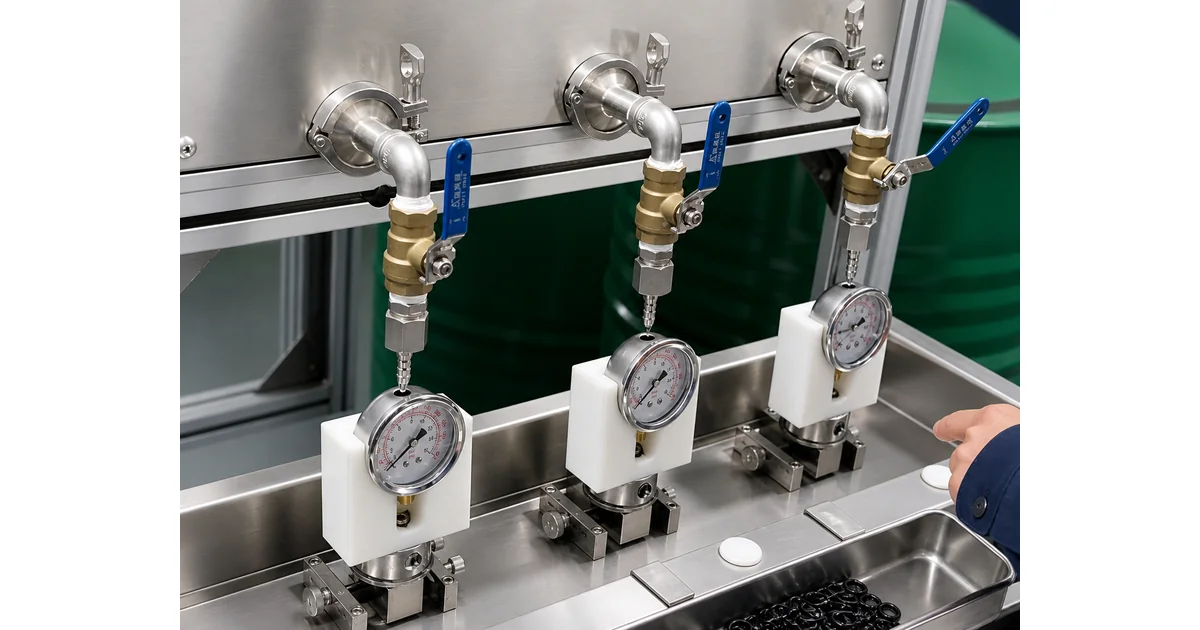
A pressure gauge snubber is a small restriction or damping device installed between a pulsating pressure source and the gauge. It slows rapid pressure changes so the pointer is readable and the Bourdon tube is not exposed to every pump stroke, compressor pulse or hydraulic shock. Correct selection depends on pulse frequency, medium cleanliness, viscosity, wetted material, response time, pressure range and the way operators use the reading. For supplier review, specify the pump or compressor type, normal pressure, pulsation frequency if known, medium cleanliness, viscosity, thread connection and whether the snubber must be cleaned or adjusted in service.
What a pressure gauge snubber does and does not do

A pressure gauge snubber is a flow restriction, porous element, piston device or adjustable needle arrangement used to reduce the effect of pressure pulses before they reach the gauge movement. WIKA describes pressure gauge snubbers as accessories for suppressing pressure pulses and pressure peaks, with porous, piston and adjustable versions available in its pressure gauge snubber technical description. ASME B40.100 also treats snubbers as gauge attachments alongside diaphragm seals and pressure limiting valves in its pressure gauges and gauge attachments scope.
The device does not make a weak gauge safe for any pressure. It does not replace a relief valve, surge analysis, accumulator, pulsation bottle or process interlock. It also does not correct an undersized range, poor material compatibility, blocked impulse line or a gauge mounted where vibration is already severe. Treat it as one part of the measurement chain: process tapping, isolation valve, snubber, gauge, mounting support and maintenance access.
For the base instrument rules, compare this article with the industrial pressure gauge selection guide and pressure gauge installation best practices.
Compare Pressure Gauge Options for This ApplicationUse range, media, material and connection as the starting point.→How a pressure gauge snubber damps pulses
Pressure pulses are short, repeated changes in pressure caused by reciprocating pumps, metering pumps, compressors, hydraulic valves, water hammer or fast control actions. A Bourdon tube gauge can show those pulses as pointer flutter. Over time, the motion can wear the movement, loosen the pointer, fatigue the sensing element or make the reading useless for operators.
A snubber adds hydraulic resistance between the process and the gauge. Rapid changes are restricted more than slow changes, so the gauge sees a smoother average pressure. Porous snubbers use a sintered or mesh path. Piston snubbers use a small moving element selected for the medium. Adjustable restrictors use a needle valve so the technician can tune damping during commissioning.
The tradeoff is response time. More damping improves readability but delays the gauge response after a real process change. On safety-related or diagnostic readings, excessive damping can hide a rapid pressure rise. Specify the minimum damping needed for a stable reading, not the maximum restriction that stops all movement.
Have a question? Ask our engineers →WhatsApp · reply within 24 h→Where pulsation protection is usually needed
Pump discharge lines are common candidates. Reciprocating, diaphragm and dosing pumps can produce a pressure wave every stroke. Centrifugal pumps may need protection when the gauge is mounted near a throttling valve, check valve chatter or a poorly supported pipe section. Compressors, hydraulic presses, injection molding machines and test stands can also generate high-frequency cycles that shorten gauge life.
The installation should first ask why the pulse exists. If the process needs a pulsation dampener, accumulator, flexible connector or pipe support change, a pressure gauge snubber is not the whole fix. The snubber only protects the local instrument and improves readability at that point.
In dirty water, slurry, crystallising chemicals or viscous media, a narrow restriction can plug. For these services, consider a diaphragm seal, flush connection, remote capillary assembly or a protected pressure transmitter. Review differential pressure gauge selection when the real task is filter or pump differential monitoring rather than local line pressure.
Send Range, Media and Connection for Engineer ReviewA short specification is enough to start a quote review.→Choosing between liquid fill, fixed snubber and adjustable restrictor
Liquid-filled gauges and snubbers solve related but different problems. A liquid-filled case damps pointer and movement vibration inside the gauge. It is useful when the instrument body vibrates or when pointer flutter is moderate. It does not stop process pressure spikes from entering the Bourdon tube.
A fixed snubber is better when the process itself is pulsing. Porous or piston versions are compact and repeatable, but they must match the medium. Clean hydraulic oil, gas, water and steam condensate do not behave the same way through a restriction. Viscosity changes with temperature, and small passages that work on clean oil may clog in untreated water or polymer service.
An adjustable restrictor is useful during commissioning because the technician can open or close the needle until the reading is stable enough. It also introduces a maintenance setting that can be changed accidentally. Locking, tagging or documenting the final position may be necessary in regulated plants.
| Protection method | Best use | Main limitation |
|---|---|---|
| Liquid-filled gauge | Mechanical vibration and moderate pointer flutter | Does not isolate the Bourdon tube from pressure spikes |
| Fixed snubber | Repeatable pump or compressor pulses in clean media | Can clog or respond too slowly if misapplied |
| Adjustable restrictor | Commissioning where pulse severity is unknown | Needs documented setting and maintenance control |
Specification checklist for a pressure gauge snubber
Start with the pressure range. The gauge should still follow normal range practice: working pressure commonly sits in the middle portion of the scale, with additional margin for pulsating service. A snubber is not permission to use a gauge with too little full-scale range or poor overpressure protection.
Confirm wetted material and seals. Brass may be suitable for clean air or water in many utility systems, while 316L stainless steel gauges are usually preferred for corrosive, outdoor, washdown, chemical, steam condensate and many food-adjacent installations. Elastomers, thread sealants and fill fluids must also match the medium and temperature.
Specify connection details as a complete assembly: NPT, BSP, G or metric thread, bottom or back connection, isolation valve, gauge cock, orientation and clearance for removal. If the snubber will be cleaned or replaced, provide a safe isolation method. For hazardous area, oxygen, high-pressure, high-temperature or sanitary applications, the plant engineer must confirm the applicable standard, cleaning method and material certificate requirements.
Have a question? Ask our engineers →WhatsApp · reply within 24 h→What must be confirmed on site before purchasing
A pressure gauge snubber can make a reading calmer, but it cannot prove that the process is stable. Before purchasing, confirm the actual pulsation source, maximum and minimum pressure, temperature, medium, contamination level, required response time and whether the gauge is used for routine indication, troubleshooting or safety-critical decisions.
Manogauge is a Zhejiang-based manufacturer supplying industrial pressure gauges, diaphragm gauges, stainless steel gauges and related assemblies. For an RFQ, provide the gauge range, accuracy class, dial size, connection, wetted material, medium, temperature, pulse source and any requested document package. Final selection for high-pressure, corrosive, hygienic or hazardous service should be confirmed by the site engineer or the project specification.
The practical rule is simple: use a pressure gauge snubber when process pulses are damaging the gauge or hiding a readable average pressure, but fix the process cause when pulses threaten the equipment itself.
When the real risk is a pressure excursion rather than repeated pulsation, use the pressure gauge overpressure protection guide to compare range selection, pressure limiters and safety-case requirements. For hydraulic circuits, the hydraulic pressure gauge selection guide explains where snubbers, liquid-filled gauges and remote mounting fit into a complete specification.
RFQ checklist: include pressure range, normal operating point, process media, wetted material preference, case material, dial size, thread connection, mounting position, quantity, certificates required and target delivery. These details let a supplier confirm whether a dry gauge, liquid-filled gauge, snubber, diaphragm seal, differential gauge or transmitter is the safer fit.
For compressed air and gas distribution systems — where pulsation from screw or reciprocating compressors is a common concern — the compressed air pressure monitoring guide covers snubber selection alongside compressor station and line-pressure gauge placement.
For thermal oil systems where pulsation combines with high process temperature, see industrial pressure gauge selection guide.
Protection should be tuned from observed process behaviour. First record the unprotected gauge response, pump speed, stroke frequency, pressure peak and the time scale that matters to the operator. A restrictor that removes needle flutter may also hide a rapid pressure excursion. For a reciprocating pump or compressor, compare the gauge indication with a temporary calibrated instrument or transmitter when the peak pressure is safety-critical. The snubber is a damping accessory, not a pressure relief device.
Installation cleanliness is important because a small orifice can plug with solids, rust or thread-sealant fragments. Provide an isolation valve and a way to remove or clean the accessory where maintenance permits. Check whether the medium can crystallise, whether the pressure connection is hot, and whether the selected seal and body materials match the process. A liquid-filled case can reduce pointer vibration, but it does not solve a blocked inlet or an incompatible wetted part.
In a pressure gauge snubber RFQ, state the gauge connection, process medium, viscosity or solids risk, pressure range, temperature, pulse frequency and whether peak pressure must remain visible. Confirm the resulting response time during commissioning and record the cleaning interval. The right choice balances readable damping with enough response to reveal a genuine process problem.
How to turn pulse amplitude, frequency, response time, blockage risk and the difference between damping and relief into a purchase specification
A useful specification begins with the process rather than the catalogue name. Record the normal operating value, the minimum and maximum credible values, the upset condition, the medium composition, the process temperature and the way the instrument will be mounted. Then state what the operator must see: a stable local indication, a peak, a differential, a switch point or a value that will be compared with a calibrated reference. This distinction matters because a gauge can be mechanically accurate yet unsuitable when its sensing element, connection or response is wrong for the installation.
Separate the continuously expected condition from the short duration event. For pulse amplitude, frequency, response time, blockage risk and the difference between damping and relief, the short event may be more important than the average reading, but it should not be handled by quietly selecting a larger dial range. A larger range reduces readability and can increase the error at the operating point. Conversely, a range selected too tightly can expose the element to repeated overload. Document the expected cycle, the allowable overpressure and the required indication during start-up, shutdown and cleaning. If those values are unavailable, the final range must remain a site-engineering decision.
Installation details deserve the same attention as the gauge body. Confirm whether the tapping point is exposed to vibration, pulsation, water hammer, thermal shock, condensation, washdown or a corrosive atmosphere. Provide an isolation valve where safe maintenance requires it, and consider a gauge cock, siphon, snubber, diaphragm seal or remote mounting only when its effect on response and calibration is understood. The connection thread must match the mating component; NPT, BSP/G and metric threads are not interchangeable simply because their nominal size appears similar. Never force a mismatched thread or use sealant to compensate for the wrong standard.
Before release, ask for the evidence that is actually needed for the job: dimensional drawing, wetted-material declaration, accuracy statement, calibration method, pressure test requirement and packing or cleanliness instruction. Do not request certificates as a substitute for checking the process chemistry or hazard classification. Standards and customer specifications may define construction, testing or documentation, but they do not automatically prove compatibility with every concentration, temperature or cleaning cycle. The responsible engineer should reconcile the instrument data sheet with the P&ID, valve arrangement and maintenance procedure.
Commissioning should establish a baseline. With the process in a known condition, record the gauge indication, reference reading, temperature, pump or compressor state and any pointer oscillation. Recheck after the system reaches normal load and after a controlled shutdown. A drifting zero, a slow response, a blocked impulse path or an unexpectedly quiet pointer can all be failure signals rather than evidence of good performance. Trend records also make later replacement decisions more reliable because the next instrument can be specified from observed service instead of a generic catalogue assumption.
The practical conclusion for pulse amplitude, frequency, response time, blockage risk and the difference between damping and relief is to select the complete measurement chain: sensing element, wetted material, range, accuracy, connection, mounting, protection accessory and documentation. The product photograph on this page identifies the real Manogauge gauge construction used as a reference; it is not proof that the same configuration is correct for every medium or pressure. Confirm the final model, dimensions and available options against the current data sheet before purchase.
Get free gauge selection advice for your application →Tell us your working conditions — no commitment required→Key takeaways
- A pressure gauge snubber dampens pulses at the instrument; it is not a relief device or process surge solution.
- Choose liquid fill for gauge vibration, fixed snubbers for clean repeatable pulses, and adjustable restrictors when field tuning is needed.
- Confirm media cleanliness, viscosity, wetted materials, response time and isolation before specifying the assembly.
Frequently asked questions
When should I use a pressure gauge snubber?
Use a pressure gauge snubber when pump, compressor or hydraulic pulsation makes the pointer unreadable or causes repeated gauge failures. Do not use it as a substitute for process surge protection when pulses threaten the equipment itself.
Is a liquid-filled pressure gauge the same as a snubber?
No. Liquid fill dampens movement vibration inside the gauge case. A snubber restricts the process pressure path before pressure reaches the Bourdon tube. Severe process pulses may need both.
Can a snubber clog?
Yes. Porous and small-orifice snubbers can clog in dirty water, slurry, crystallising chemicals or viscous media. In those services, consider a diaphragm seal, flush connection or protected pressure transmitter.
Does a snubber change gauge accuracy?
A correctly selected snubber should not change the steady pressure indication, but it slows response. Excessive restriction can delay the reading enough to mislead operators during fast process changes.
What information is needed to specify one?
Provide pressure range, maximum pressure, pulse source, medium, temperature, viscosity or contamination level, connection thread, wetted material, required response time and whether the reading is for indication or safety-related decisions.