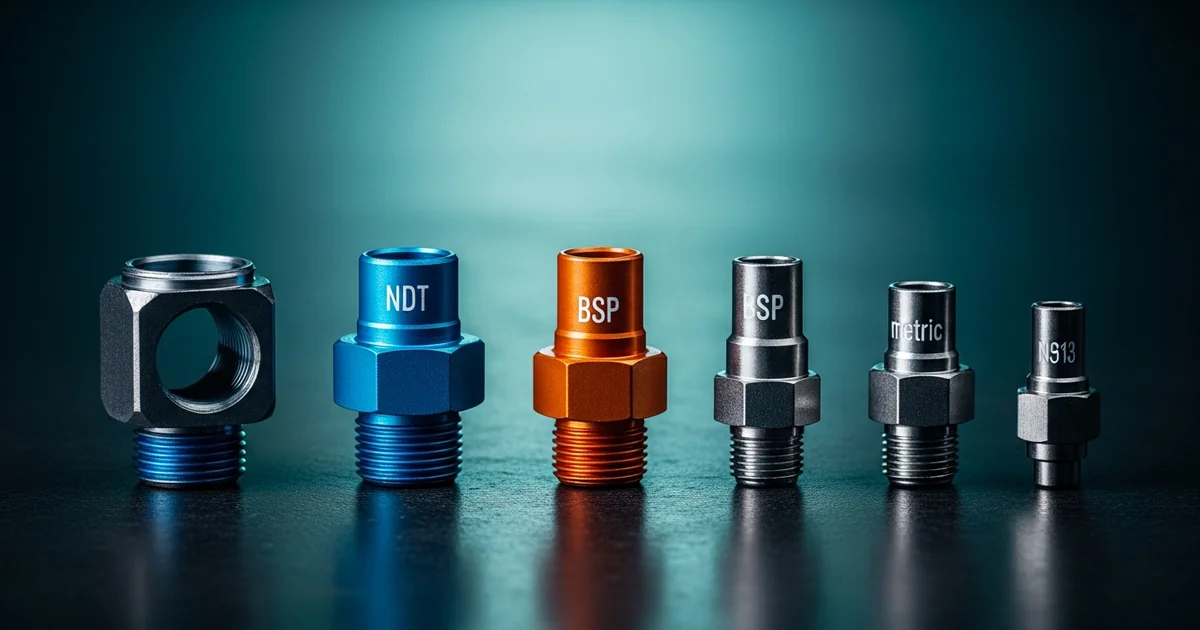
The process connection is a critical interface for any pressure gauge, directly impacting measurement accuracy, system safety, and long-term reliability. A mismatched thread can lead to catastrophic leaks, equipment damage, and process downtime. This technical reference provides a detailed comparison of the most common industrial pressure gauge thread standards—including NPT, BSPT, G (BSPP), Metric, and SAE—to guide engineers in making the correct selection for their specific application, from general process instrumentation to high-pressure hydraulic systems.
Fundamental Sealing Mechanisms: Taper vs. Parallel
Industrial pressure gauge connections achieve a seal in one of two ways: on the threads themselves or on a separate face. Understanding this distinction is the first step in proper gauge selection.
Tapered Threads (also known as pipe threads) form a seal through metal-to-metal interference. The male and female threads are cut on a slight cone angle. As the connection is tightened, the flanks of the threads are compressed and deformed, creating a seal. This type of connection, found in NPT and BSPT standards, always requires a thread sealant to fill microscopic voids and prevent galling.
Parallel Threads (also known as straight threads) have a constant diameter along their entire length. The threads themselves serve only to provide mechanical clamping force. The seal is made by compressing a separate sealing element—such as a bonded washer, an O-ring, or a metal gasket—against a smooth, machined surface on the gauge socket or the mating port. Common parallel thread standards include G (BSPP), Metric, and SAE.
For the formal NPT reference, consult ASME B1.20.1 pipe threads.
Compare RFQ-Ready Pressure Gauge Options ->Use range, media, material and connection as the starting point.→Tapered Thread Standards: NPT vs. BSPT (R/Rc)

NPT (National Pipe Taper) is the dominant standard in North America, defined by ASME B1.20.1. It features a 60° thread angle with flattened crests and roots. The taper rate is 1° 47’ (1.7833°), or 1 in 16 (inch per inch).
BSPT (British Standard Pipe Taper) is common in Europe, Asia, and many other regions. It is defined by standards such as ISO 7-1, EN 10226-1, and GB/T 7306.2. BSPT features a 55° Whitworth thread profile with rounded crests and roots. The male thread is designated 'R' and the female is 'Rc'.
A critical point is that NPT and BSPT threads are not interchangeable. While some sizes share the same number of threads per inch (TPI), the differing thread angles (60° vs. 55°) and thread forms will cause a mismatched connection to gall, damage threads, and create a leak path that cannot be reliably sealed, especially under pressure or vibration. Always use a thread gauge to confirm the type before installation.
BSP sealing should be checked against ISO 7-1 pipe threads where pressure-tight joints are made on the threads.
Have a question? Ask our engineers →WhatsApp · reply within 24 h→Parallel Thread Standards: G (BSPP) and Metric
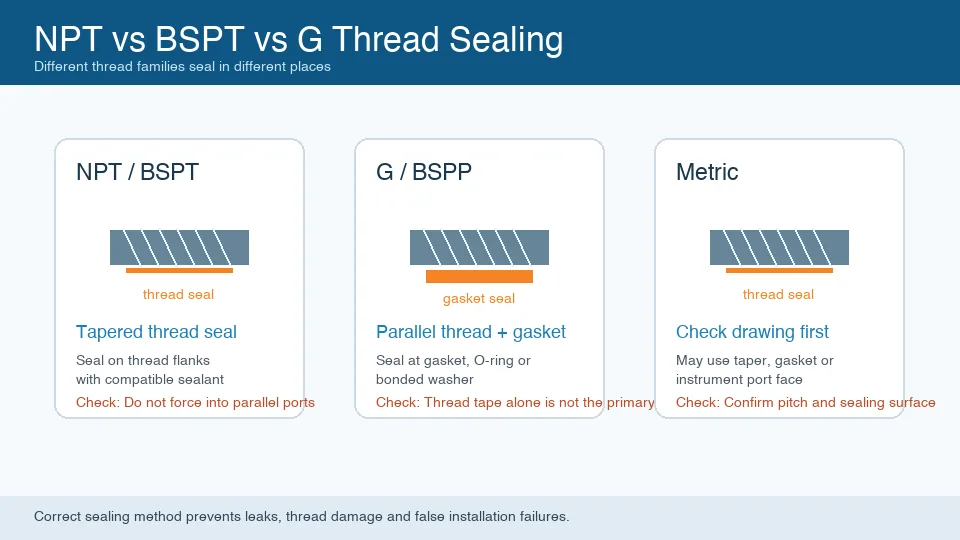
G / BSPP (British Standard Pipe Parallel) threads are defined by ISO 228-1. The 'G' designation is standard. These threads require a sealing washer, typically a bonded seal (e.g., a metal washer with a vulcanized elastomer ring), which is compressed between the face of the gauge socket and the face of the mating port. This design is common for general industrial applications and is standard for gauges compliant with EN 837-1.
Metric Parallel Threads are also widely used, particularly in European equipment. The most common connection for high-quality pressure gauges is M20×1.5, often specified in EN 837-1. This connection typically seals using a profile sealing ring (e.g., made of NBR or FKM) that fits into a recess in the male port, sealing against a smooth female port face. This method provides a very reliable seal for high-pressure applications, such as those found in test benches and hydraulic systems.
Thread material and corrosion risk should be selected with the 316L stainless steel vs. brass gauge connection guide.
Send Working Conditions for Engineer Review ->A short specification is enough to start quote review.→NPT vs BSPP Thread Size Chart: TPI, Diameter and Compatibility
The most common sourcing error is assuming that NPT and G (BSPP) are the same connection because the nominal size label matches. They are two different thread systems. NPT is a 60° tapered thread that seals on the thread flanks and needs a sealant. G (BSPP) is a 55° Whitworth parallel thread that seals on a bonded washer or O-ring against a machined face. The figure in the label — 1/2, 3/4 — is a nominal pipe size, not a dimension the two systems share.
The values below are nominal male-thread dimensions for identification only. The NPT figures are the nominal pipe outside diameter; the real major diameter changes along the taper, so measure at the same point every time. Confirm any unknown thread with a pitch gauge and a caliper before it goes into a pressurised joint.
| Nominal size | NPT (TPI) | NPT male OD (mm) | G / BSPP (TPI) | G male OD (mm) | Interchangeable? |
|---|---|---|---|---|---|
| 1/8 | 27 | 10.29 | 28 | 9.73 | No |
| 1/4 | 18 | 13.72 | 19 | 13.16 | No |
| 3/8 | 18 | 17.15 | 19 | 16.66 | No |
| 1/2 | 14 | 21.34 | 14 | 20.96 | No — same TPI, different profile |
| 3/4 | 14 | 26.67 | 14 | 26.44 | No — same TPI, different profile |
| 1 | 11.5 | 33.40 | 11 | 33.25 | No |
- Same TPI does not mean compatible. In 1/2 and 3/4 sizes both systems use 14 threads per inch, which is exactly why mismatched joints get hand-started, torqued and then leak under vibration or thermal cycling.
- Match the sealant to the thread, not to habit. PTFE tape and anaerobic sealant belong on NPT and BSPT flanks only. On a G/BSPP gauge the seal is the bonded washer; tape wound onto the threads holds the gauge off its sealing face and causes the leak it was meant to prevent.
- State the standard, not just the size, on the RFQ. "G 1/2 B male, EN 837-1, bonded seal" is unambiguous. "1/2 inch thread" is not, and is the single most common cause of a rejected gauge delivery.
For gauges built to EN 837-1, G 1/4 and G 1/2 — with M20×1.5 as the metric alternative — cover most European process instrumentation, while 1/4 NPT and 1/2 NPT dominate North American plants. Where both exist on one site, fit a proper adapter with the correct standard machined on each end rather than forcing the joint, and confirm the mounting orientation using the pressure gauge installation guide. Accuracy class and dial marking requirements for the same gauges are set out in the EN 837-1 standard explainer.
High-Pressure Hydraulic Connections: SAE J514

Hydraulic systems, characterized by high pressure, pressure spikes, and vibration, demand more robust connection types than standard pipe threads. The SAE J514 standard defines two prevalent types for these applications.
- SAE J514 37° Flare (JIC): This connection features a straight thread for mechanical strength and a 37° conical flare on the male fitting that seats against a matching 37° cone in the female fitting. The seal is a metal-to-metal line of contact between the two cones. It is extremely common in fluid power systems worldwide.
- SAE J514 O-Ring Face Seal (ORFS): Considered one of the best connections for preventing leakage in high-vibration environments. The male fitting has a straight thread and a flat face with a groove containing an O-ring. This flat face is tightened against the flat face of the female port, compressing the O-ring to create a highly reliable seal. This design is often specified for critical mobile equipment and industrial hydraulic power units.
Tri-clamp and hygienic connections are covered in the sanitary pressure gauge selection guide.
Get free gauge selection advice for your application →Tell us your working conditions — no commitment required→Sealant Selection and Connection Orientation
The choice of sealant is dictated entirely by the thread's sealing mechanism.
- For Tapered Threads (NPT, BSPT): A sealant is mandatory. High-density PTFE tape (3-4 wraps, applied clockwise on the male thread) or a suitable liquid/paste PTFE thread sealant is required. For applications with vibration, an anaerobic thread sealant that cures in the absence of air can provide a more robust, locked seal. Always leave the first 1-2 threads bare to prevent sealant from entering the process media.
- For Parallel Threads (G/BSPP, Metric, SAE): Never use thread sealant. The seal is made by the gasket, bonded seal, or O-ring. Applying tape or paste can prevent the sealing faces from mating correctly, causing a leak. A light machine oil may be applied to the threads to prevent galling during tightening, but it does not act as a sealant.
Connection orientation refers to the location of the process connection on the gauge case. Lower Mount (or bottom mount) connections extend from the bottom of the gauge and are used for vertical pipe runs or surface mounting. Back Mount connections (either center-back or lower-back) extend from the rear of the gauge and are ideal for panel mounting, allowing the gauge to be read flush against an instrument panel.
Final mounting checks belong in the pressure gauge installation best practices.
If the gauge connection is on a hydraulic manifold, test port or power unit, also review the hydraulic pressure gauge selection guide. Hydraulic service can combine SAE, BSP or NPT ports with vibration, pump ripple and pressure spikes, so the thread choice should be checked together with range and pulsation protection. For pump discharge and vibration-heavy applications, a liquid-filled pressure gauge or stainless steel pressure gauge with the correct thread reduces both leak and vibration fatigue risk.
Related guide: pressure gauge export certifications guide — for buyers who need certificate documentation with their gauge order.
Oxygen service adds a further restriction: thread sealants and any residual oil or grease must be compatible with oxygen, which rules out several common tapes and pastes. See the oxygen pressure gauge selection guide before specifying a sealant for an oxygen line.
Thread Standard Selection by Region and Industry
The thread standard on a pressure gauge socket must match the piping system already in place. Ordering the wrong thread creates a field problem that cannot be solved without an adapter or a replacement gauge. The following table covers the dominant standards by region and application sector.
| Region / Market | Dominant Standard | Notes |
|---|---|---|
| North America | NPT (ASME B1.20.1) | Oil and gas, chemical, HVAC, utilities |
| Europe (EN 837-1) | G / BSPP (ISO 228-1) | EN 837-1 specifies G; face seal with bonded washer |
| UK and Commonwealth | BSP (Rc taper + G parallel) | Older plants: taper; newer hydraulic and instrument work: G |
| China, Korea, Japan | G (ISO 228-1) or M20x1.5 | G most common for gauges; GB/T 7306 maps to BSP Rc/Rp |
| Middle East (oil and gas) | NPT or BSPT, project-dependent | American-engineered plants: NPT; European-origin: BSP. Confirm per project spec |
| Russia and CIS | Metric (GOST) or G | GOST threads remain in legacy installations |
Industry notes: North American oil and gas facilities default to NPT on instrument connections. EN 837-1 compliant gauges ship with G unless otherwise ordered. Food, beverage, and pharmaceutical process connections use hygienic fittings (SMS, DIN 11851, tri-clamp) rather than pipe threads. Hydraulic circuit gauges follow SAE J514 in North America and BSP port connections in European and Asian systems.
When in doubt, specify thread standard, nominal size, and taper or parallel in the RFQ. Do not rely on visual similarity — NPT and BSPT look alike but are not interchangeable.
Thread Adapters: When They Are Acceptable and When They Are Not
Thread adapters allow a gauge with one connection standard to be installed in a port with a different standard. They are used when the correct gauge is not immediately available or where a facility has mixed standards across its piping and instrumentation.
When adapters are acceptable: Low-pressure utility applications (instrument air, water, hydraulic oil below 40 bar) where vibration is minimal and the connection is accessible for regular inspection. Temporary and commissioning installations where the adapter is documented and will be replaced with a correctly specified gauge at the next opportunity. Adapters that use a compatible sealing mechanism — for example, G (BSPP) to metric with a face gasket.
When adapters must not be used: Oxygen or oxidizing gas service — adapters may trap contamination. High-pressure applications above 100 bar — thread engagement length through an adapter may be insufficient. Steam, hot oil, or cryogenic service — thermal cycling can work an adapter loose. Food, beverage, or pharmaceutical service — adapters introduce a contamination risk point. Safety-instrumented systems or SIL-rated loops — procedure may prohibit adapters.
The NPT-to-BSPT problem: NPT and BSPT taper at the same rate but have different thread angles (60° vs. 55°) and different pitches in some sizes. An NPT male thread in a BSPT female port may feel acceptable during installation, but contact is at thread peaks rather than flanks. Under pressure, this joint leaks. This combination is prohibited in most industrial codes. A conversion fitting with NPT on one end and BSPT on the other is not a solution — it hides the mismatch inside the fitting.
When an adapter is genuinely needed, select a forged steel or stainless steel type rated to the full system pressure. Cast adapters are not suitable for instrumentation service. Document adapter use in the equipment maintenance record: brand, material, pressure rating, installation date. For the related question of gauge mounting orientation, see the pressure gauge installation best practices.
Download PDF: Pressure Gauge Thread Standards Guide (PDF) - G/BSP, NPT, BSPT, PT and metric thread references for safer connection selection.
Browse all pressure gauge technical guides and standards references at the Manogauge PDF resource library.
Key takeaways
- Tapered threads (NPT, BSPT) seal on the thread flanks and require a sealant; they are not interchangeable due to differing thread angles (60° vs 55°).
- Parallel threads (G/BSPP, Metric) have a constant diameter and seal using a separate bonded seal, gasket, or O-ring against a machined face.
- For high-vibration hydraulic systems, SAE J514 connections like 37° Flare (JIC) or O-Ring Face Seal (ORFS) provide superior leak resistance.
- Never use thread sealant on parallel or SAE connections; the seal is mechanical and sealant can interfere with proper seating.
- Always verify thread type, size, and pitch with a thread gauge before installation to prevent dangerous leaks and equipment damage.
Related products
- General Pressure Gauge - Radial (ZX-08-R) — 0–40 MPa
- Stainless Steel Pressure Gauge - Radial (ZX-01-R) — 0–100 MPa
- Liquid-Filled Pressure Gauge - Radial (ZX-06-R) — 0–60 MPa
Frequently asked questions
What is the difference between NPT and BSP pressure gauge connections?
NPT (National Pipe Thread, ASME B1.20.1) is the US tapered thread standard, sealing on the threads with PTFE tape. BSP (British Standard Pipe) comes in two variants: BSPT (tapered, seals on threads) and BSPP (parallel, seals on a flat face with a washer or O-ring). The 60° NPT thread profile differs from BSP's 55° profile — they are NOT interchangeable even when the same nominal size fits.
What thread size is standard for a 100mm industrial pressure gauge?
For 100mm (4-inch) dial gauges, the standard connection is G1/2 B (BSPP, per EN 837-1) or 1/2 NPT depending on region. For 63mm (2.5-inch) gauges, G1/4 B or 1/4 NPT is standard. Always specify the full connection designation — '1/2 NPT' or 'G1/2 B' — not just the nominal size, since the thread system differs.
How do I identify whether a pressure gauge has NPT or BSP threads?
Use thread identification gauges (Go/No-Go) for definitive identification. Quick field check: NPT has a 60° thread angle and tapers at 1/16 inch per inch; BSP has a 55° thread angle. NPT threads appear slightly coarser (fewer threads per inch at the same nominal size). Always verify with gauges before installation — a mismatched connection may appear to seal initially but will leak under pressure cycling.
Can I use PTFE tape on BSP parallel (BSPP / G thread) connections?
No. BSPP (G thread) connections seal on the flat face with an O-ring or fiber washer — PTFE tape on the thread does not provide the required seal and may prevent the flat-face seal from seating correctly. For BSPT (tapered BSP), PTFE tape or anaerobic thread sealant is acceptable. For NPT, PTFE tape is the standard sealant.
What is the correct torque for installing a pressure gauge connection?
For G1/4 B on 63mm gauges: 10–20 N·m (7–15 ft·lb). For G1/2 B on 100mm gauges: 20–40 N·m (15–30 ft·lb). For 1/2 NPT: 20–35 N·m (15–26 ft·lb). Always apply torque to the hex flats on the gauge socket, never to the case — torquing the case can deform the Bourdon tube internals. Never use thread sealant on BSPP flat-face connections.
What connection type should I use for a pressure gauge on a high-purity or hygienic system?
Specify tri-clamp (TC / DIN 32676) or aseptic connections for food, pharmaceutical, or high-purity applications. Threaded connections (NPT, BSP) cannot be adequately cleaned and create crevices where bacteria or contaminants can harbor. For instrumentation in these industries, all process-wetted connections should be tri-clamp or equivalent hygienic fittings per EHEDG, 3-A, or ASME BPE standards.
What thread information should be included in a pressure gauge RFQ?
Specify the full thread standard, such as 1/2 NPT, G1/2 B, R1/2, M20x1.5 or SAE port type. Also include bottom or back connection, sealing washer or thread sealant preference, medium, pressure range and installation region.
Can PTFE tape be used on both NPT and BSP pressure gauge connections?
PTFE tape is correct for tapered threads: NPT (ASME B1.20.1) and BSPT (ISO 7). Do not use PTFE tape on parallel threads such as G (BSPP, ISO 228) or metric parallel — these threads seal against a machined face using a bonded seal, gasket, or O-ring. Applying tape to parallel threads prevents proper face contact and cannot form a reliable seal.
What thread should I specify when ordering gauges for a European plant with mixed American and European equipment?
European plants typically default to G (BSPP, ISO 228) parallel threads: G1/4, G1/2, or G3/4. However, US-origin equipment often uses NPT. Check the existing process connection fitting before ordering — an NPT gauge on a G connection requires an adapter and may cause misalignment or leak. If the plant has mixed standards, specify the exact thread and seal type for each connection point on the RFQ.
Is a G thread the same as BSPP?
Yes. G is the ISO 228-1 designation for the parallel version of the British Standard Pipe thread, which is commonly written BSPP. BSP is the family name: BSPT (designated R for male and Rc for female) is the tapered member that seals on the thread flanks, and BSPP (G) is the parallel member that seals on a bonded washer or O-ring against a machined face. A gauge marked G 1/2 B and one marked BSPP 1/2 are the same connection; the B is the tolerance class of the external thread, not a different size.
Are NPT and G (BSPP) threads compatible?
No. NPT has a 60 degree thread angle on a 1:16 taper and seals on the flanks with a sealant, while G has a 55 degree Whitworth profile on a parallel thread and seals on a face gasket. In the 1/2 and 3/4 sizes both systems happen to use 14 threads per inch, so a mismatched pair can be hand-started and even torqued, but the flanks never make full contact and the joint will not stay pressure-tight under vibration or thermal cycling. Use an adapter machined to the correct standard on each end instead of forcing the connection.
NPT vs BSPP — can they be used interchangeably?
No. NPT (ASME B1.20.1) is a 60° tapered thread that seals on the thread flanks using PTFE tape or liquid sealant. BSPP (G thread, ISO 228-1) is a 55° Whitworth parallel thread that seals on the face using a bonded seal or O-ring. Although the nominal size labels match (e.g., 1/2 NPT and G1/2 both appear as “1/2”), the thread angle, TPI, and sealing method are all different — they cannot be connected directly. Thread adapters exist but add a potential leak point. Always verify thread type with a thread gauge before installation.