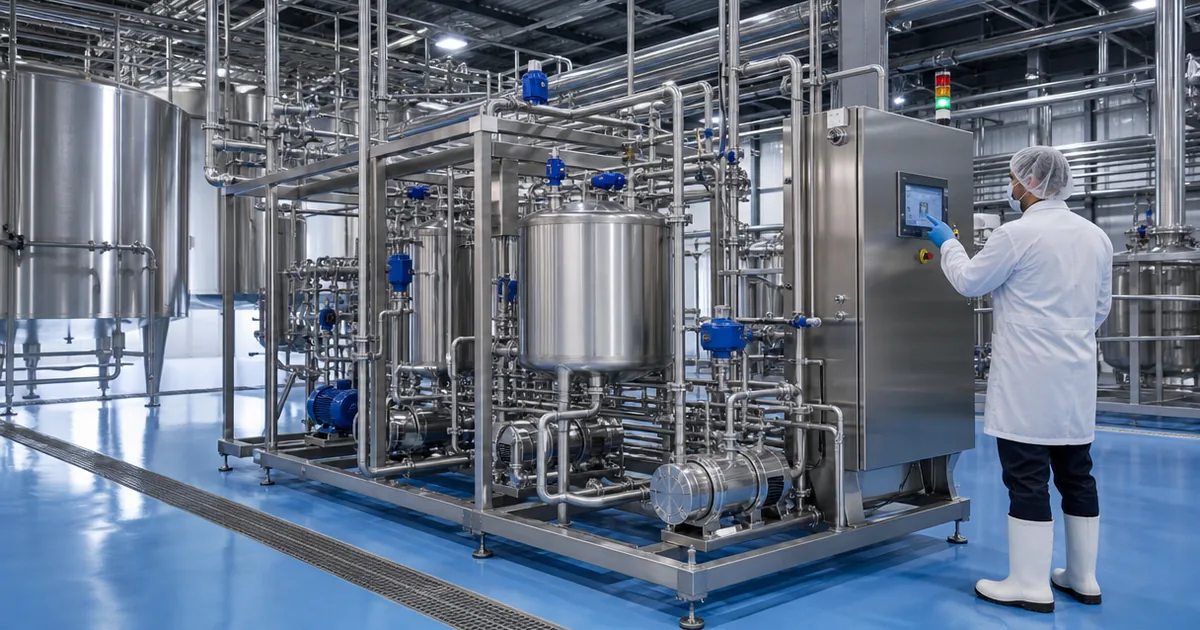
Smart CIP sanitary pressure monitoring is becoming more important as food and beverage manufacturers automate cleaning, traceability and quality records. Pressure cannot prove hygiene by itself, but it helps verify whether pumps, spray devices, return lines and valve paths are behaving as expected during Clean-in-Place cycles.
1. Smart CIP sanitary pressure monitoring is a 2026 food automation issue

Food and beverage manufacturers are investing in automation because labor shortages, SKU complexity, traceability deadlines and aging facilities are converging. CRB’s 2026 food safety reporting highlights rising attention to hygienic design, digital traceability, automation and environmental controls, while EOSYS describes food and beverage automation shifting toward more consistent execution under labor and traceability pressure.
Clean-in-Place, or CIP, means cleaning internal surfaces of tanks, pipelines, fillers, heat exchangers and process skids without dismantling them. In a smart CIP program, the cleaning cycle is no longer only a recipe in a binder. It becomes a recorded sequence of time, temperature, flow, conductivity, valve state, chemical concentration, pump status and pressure. Smart CIP sanitary pressure monitoring matters because pressure helps show whether cleaning energy actually reached the intended circuit.
Useful external context: CRB 2026 Horizons Food Safety report note and EOSYS food and beverage automation trends.
Revisar conceitos de pressão CIP ->Use the article sections to compare pressure signals, cleaning steps and hygienic measurement points.→2. What pressure can and cannot prove in a CIP cycle
Pressure is not a direct microbiological measurement. A pressure gauge or pressure transmitter cannot prove that a surface is clean, cannot replace validation, and cannot confirm chemical concentration. It is a process-behavior signal. When paired with flow, temperature, conductivity and valve feedback, pressure helps operators see whether the cleaning path is hydraulically plausible.
For example, low supply pressure during a spray-ball step may indicate insufficient pump head, an open bypass, a blocked strainer, a partly closed valve or an undersized temporary connection. High return pressure may point to a restriction, a blocked drain, foam, product residue or a wrong route through the valve matrix. A normal pressure trend does not guarantee sanitation, but an abnormal pressure trend is a useful reason to investigate the cycle before releasing equipment.
A practical CIP record should therefore treat pressure as one layer of evidence. It supports the cleaning narrative: correct route, enough hydraulic energy, stable pump behavior and no obvious blockage. Final acceptance still depends on the plant’s validated procedure, inspection requirements and food safety program.
3. CIP pressure monitoring points in food and beverage plants
The strongest pressure monitoring design starts with the cleaning failure modes, not with the instrument catalog. A dairy pasteurizer loop, brewery tank, beverage filler, sauce line and ingredient skid may each need different monitoring points because residue type, pipe length, elevation, spray device and cleaning chemistry are different.
Common pressure points include the CIP supply pump discharge, the supply header after a heat exchanger, the return line before the CIP skid, filter or strainer differential pressure, utility water or steam pressure, and local points near high-risk equipment. Supply pressure confirms that the pump and route can deliver cleaning energy. Return pressure helps identify restrictions or drain limitations. Differential pressure across a filter or strainer indicates fouling that can reduce cleaning flow.
The pressure trend should be interpreted by step. Pre-rinse, caustic wash, intermediate rinse, acid wash, final rinse and optional sanitizing or SIP steps do not have the same expected pressure behavior. A single alarm limit across every step may create nuisance alarms or miss a real cleaning problem.
Usar checklist de especificação CIP ->Document media, temperature, range, connection, cleaning exposure and signal needs before selecting instruments.→4. Sanitary pressure gauge and transmitter selection for CIP
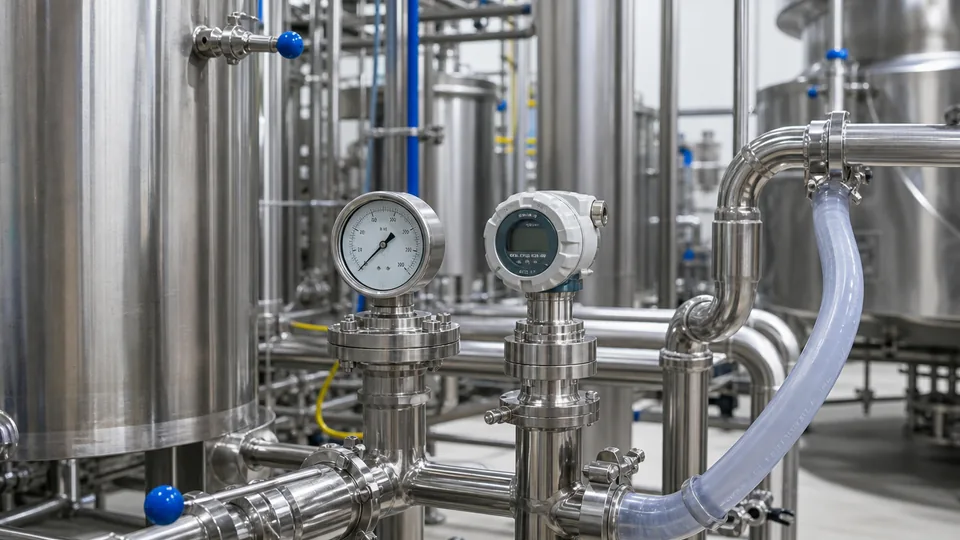
CIP pressure instruments in food and beverage service are usually specified around hygienic design first. Wetted parts are commonly 316L stainless steel for food-contact or cleaning-contact service. Connections may use sanitary clamps or diaphragm seals when the process must avoid dead legs, crevices or product traps. The exact connection standard and surface finish must be confirmed against the customer’s process and sanitary requirements.
A mechanical sanitary pressure gauge gives operators a local reference during setup, maintenance and troubleshooting. A pressure transmitter provides the continuous signal for PLC, SCADA, historian and batch records. In many plants, both are useful: the gauge helps confirm whether the electronic value is believable, while the transmitter creates the audit trail.
Selection details include normal and maximum pressure, cleaning temperature, caustic or acid exposure, diaphragm material, fill fluid, clamp size, gasket material, IP rating, dial readability, transmitter output, calibration access and whether the instrument is installed in a washdown zone. For severe chemicals, high temperature or regulated sanitary applications, the final material and documentation package should be confirmed by the plant engineer or quality team.
5. From Golden CIP data to pressure alarms
Smart CIP programs often look for a repeatable best cycle sometimes called a Golden CIP: a reference cycle that cleaned effectively with acceptable time, temperature, conductivity, flow and pressure behavior. Once that baseline is documented, pressure data becomes useful for exception management. Operators do not need to manually interpret every trend; they need clear alarms when the cycle departs from known good behavior.
Pressure alarms should be step-specific and equipment-specific. A brewery bright tank, an aseptic filler and a long sauce transfer line have different cleaning hydraulics. Useful alarms may include low supply pressure during wash, high return pressure during drain, unstable pump discharge pressure, pressure loss during route hold, or a pressure pattern that does not match the valve state.
External automation discussions of CIP emphasize repeatability, real-time data and variables such as temperature, turbulence, turbidity, titration and cycle duration. Pressure should sit beside those variables as a diagnostic signal, not as a standalone proof of cleaning success. Reference: Smart CIP systems and real-time data.
6. Specification checklist for sanitary pressure monitoring in CIP systems
A useful specification for smart CIP sanitary pressure monitoring should describe the process before naming the instrument. The application data should include the food or beverage product, cleaning chemicals, temperature range, pressure range, connection type, clamp size, expected washdown exposure, signal output and whether the device touches product, cleaning solution or only a utility line.
The instrument choice can then be mapped to the measurement purpose. A diaphragm-style pressure gauge is often considered for low-pressure local indication where a flush or isolated sensing surface is preferred. A diaphragm seal may be needed when viscous product, particles, aggressive cleaning fluids or hygienic geometry make a standard Bourdon tube connection unsuitable. A stainless steel gauge can be appropriate on non-product utility lines such as water, air or steam when the connection and material are compatible with the service.
For background reading, compare this checklist with the general article on sanitary pressure gauge selection for food and pharma and the material-focused guide to 316L stainless steel versus brass pressure gauge wetted parts. Smart CIP sanitary pressure monitoring works best when instrumentation, hygienic design, automation logic and quality records are specified together. The goal is to create pressure data that supports repeatable cleaning, faster troubleshooting and stronger food safety documentation.
Key takeaways
- Smart CIP sanitary pressure monitoring supports cleaning records but does not replace validation.
- Pressure is most useful with flow, temperature, conductivity, valve state and pump behavior.
- Specify sanitary instruments by media, temperature, range, connection, wetted material and washdown exposure.
Related products
- Diaphragm Pressure Gauge - Type 1 (ZX-05-1) — 0–60 kPa
- Isolating-Diaphragm Gauge - Radial Type 1 (ZX-04-R1) — 0–60 MPa
Часто задаваемые вопросы
What is Smart CIP sanitary pressure monitoring?
Smart CIP sanitary pressure monitoring records pressure behavior during Clean-in-Place cycles and interprets it with flow, temperature, conductivity, valve state and pump behavior. It helps identify whether cleaning energy reached the intended route.
Can pressure prove that a food line is clean?
No. Pressure is not a microbiological or chemical validation result. It supports process verification by showing hydraulic behavior, but final release depends on validated procedures, inspection and the plant food safety program.
Where should pressure be measured in a CIP system?
Common points include CIP supply pump discharge, supply header, return line, filter or strainer differential pressure, utility water or steam pressure and local high-risk equipment points. The right points depend on residue, route, pipe length and cleaning objective.
What type of pressure instrument is used for sanitary CIP service?
Food and beverage CIP service commonly uses 316L wetted parts, sanitary clamp connections, diaphragm seals where needed, local sanitary gauges for visual reference and pressure transmitters for PLC or batch records.
What information is needed to specify a CIP pressure gauge or transmitter?
Confirm product or cleaning media, pressure range, temperature, cleaning chemicals, connection type, clamp size, gasket material, output signal, washdown exposure, calibration access and required documentation.