The selection of wetted part materials—principally the Bourdon tube and socket—is a critical decision that dictates a pressure gauge's service life, accuracy, and safety. While brass offers a cost-effective solution for benign media, 316L stainless steel provides the corrosion resistance necessary for a broad range of industrial processes. Understanding the specific failure mechanisms of each alloy in different chemical environments is essential for proper instrument specification and preventing premature failure, process contamination, or catastrophic leaks. This analysis provides a technical basis for choosing between these common materials and identifies when higher-performance alloys are required.
316L stainless steel vs brass pressure gauge wetted parts
Pressure gauge wetted parts are the components that touch the process medium, usually the Bourdon tube, socket, diaphragm seal fill boundary or process connection. Brass wetted parts are economical for clean air, mild water and many non-corrosive utility services. 316L stainless steel wetted parts are selected when corrosion, washdown, food contact, condensate, ammonia risk or chloride exposure makes copper alloy unsuitable.
The choice should follow the actual medium, concentration and temperature, not only the pressure range. A gauge that is accurate on the bench can fail early if the socket or Bourdon tube is attacked by the process fluid. For severe media, a diaphragm seal with special wetted material may be safer than exposing the gauge movement directly.
Browse Our Pressure Gauge Catalog →Explore 143+ industrial gauge models→Media compatibility decision table
Material choice should start with the process medium and cleaning fluid, then be checked against temperature, concentration and exposure time.
| Medium or environment | Brass gauge risk | 316L stainless gauge risk | Better RFQ wording |
|---|---|---|---|
| Clean water or mild air | Often acceptable when corrosion risk is low | Usually acceptable but may be higher cost | Confirm water chemistry and connection material |
| Seawater or chloride-rich water | Dezincification and corrosion risk | Chloride pitting risk at higher concentration or temperature | Ask for compatible wetted material or diaphragm seal |
| Ammonia service | Generally avoid copper alloys | Often preferred, but system requirements still control | State R717 ammonia, pressure range and cleaning method |
| CIP/SIP or aggressive chemicals | Usually unsuitable | May still need special alloy or seal | Provide chemical name, concentration, temperature and exposure time |
Related reading: ammonia refrigeration pressure monitoring and sanitary pressure gauge selection.
Corrosion behavior in common pressure gauge process media
Material compatibility is service-specific. Brass can be acceptable for dry compressed air and many HVAC water loops, but it is usually avoided for ammonia, seawater, strong acids, caustic cleaning, deionized water and sanitary product contact. 316L stainless steel improves resistance in many industrial and food-grade services, but it is not universal. High chlorides, strong acids, high temperature and stagnant crevice conditions can still create pitting or stress corrosion risk.
| Service | Typical concern | Wetted-part direction |
|---|---|---|
| Compressed air | Condensate, oil carryover, outdoor humidity | Brass or 316L depending on plant standard and corrosion risk |
| Ammonia refrigeration | Copper alloy incompatibility | Use stainless wetted parts and confirm local safety requirements |
| Food, beverage, CIP | Cleaning chemicals, hygiene, crevices | Prefer 316L and sanitary diaphragm construction where product contact exists |
| Seawater or brine | Chloride pitting | 316L may be insufficient; review diaphragm seal alloy options |
PREN, CIP/SIP cleaning and when 316L is not enough
PREN, or pitting resistance equivalent number, is a comparative index used to discuss chloride pitting resistance in stainless steels. It is useful as a screening concept, but it does not prove field suitability by itself. Temperature, oxygen, crevices, deposits, cleaning chemicals and exposure time can change corrosion behavior.
For CIP and SIP utilities, 316L stainless steel is often a practical baseline, especially when the gauge is separated from product by a hygienic diaphragm seal. Confirm elastomer, fill fluid, surface finish, clamp size and cleaning temperature before approving the instrument. If the medium is highly corrosive, use a diaphragm seal with a verified wetted material such as Hastelloy, Monel, tantalum or PTFE-lined construction where appropriate.
Request a Free QuoteOur engineers respond within 24 hours→Alloy comparison: PREN values behind the 316L decision
PREN is calculated as %Cr + 3.3 x %Mo + 16 x %N, so the molybdenum content is what separates 316L from 304L in chloride service. The table below places the alloys normally offered for pressure gauge wetted parts on the same scale.
| Wetted alloy | PREN (typical) | Where it is normally considered |
|---|---|---|
| Brass (CuZn) | — | Clean air, mild water, HVAC utility service |
| 304 / 304L | 18–20 | General industrial water, non-chloride service |
| 316 / 316L | 24–26 | Most chemical, sanitary and marine-adjacent service |
| 904L | 34–36 | Dilute sulphuric acid, higher chloride exposure |
| Duplex 2205 | 34–36 | Chloride service needing strength and SCC resistance |
| Super duplex 2507 | 42–43 | Seawater and high-chloride process service |
| Alloy C-276 | 68–70 | Strong acids, wet chlorine, aggressive mixed media |
PREN ranks pitting resistance in a chloride laboratory comparison. It does not rank resistance to strong acids, caustic cleaning, ammonia or galvanic pairing, and it says nothing about weld quality, surface finish or crevice geometry in the finished gauge. Treat it as a screening step, then confirm the final choice against the actual medium, concentration, temperature and cleaning regime.
RFQ checklist for 316L stainless vs brass pressure gauge selection
A useful RFQ should state the medium, concentration, temperature, normal and maximum pressure, cleaning chemicals, connection thread, dial size, mounting direction, wetted material, case material and whether a diaphragm seal is required. Do not ask only for “stainless gauge” or “brass gauge”; specify which parts must be stainless and whether the case, socket, Bourdon tube and process connection are all included.
For adjacent decisions, review the ammonia refrigeration pressure gauge selection, sanitary pressure gauge food and beverage guide and pressure gauge thread connection guide.
To request 304 or 316L stainless steel pressure gauges in dry or liquid-filled configuration, see Manogauge's stainless steel pressure gauge manufacturer page.
Material selection must follow the actual chemistry at the wetted surface. 316L is often a better starting point for chloride-bearing water, hygienic service and many mildly corrosive fluids, while brass can be practical for clean, non-aggressive water and air. Neither statement is universal. Temperature, oxygen content, concentration, velocity, stagnant pockets and galvanic couples can change the result. Ask for the complete wetted-part list: socket, tube or diaphragm, seals, movement interface and any diaphragm-seal fill fluid.
Do not use PREN as a pass/fail certificate. It is a comparative indicator for pitting resistance, not a guarantee for a particular chloride concentration or temperature. Likewise, “stainless case” describes the enclosure and says nothing about the alloy touching the process. Where a diaphragm seal is used, the membrane, gasket and fill system may control compatibility more than the gauge case.
For a defensible 316L vs brass pressure gauge decision, provide the medium name and concentration, pressure, temperature, cleaning chemicals, chloride exposure, connection metal and required service life. The supplier can then confirm the configuration or identify where laboratory or process-engineer review is needed. A material label alone cannot replace a compatibility assessment.
Include galvanic contact and cleaning in the review. A brass adapter attached to a stainless wetted assembly can create a different risk from either material considered alone, while repeated alkaline or acidic cleaning can attack seals even when the metal appears sound. Record the actual connection alloy, chemical concentration and exposure time. If the service changes seasonally, check the worst combination rather than the average water chemistry.
Where failure has a serious consequence, define inspection evidence and replacement criteria: drift, pitting, leakage, sticky movement and damaged threads should not be treated as interchangeable symptoms. The responsible engineer should confirm the selected alloy, seal and pressure boundary for the complete assembly.
How to turn chloride concentration, temperature, wetted materials, galvanic couples and cleaning chemistry into a purchase specification
A useful specification begins with the process rather than the catalogue name. Record the normal operating value, the minimum and maximum credible values, the upset condition, the medium composition, the process temperature and the way the instrument will be mounted. Then state what the operator must see: a stable local indication, a peak, a differential, a switch point or a value that will be compared with a calibrated reference. This distinction matters because a gauge can be mechanically accurate yet unsuitable when its sensing element, connection or response is wrong for the installation.
Separate the continuously expected condition from the short duration event. For chloride concentration, temperature, wetted materials, galvanic couples and cleaning chemistry, the short event may be more important than the average reading, but it should not be handled by quietly selecting a larger dial range. A larger range reduces readability and can increase the error at the operating point. Conversely, a range selected too tightly can expose the element to repeated overload. Document the expected cycle, the allowable overpressure and the required indication during start-up, shutdown and cleaning. If those values are unavailable, the final range must remain a site-engineering decision.
Installation details deserve the same attention as the gauge body. Confirm whether the tapping point is exposed to vibration, pulsation, water hammer, thermal shock, condensation, washdown or a corrosive atmosphere. Provide an isolation valve where safe maintenance requires it, and consider a gauge cock, siphon, snubber, diaphragm seal or remote mounting only when its effect on response and calibration is understood. The connection thread must match the mating component; NPT, BSP/G and metric threads are not interchangeable simply because their nominal size appears similar. Never force a mismatched thread or use sealant to compensate for the wrong standard.
Before release, ask for the evidence that is actually needed for the job: dimensional drawing, wetted-material declaration, accuracy statement, calibration method, pressure test requirement and packing or cleanliness instruction. Do not request certificates as a substitute for checking the process chemistry or hazard classification. Standards and customer specifications may define construction, testing or documentation, but they do not automatically prove compatibility with every concentration, temperature or cleaning cycle. The responsible engineer should reconcile the instrument data sheet with the P&ID, valve arrangement and maintenance procedure.
Commissioning should establish a baseline. With the process in a known condition, record the gauge indication, reference reading, temperature, pump or compressor state and any pointer oscillation. Recheck after the system reaches normal load and after a controlled shutdown. A drifting zero, a slow response, a blocked impulse path or an unexpectedly quiet pointer can all be failure signals rather than evidence of good performance. Trend records also make later replacement decisions more reliable because the next instrument can be specified from observed service instead of a generic catalogue assumption.
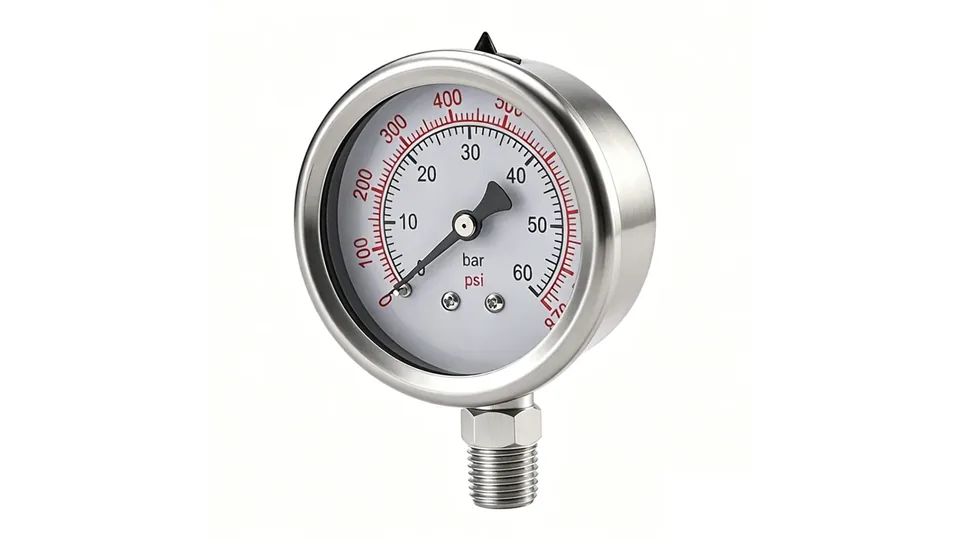
The practical conclusion for chloride concentration, temperature, wetted materials, galvanic couples and cleaning chemistry is to select the complete measurement chain: sensing element, wetted material, range, accuracy, connection, mounting, protection accessory and documentation. The product photograph on this page identifies the real Manogauge gauge construction used as a reference; it is not proof that the same configuration is correct for every medium or pressure. Confirm the final model, dimensions and available options against the current data sheet before purchase.
Key takeaways
- Use brass wetted parts only for neutral, non-corrosive media like air, water, and hydraulic oil to optimize cost.
- Select 316L stainless steel as the standard for chemical compatibility, sanitary applications (CIP/SIP), and any service involving ammonia or chlorides.
- 316L SS is susceptible to pitting in hot, stagnant, high-chloride environments; its Pitting Resistance Equivalent Number (PREN) is approximately 24.
- For media too aggressive for 316L SS, such as wet chlorine or hydrofluoric acid, use a diaphragm seal with a higher alloy like Hastelloy C-276 or Monel.
Related products
- Stainless Steel Pressure Gauge - Radial (ZX-01-R) — 0–100 MPa
- Isolating-Diaphragm Gauge - Radial Type 1 (ZX-04-R1) — 0–60 MPa
Frequently asked questions
Why is 316L stainless steel preferred over brass for corrosive applications?
316L SS contains 2–3% molybdenum, which provides superior resistance to chloride pitting and crevice corrosion compared to brass. Brass alloys are prone to dezincification in chloride-containing media and stress-corrosion cracking in ammonia atmospheres. 316L maintains mechanical integrity in a wider range of industrial chemicals.
What media will attack 316L stainless steel in a pressure gauge?
Concentrated hydrochloric acid (>5%), hydrofluoric acid, bromine, and hot concentrated sodium hydroxide are among the most aggressive media for 316L SS. For these services, specify Hastelloy C-276, Monel 400, or tantalum wetted parts depending on the specific chemical.
Can a brass gauge be used for seawater monitoring?
Not recommended. Seawater (chloride ~19,000 ppm) causes rapid dezincification of brass alloys, leading to porous, weakened fittings and potential gauge failure. Specify 316L SS or duplex stainless steel for seawater and brackish water applications.
What is the temperature limit for 316L stainless steel Bourdon tubes?
Standard 316L SS Bourdon tubes are rated to approximately 200°C continuous service. Above this temperature, creep and oxidation degrade accuracy. For high-temperature steam (>200°C), specify a siphon tube and confirm with the manufacturer on the specific alloy heat treatment.
Does the gauge socket material matter as much as the Bourdon tube material?
Yes. The socket (process connection) is the first point of contact with media and experiences the most stress from pressure cycling and thread engagement. Always specify the same corrosion-resistant alloy for both the socket and Bourdon tube. A 316L tube on a brass socket will fail at the socket first.
What chloride and ammonia limits apply to brass pressure gauge wetted parts?
Brass (copper-zinc alloy) is susceptible to stress corrosion cracking in ammonia and chloride environments. As a practical guideline, avoid brass wetted parts where chloride concentration exceeds 200 ppm in process contact, or where any ammonia is present in the media. For seawater, brackish water, or chlorinated process streams, specify 316L stainless steel or a higher-alloy alternative.
Why is 316L preferred over standard 316 stainless steel in welded gauge construction?
The 'L' (low-carbon) designation limits carbon content to 0.03% maximum. Standard 316 SS can undergo sensitization at heat-affected zones during welding — chromium carbide precipitates and depletes corrosion resistance near welds. 316L avoids this, maintaining full corrosion resistance in welded Bourdon tube and socket assemblies. For weld-free machined parts, the corrosion performance of 316 and 316L is nearly identical.