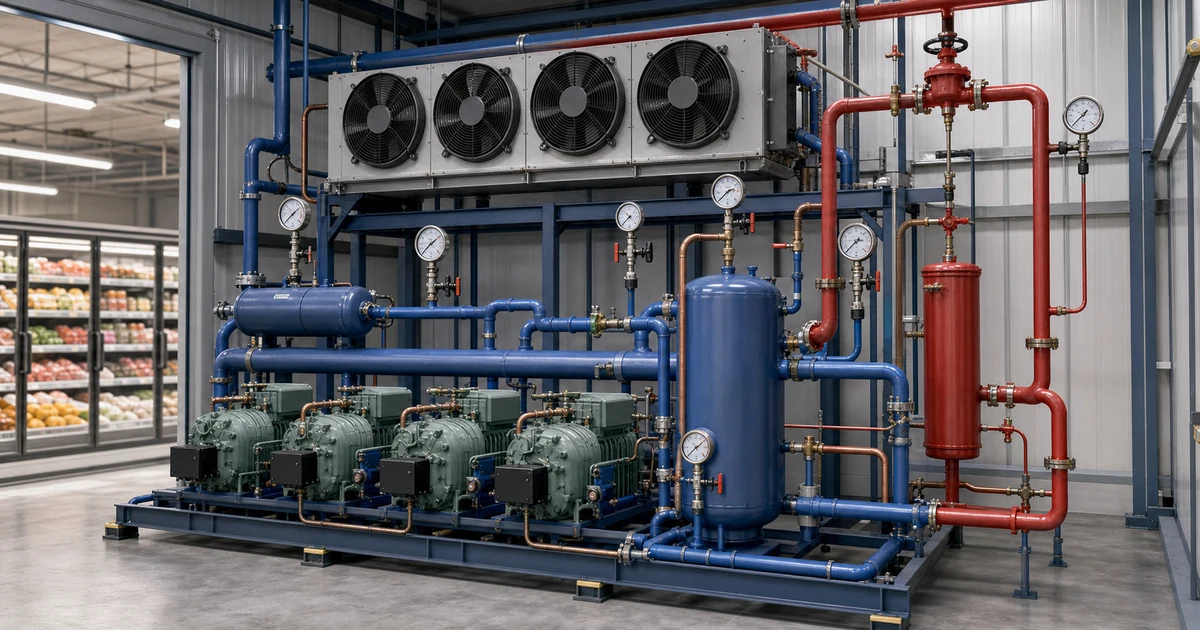
CO2 transcritical refrigeration pressure gauge selection means choosing local pressure indicators, transmitters and accessories for an R744 refrigeration rack whose high side may operate far above traditional HFC systems. The useful reading may be compressor suction pressure, discharge pressure, gas-cooler outlet pressure, flash-tank pressure or filter pressure loss. This guide explains where gauges belong, how to think about range and safety case selection, what materials should be confirmed, and what a pressure reading cannot prove without temperature, control and OEM rack data.
What CO2 transcritical refrigeration pressure gauge selection has to measure
CO2 transcritical refrigeration pressure gauge selection starts with the rack function, not only the dial range. R744 systems can include compressor suction, compressor discharge, gas cooler outlet, high-pressure valve inlet, flash tank, liquid header, evaporator branch and service filter points. Each point answers a different question.
ASHRAE publishes refrigeration safety guidance for carbon dioxide systems, including design-pressure logic for R744 circuits; see the ASHRAE Standard 15 addendum on carbon dioxide refrigeration systems. OEM rack manuals may use different pressure classes for low-temperature suction, medium-temperature suction, flash tank, liquid and high side sections, so final gauge selection must follow the project documents.
Local mechanical gauges help technicians confirm service conditions during walkdowns. Pressure transmitters are used where the value drives high-pressure control, compressor staging, alarm logic, trend records or safety shutdowns. A gauge should support the control system; it should not replace the rack controller, relief devices or commissioning procedure.
Ver manómetros inoxidables ->Más de 143 modelos de manómetros industriales→Typical measurement points on an R744 rack
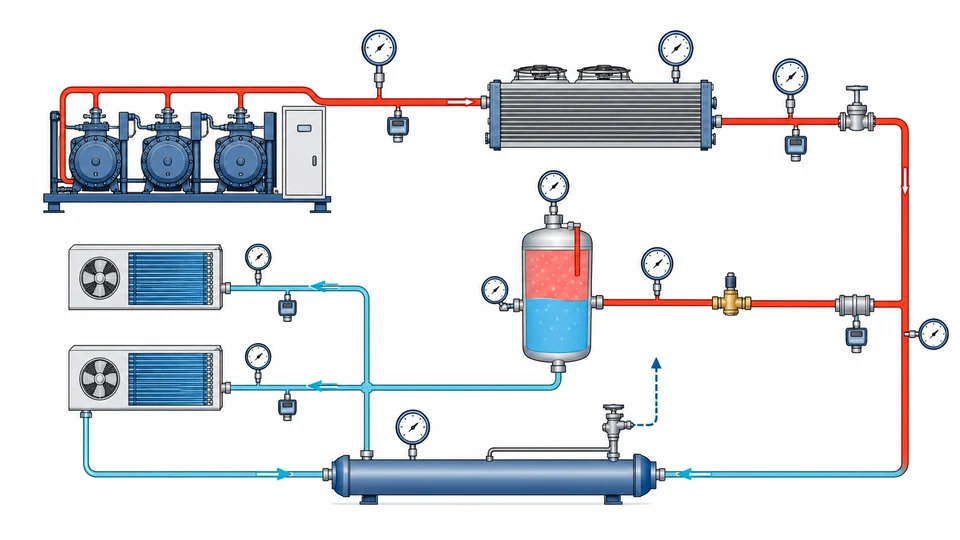
The same CO2 rack may need several pressure ranges because the suction side, receiver and high side operate in different windows. Treat each point as a separate service, then standardize only where the pressure class and diagnostic purpose are truly similar.
| Measurement point | Why technicians read it | Instrument choice |
|---|---|---|
| Compressor suction header | Evaporator load, starvation, valve behavior, low-pressure alarms | Gauge plus transmitter where control uses the value |
| Compressor discharge | High-side stress, gas cooler performance and abnormal restriction | High-pressure gauge or transmitter rated for the section |
| Gas cooler outlet / high-pressure valve inlet | Transcritical control and pressure optimization | Transmitter for control, local gauge for service confirmation |
| Flash tank / receiver | Liquid supply stability and bypass behavior | Gauge or transmitter matched to receiver design pressure |
| Filter drier or service filter | Restriction and contamination trend | Gauge pair or differential pressure method |
For adjacent topics, compare the A2L R-454B refrigerant pressure gauge selection guide and the ammonia refrigeration pressure monitoring guide.
Range and case design for CO2 transcritical refrigeration pressure gauge selection
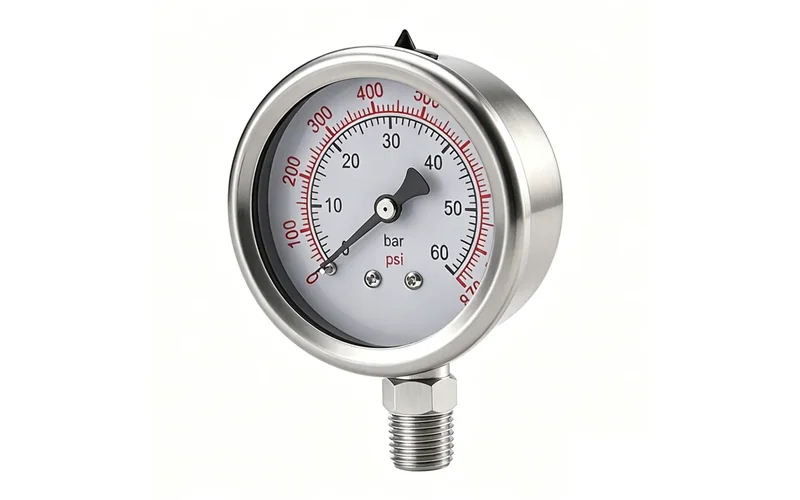
Range selection should begin with the rack pressure class, normal operating pressure, maximum expected pressure, relief settings, warm-standstill exposure and service-test procedure. Many CO2 sections require much higher pressure ratings than familiar HFC refrigeration points. Do not select a gauge only because the normal operating pressure fits the printed scale.
A readable dial normally places the routine reading away from the bottom stop and away from full scale. However, high-side CO2 service may prioritize overpressure margin and case safety over a narrow display range. If the medium is high-pressure gas near technicians, review whether a solid-front safety case with rear relief, laminated safety glass, stainless case and unobstructed blow-out clearance are required.
Pointer flutter can occur near compressors and valve stations. Liquid filling, movement damping, snubbers or remote mounting may improve readability, but they do not correct a wrong pressure class. See the pressure gauge snubber selection guide for pulsation logic.
Preparar RFQ de manómetro CO2 ->Nuestros ingenieros responden en 24 horas→Materials, threads and installation details
CO2 is usually dry and non-corrosive in properly maintained refrigeration service, but the installation still needs careful material selection. Stainless steel wetted parts are a conservative default for industrial racks, outdoor units, washdown areas and systems where moisture, oil, cleaning chemicals or mixed service may occur. Brass may appear on some refrigeration service tools, but it should not be assumed suitable for every CO2 rack pressure class or customer standard.
Confirm connection standard, sealing method and access. Common refrigeration service connections are not the same as NPT, BSP, G or metric process threads. A near-fit thread is not a safe seal, especially on high-pressure gas. Gauge valves, service ports and capillary lines should be supported against vibration and placed where technicians can isolate and replace the instrument without bending small tubing.
For material reasoning, review 316L stainless steel vs brass pressure gauge wetted parts. The final material decision should follow the rack OEM, refrigerant/oil compatibility, customer specification and local code.
What pressure readings cannot prove in a CO2 rack
A pressure reading cannot prove rack efficiency by itself. CO2 transcritical performance depends on gas cooler outlet temperature, ambient condition, compressor speed, high-pressure valve position, flash-gas bypass, evaporator load, refrigerant charge, oil management and controller strategy. A normal pressure value can still coexist with poor superheat control, fouled heat exchangers, sensor drift or incorrect commissioning parameters.
Pressure also cannot prove safety compliance alone. Relief valves, pressure vessels, piping design pressure, ventilation, leak detection, electrical classification where applicable and maintenance procedure must be reviewed separately. The gauge is an indicator, not an overpressure protection device.
For procurement language, avoid promising that CO2 transcritical refrigeration pressure gauge selection solves high-side control or refrigeration efficiency. It supports maintenance, troubleshooting and independent service confirmation when interpreted with temperature, controller and OEM data.
RFQ checklist for CO2 refrigeration pressure gauges
A complete RFQ should describe the exact rack section, not only the refrigerant name. Include medium as R744 / CO2, normal pressure, maximum pressure, design pressure or MAWP for the section, pressure unit, dial diameter, connection thread, bottom or back mount, wetted material, case type, window material, fill fluid, vibration exposure, ambient temperature, service valve arrangement and documentation needs.
- State whether the point is suction, discharge, gas cooler, receiver, liquid line, filter or service manifold.
- Confirm whether a mechanical gauge, pressure transmitter or both are required.
- Specify if the gauge must be stainless steel, liquid-filled, solid-front, oxygen-cleaned or supplied with a calibration certificate.
- Attach the rack OEM pressure table when available; do not ask suppliers to infer pressure class from the word CO2.
- For Manogauge OEM supply from Zhejiang, China, request a drawing, material statement, packaging requirement and sample approval record before bulk order.
This makes the quote safer and easier to compare than a generic request for a CO2 gauge.
Key takeaways
- CO2 transcritical refrigeration pressure gauge selection should be done by rack section: suction, discharge, gas cooler, flash tank, liquid line or filter.
- High-side R744 service may need a different pressure range and safety case than suction or receiver points.
- Pressure readings support service checks, but they do not prove efficiency, charge, relief protection or safety compliance by themselves.
Часто задаваемые вопросы
What pressure range is best for a CO2 transcritical refrigeration gauge?
There is no single range for the whole rack. Select by section pressure class, normal operating pressure, maximum expected pressure, relief setting and OEM data. Suction, receiver and high-side points often need different ranges.
Should a CO2 refrigeration gauge use a solid-front safety case?
Use a solid-front case where the risk assessment, pressure class, gas service and operator exposure justify it. High-pressure R744 points near technicians deserve special review of case design and rear relief clearance.
Can a standard refrigerant manifold gauge be used on an R744 rack?
Only if its pressure rating, connection, material and service procedure match that exact point. CO2 rack sections can exceed familiar refrigerant service-tool assumptions.
Are stainless steel wetted parts required for CO2?
Dry CO2 is not usually corrosive, but stainless steel is often the conservative choice for industrial racks, outdoor service, washdown areas and customer standards. Confirm with OEM and project specification.
Can pressure readings prove CO2 rack efficiency?
No. Efficiency needs pressure plus temperature, controller state, gas cooler data, compressor operation, charge, oil management and OEM performance logic.