
SWRO pressure gauge selection means choosing local gauges, differential pressure gauges and pressure transmitters for a seawater reverse osmosis train. The useful reading may be a high feed pressure after the pump, a small pressure loss across cartridge filters, or a differential trend across membrane vessels. This guide explains where pressure instruments belong, how to size range for seawater RO service, which corrosion and vibration risks matter, and what pressure readings cannot prove without flow, conductivity and membrane data.
What SWRO pressure gauge selection has to measure
SWRO pressure gauge selection starts with the measurement purpose. A seawater reverse osmosis train uses pressure to overcome osmotic pressure and drive water through membranes, so the gauge is not just a local indicator. It helps operators see pump discharge pressure, cartridge filter fouling, membrane feed pressure, concentrate pressure and abnormal loss across vessels.
Public desalination guidance from the Organization of American States notes operating pressures around 800-1,000 psi for seawater reverse osmosis and lower pressures for brackish water; see the OAS reverse osmosis desalination overview. The exact design pressure still comes from membrane supplier data, seawater salinity, temperature, recovery rate and plant hydraulics.
Local gauges are useful for walkdown checks and commissioning. Pressure transmitters are needed when the value drives alarms, interlocks, trend logs or pump control. Differential pressure instruments are useful where the question is fouling or pressure loss rather than absolute pressure.
耐食圧力計を比較 ->143以上の工業用ゲージを見る→Where to place gauges in a seawater RO train
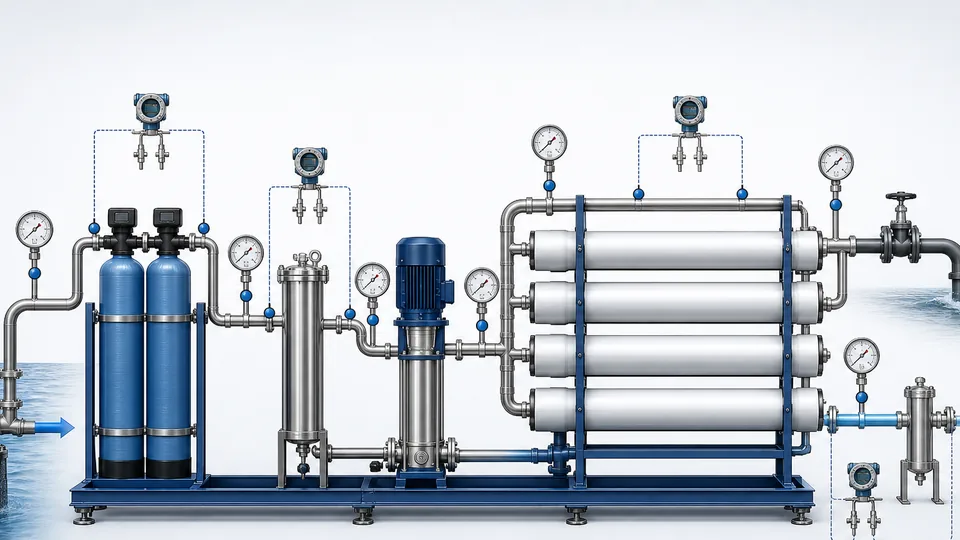
Typical pressure points include raw seawater intake, pretreatment outlet, cartridge filter inlet and outlet, high-pressure pump suction and discharge, membrane feed header, concentrate outlet and permeate line. The highest-risk point is usually the high-pressure pump discharge and membrane feed line, where a wrong range or poor isolation arrangement can make maintenance unsafe.
| Measurement point | What it helps diagnose | Typical instrument |
|---|---|---|
| Cartridge filter inlet and outlet | Fouling before membrane feed pressure falls | Two gauges or a DP transmitter |
| High-pressure pump suction | Starvation, blocked pretreatment, cavitation risk | Pressure gauge or transmitter |
| High-pressure pump discharge | Available membrane feed pressure and pump performance | High-pressure gauge plus transmitter |
| Membrane feed and concentrate headers | Membrane pressure drop, scaling or flow imbalance | Gauge pair or DP trend from transmitters |
| Permeate line | Backpressure check, not salt rejection by itself | Low-pressure gauge or transmitter |
For related fundamentals, compare the differential pressure gauge selection guide and the pressure transmitter vs pressure gauge selection guide.
Range, accuracy and overpressure margin for SWRO pressure gauge selection
Choose gauge range from maximum operating pressure, membrane cleaning pressure, hydrostatic test pressure, pump shutoff head and relief settings. A gauge that normally reads near mid-scale is easier to read than one operating close to full scale. For high-pressure SWRO feed lines, confirm whether the scale should be in bar, psi, MPa or dual units for the maintenance team.
Accuracy class should match the decision. A commissioning gauge used to compare membrane pressure drop may need tighter accuracy than a local visual indicator. Small differential readings across filters can be lost when operators compare two high-range pressure gauges, so a DP gauge or transmitter may be the better choice.
Overpressure protection also matters. Pump start, valve sequencing, pressure exchanger behavior and blocked concentrate flow can create transients. Use isolation valves, snubbers or damped movements where vibration and pulsation are present. See the pressure gauge snubber selection guide for pulsation logic.
SWRO圧力計器RFQを準備 ->エンジニアが24時間以内に返答→Materials for seawater, brine and chemical cleaning

Seawater and concentrate brine are chloride-rich, so wetted materials must be confirmed against plant standards. Common stainless grades may not be enough for every chloride, temperature and stagnant condition. Duplex stainless, super duplex, titanium, high-nickel alloys or diaphragm seal materials may be specified by the project, but the final choice must come from corrosion data and the owner specification.
Cleaning-in-place chemicals can be as important as seawater. Acid cleaning, alkaline cleaning, biocide exposure and preservative solutions may contact pressure taps and manifolds. If a pressure gauge is isolated during cleaning, the isolation plan should be documented; if not, the wetted parts and fill fluid must be compatible.
For general wetted-part reasoning, review 316L stainless steel vs brass pressure gauge wetted parts. In SWRO service, brass wetted parts are usually a poor default unless the exact low-pressure auxiliary service and compatibility are confirmed.
What SWRO pressure readings cannot prove
A pressure reading cannot prove permeate quality. Salt rejection depends on membrane condition, conductivity, temperature compensation, recovery, flow and pretreatment. A normal feed pressure can still coexist with scaling, biofouling or membrane damage. A rising differential pressure suggests restriction, but it does not identify whether the cause is particles, scale, biological growth, valve position or instrumentation error.
Do not use SWRO pressure gauge selection as a substitute for process design. Final acceptance should compare pressure, flow, conductivity, recovery, differential pressure, pump speed, energy recovery device data and membrane manufacturer limits. High-pressure seawater systems also require project-specific review of pressure class, relief protection, materials and maintenance isolation.
Manogauge can support local indication and pressure instrument selection from Zhejiang manufacturing, but seawater salinity, chloride level, pressure class, cleaning chemicals, connection standard, IP rating, vibration and documentation requirements must be confirmed by the plant engineer.
RFQ checklist for SWRO pressure instruments
An RFQ should describe the measurement point before naming a model. The supplier needs to know whether the gauge is for pretreatment, high-pressure feed, membrane DP, concentrate, permeate or a chemical cleaning skid.
- Provide normal pressure, maximum pressure, pump shutoff head, test pressure and relief setting.
- State medium: seawater, brine, permeate, flushing water or CIP chemical, including temperature and chloride level where available.
- Specify wetted material requirement, diaphragm seal need, connection thread or flange, dial size, mounting position and isolation valve arrangement.
- Confirm whether the value is local indication only or a transmitter signal for PLC, alarm or shutdown logic.
- Ask the supplier to state what the instrument cannot prove without flow, conductivity and membrane data.
With these inputs, SWRO pressure gauge selection becomes a useful reliability decision rather than a simple catalog match.
Часто задаваемые вопросы
What pressure range is typical for seawater reverse osmosis?
Public references often cite about 800-1,000 psi for seawater RO, but the final gauge range must be based on membrane data, pump shutoff head, relief setting, recovery rate, salinity and temperature.
Should SWRO filters use two pressure gauges or a DP transmitter?
Two gauges can work for local checks, but a DP gauge or DP transmitter gives a clearer fouling signal when the pressure loss across the cartridge filter is small.
Are 316 stainless steel pressure gauges enough for seawater?
Not automatically. Chloride level, temperature, stagnant conditions and cleaning chemicals may require duplex stainless, titanium, high-nickel alloy or a diaphragm seal specified by the project.
Can feed pressure prove RO membrane performance?
No. Feed pressure must be interpreted with flow, conductivity, recovery, temperature and membrane manufacturer limits. Pressure alone cannot prove salt rejection or membrane health.
Where is overpressure protection most important in SWRO?
The high-pressure pump discharge, membrane feed header and concentrate side deserve special review because valve sequencing, blocked flow or pump transients can exceed normal operating pressure.