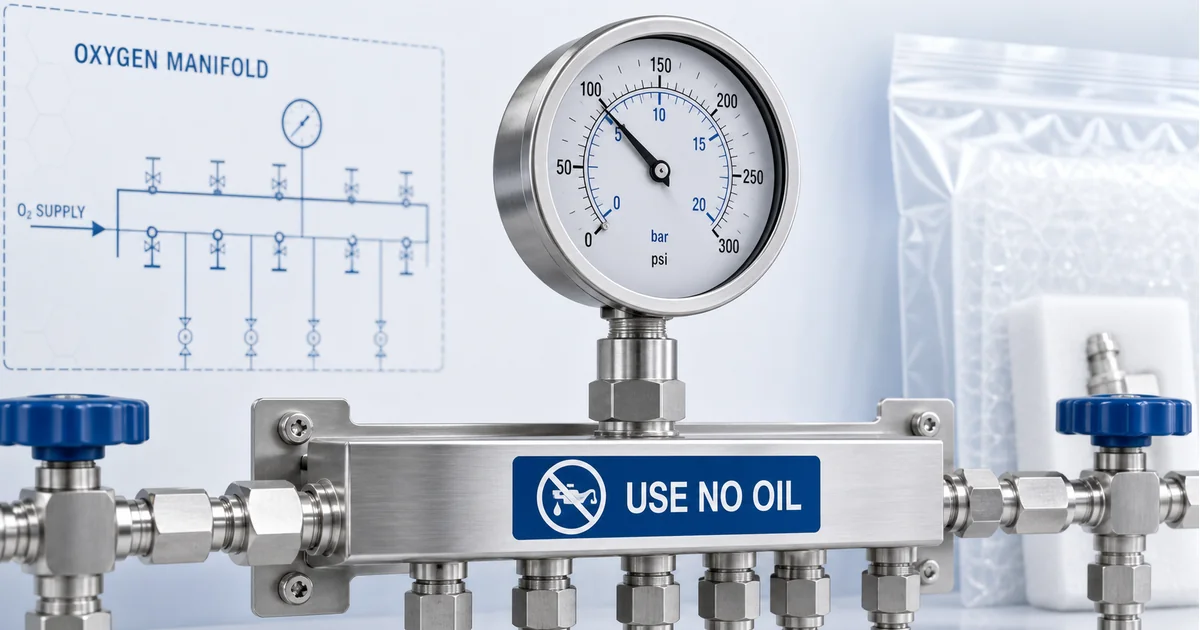
Oxygen pressure gauge selection is a cleanliness and compatibility decision before it is a dial-size decision.
What oxygen pressure gauge selection really means
Oxygen pressure gauge selection means choosing an instrument whose pressure range, wetted materials, internal cleanliness, packaging and installation controls are suitable for oxygen service. The U.S. OSHA rule for bulk oxygen systems states that equipment must be cleaned to remove oil, grease and readily oxidizable materials, and that valves, gages, regulators and other accessories must be suitable for oxygen service. See OSHA 29 CFR 1910.104 for the safety context.
This does not mean every oxygen gauge is identical. A cylinder regulator gauge, a hospital gas manifold gauge, a laser-cutting oxygen line gauge and a laboratory test bench gauge may have different pressures, connections, cleaning requirements and documentation needs. The common rule is that the instrument should not introduce hydrocarbon contamination, incompatible elastomers, unsafe filling liquid or hidden debris into the oxygen path.
For procurement, define oxygen service as a complete condition: oxygen purity, pressure, maximum credible pressure, temperature, connection, wetted materials, cleaning requirement, protective caps, packaging and document traceability. A gauge that is accurate but contaminated is not acceptable for clean oxygen service.
クリーンサービス用ゲージを見る143以上の工業用ゲージを見る→Cleanliness and oil-free handling are not optional
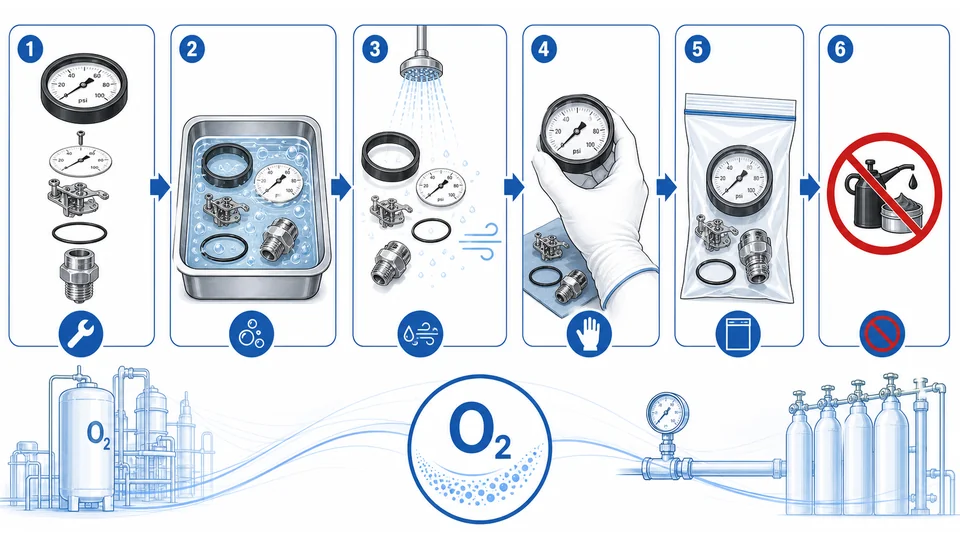
Oil, grease and organic contamination are the first RFQ filter. OSHA rules for oxygen-fuel gas welding require oxygen regulator gages to be marked USE NO OIL, which reflects the broader principle that oxygen equipment must be kept away from combustible contamination. For a pressure gauge, cleanliness has to be preserved after cleaning, not only achieved once at the factory.
Ask how the gauge is cleaned, dried, inspected, capped and packaged. The pressure connection should remain protected until installation. Installers should use clean gloves or clean hands, keep thread sealants compatible with oxygen service, and avoid shop benches where hydraulic oil, cutting fluid or grease are present.
Do not assume that a stainless-steel case or a blue oxygen label proves oxygen cleanliness. If the project requires documented cleaning, residual contamination limits or a named procedure, those documents must be requested and confirmed by the manufacturer before purchase.
Oxygen pressure gauge range, materials and dry case choice
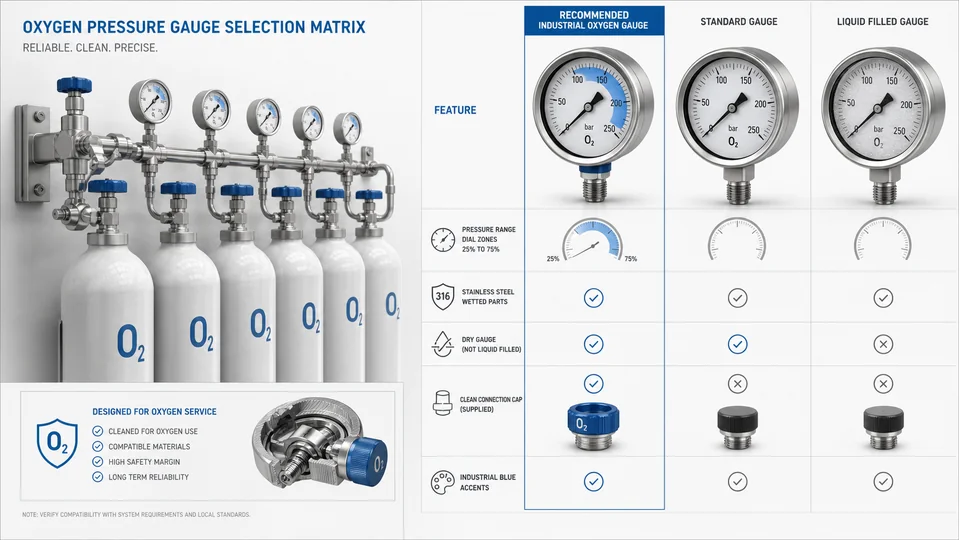
Pressure range still matters. Normal operating pressure should be in a readable zone of the scale, while the gauge must tolerate startup, cylinder changeover and regulator transients within the specified limits. If the line can see pulsation or pressure spikes, review overpressure protection separately instead of simply choosing a very high range that makes normal readings unreadable.
| Selection item | What to confirm | Why it matters in oxygen service |
|---|---|---|
| Pressure range | Normal, maximum and possible vacuum pressure | Prevents unreadable low readings or overload damage. |
| Wetted materials | Bourdon tube, socket, seal and gasket materials | Materials must be compatible with oxygen and the cleaning method. |
| Case filling | Dry case unless the application has an approved oxygen-compatible design | Ordinary glycerin or silicone filled cases are not a default choice for oxygen service. |
| Connection | Thread standard, sealing method and protective cap | Wrong sealant or exposed threads can contaminate the clean side. |
| Documentation | Cleaning statement, batch record or project-specific certificate if required | Critical projects need evidence that matches the actual item supplied. |
For related basics, compare the pressure gauge accuracy class guide and the pressure gauge thread connection guide.
酸素サービス仕様レビューを依頼エンジニアが24時間以内に返答→Where oxygen gauges are used and what changes by application
Application context changes the specification. Cylinder regulators and welding oxygen sets need clear no-oil marking and correct regulator compatibility. Medical, laboratory and high-purity gas manifolds add cleanliness, packaging and traceability expectations. Industrial oxygen pipelines, combustion skids and test benches may add higher pressure, outdoor exposure, vibration or local safety rules.
A gauge installed on a clean oxygen manifold should be easy to read and isolate, but also protected from accidental contamination. Do not install an oxygen gauge using tools, adaptors or sealants that were previously used on oil, fuel gas or hydraulic systems unless they have been cleaned and approved for the same service.
If the location has oxygen enrichment, fire-risk controls, confined spaces or local gas-code requirements, the final instrument and installation should be reviewed by the responsible engineer or safety authority. A blog guide can support specification writing; it cannot approve a hazardous oxygen system.
What an oxygen pressure gauge cannot prove by itself
An oxygen pressure gauge can indicate local pressure, but it cannot prove that the whole oxygen system is clean, leak-tight or safe. It also cannot prove that the regulator, valve, hose, manifold, thread sealant and downstream equipment are compatible. Treat the gauge as one component in an oxygen system, not as a certificate for the system.
Also avoid using a product photo as proof of compliance. Claims such as oxygen cleaned, oil-free, ASTM G93, CGA G-4.1, medical gas suitability or project-specific acceptance must be backed by documents that match the exact product, scope, date and supplier. If those documents are missing, the correct action is to ask for confirmation rather than infer compliance from color, label or material.
For severe vibration, pressure pulsation or frequent regulator cycling, review whether a remote-mounted gauge, pressure transmitter or approved protection accessory is more appropriate. The pressure gauge overpressure protection guide explains why overpressure and cleanliness are separate decisions.
RFQ checklist for oxygen pressure gauge selection
A useful RFQ for oxygen pressure gauge selection should state the oxygen purity, normal pressure, maximum pressure, temperature, pressure cycle, connection thread, wetted material preference, case material, dry or approved filled design, cleaning requirement, packaging requirement, label requirement and document requirement.
- State whether the gauge is for oxygen cylinder/regulator use, a manifold, a pipeline, medical or laboratory service, or industrial combustion support.
- Confirm whether the project requires documented oxygen cleaning, protective caps and sealed packaging.
- Specify that ordinary oil, grease, hydraulic contamination and non-approved thread sealant are not acceptable on the clean side.
- List required units, dial size, accuracy class and readable normal pressure zone.
- Ask the manufacturer to confirm material and cleaning suitability for the exact oxygen service, not only pressure range.
Manogauge, based in Zhejiang, China, supplies industrial pressure gauges and related pressure instruments for OEM and export projects. For oxygen applications, final selection must be confirmed against the actual oxygen purity, pressure, cleaning requirement and site safety rules before ordering.
Key takeaways
- Oxygen pressure gauge selection starts with cleanliness, material compatibility and document traceability, not only pressure range.
- Keep the gauge dry and clean unless a specific oxygen-compatible filled design and procedure are confirmed.
- Product photos and labels do not prove oxygen compliance; request documents that match the exact product and project scope.
Часто задаваемые вопросы
Can a normal pressure gauge be used for oxygen service?
Only if the manufacturer confirms the exact gauge is suitable for oxygen service, including materials, cleaning, packaging and documentation required by the project. Do not assume a standard gauge is acceptable.
Why are oil and grease dangerous around oxygen gauges?
Oxygen can greatly accelerate combustion. Oil, grease and organic residues on pressure connections or internal parts can create ignition risk, especially in high-pressure or oxygen-enriched service.
Should an oxygen pressure gauge be liquid filled?
A dry gauge is the default starting point. A filled design should only be used if the fill liquid, construction and cleaning procedure are specifically approved for the oxygen service.
What documents should be requested for oxygen pressure gauge selection?
Ask for a cleaning statement or certificate when required, material information for wetted parts, packaging controls, label requirements and any project-specific acceptance documents.
Does a USE NO OIL label prove the gauge is oxygen cleaned?
No. The label communicates handling intent, but oxygen-clean status should be supported by manufacturer documentation that matches the supplied item.