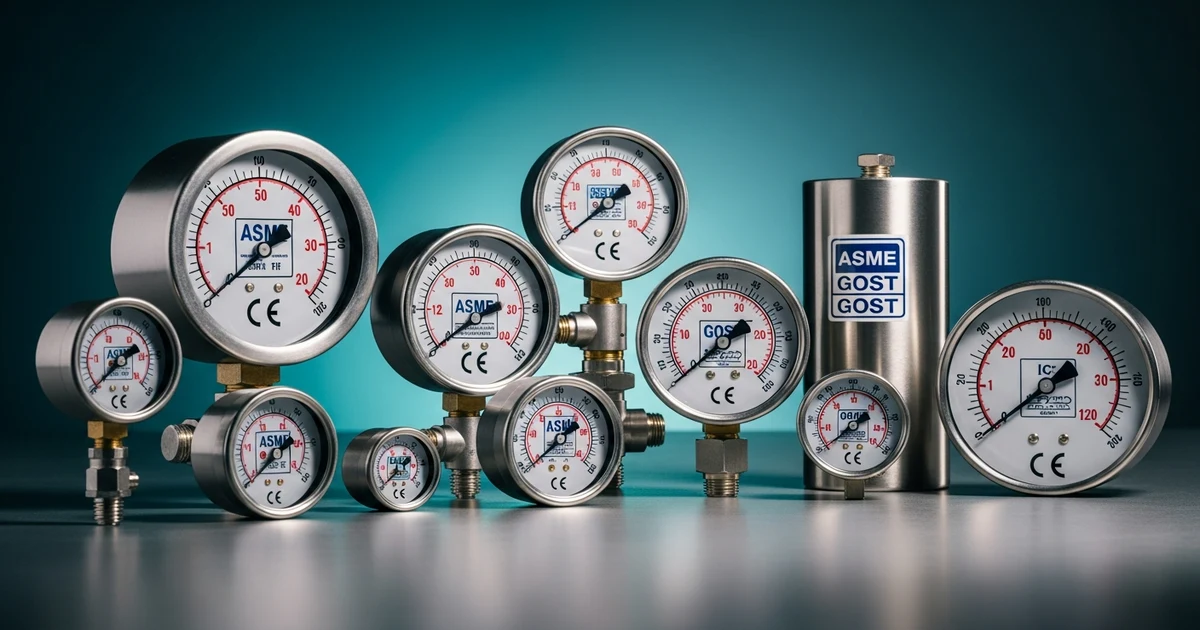
Exporting industrial pressure gauges to diverse international markets demands a thorough understanding of various certification and compliance requirements. Navigating these complex regulatory landscapes, from the European Union's PED to North American ASME standards and specialized hazardous area certifications, is critical for market access and avoiding costly delays. This guide provides a comprehensive overview of essential pressure gauge certifications and compliance pathways, helping B2B distributors, OEM equipment makers, and plant engineers ensure their Manogauge products meet global standards. We'll detail the technical specifications, conformity assessment routes, and documentation necessary for seamless international trade, ensuring your projects remain compliant and efficient.
CE Marking under PED 2014/68/EU: Conformity Routes and Category Limits
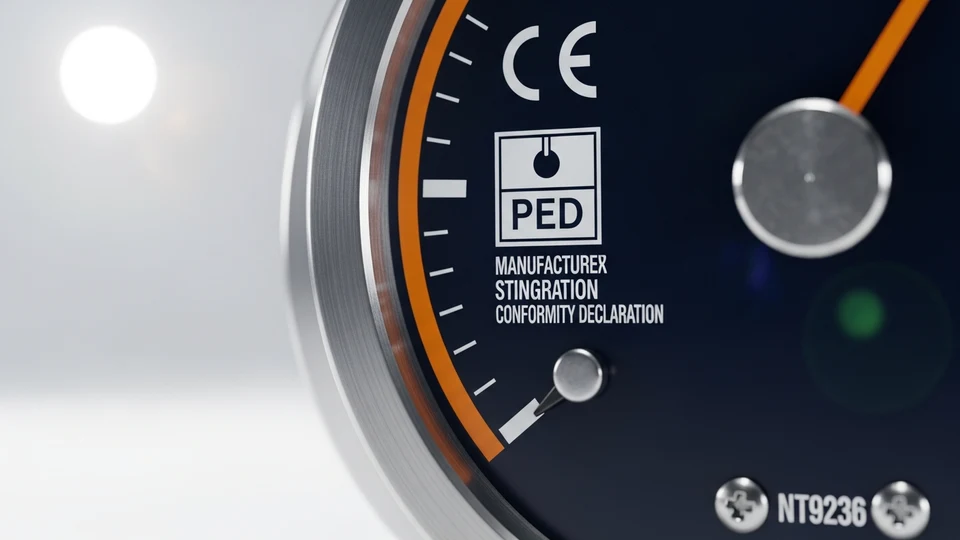
The CE marking is mandatory for pressure gauges sold within the European Economic Area (EEA), signifying compliance with the Pressure Equipment Directive (PED) 2014/68/EU. Pressure gauges, as pressure accessories, fall under the PED if their maximum allowable pressure (PS) is greater than 0.5 bar. The directive categorizes equipment (I to IV) based on the product of PS and nominal size (DN), and the fluid group (Group 1 for hazardous, Group 2 for non-hazardous). For example, a gauge for Group 1 fluids with PS > 1000 bar.DN or PS > 200 bar and DN > 25 would be Category IV.
Conformity assessment modules vary by category. Category I typically allows Module A (internal production control). For higher categories, more stringent modules are required: Category II often uses Module A2, D1, E1. Category III frequently requires Module B (EU-type examination) combined with Module D (conformity to type based on quality assurance) or F (conformity to type based on product verification). Category IV, the highest risk, mandates Module B+D, B+F, G (unit verification), or H (full quality assurance).
Manogauge ensures compliance by designing gauges to EN 837-1, the harmonized standard for pressure gauges. Our quality management system, certified to ISO 9001:2015, underpins the conformity assessment process, particularly for modules requiring quality assurance. The Declaration of Conformity (DoC) is a crucial document, stating that the product meets all applicable PED requirements and other relevant EU directives, such as the EMC Directive 2014/30/EU if electrical components are present.
The legal text for Europe is the Pressure Equipment Directive 2014/68/EU.
Browse Our Pressure Gauge Catalog →Explore 143+ industrial gauge models→North American Standards: ASME B40.100 and CSA/UL Recognition
For the North American market, ASME B40.100 is the primary standard governing pressure gauges. This standard, "Pressure Gauges and Gauge Accessories," specifies requirements for construction, dimensions, performance, testing, and accuracy. While ASME B40.100 itself is not a mandatory certification mark like CE, adherence to its guidelines is widely expected by end-users and often mandated in project specifications across the United States and Canada. Manogauge designs and manufactures gauges to meet or exceed ASME B40.100 Grade A or B accuracy requirements, ensuring reliability and interchangeability.
Beyond mechanical standards, electrical components within pressure gauges, such as switches or transmitters, require specific recognition for hazardous locations. In Canada, CSA (Canadian Standards Association) certification is essential, while in the United States, UL (Underwriters Laboratories) listing or recognition is typically required. These certifications address safety against electrical shock and fire hazards, particularly in environments classified as hazardous (e.g., Class I, Division 1 or 2, or Zone 1 or 2).
For pressure gauges with electrical contacts or transmitters intended for hazardous areas, Manogauge offers models with CSA or UL recognition, ensuring compliance with local electrical codes like the National Electrical Code (NEC) in the US and the Canadian Electrical Code (CEC). This involves rigorous testing for intrinsic safety, explosion-proof enclosures, or non-incendive circuits, depending on the protection concept. Specifying these certifications upfront is crucial for seamless integration into North American plant designs.
Accuracy and construction compliance should be paired with accuracy class selection under ASME and EN 837-1.
Asia-Pacific and CIS Market Requirements: KS, GOST R, and JIS
Entry into the South Korean market for pressure gauges necessitates compliance with KS B 5305, the Korean Industrial Standard for Bourdon tube pressure gauges. This standard outlines specifications for construction, performance, and testing, similar in scope to EN 837-1 or ASME B40.100. Obtaining KS certification demonstrates adherence to these national quality and safety benchmarks, often a prerequisite for government projects and major industrial installations. Manogauge ensures its products meet KS B 5305 requirements, facilitating market access for our distributors in South Korea.
For Russia and the Commonwealth of Independent States (CIS) countries, GOST R certification is the primary conformity assessment system. While the mandatory list of products requiring GOST R has been streamlined, many industrial pressure gauges still require a Declaration of Conformity (DoC) or a Certificate of Conformity (CoC) to the Technical Regulations of the Customs Union (TR CU). Specifically, TR CU 032/2013 (On the safety of pressure equipment) and TR CU 012/2011 (On the safety of equipment for operation in explosive atmospheres) are highly relevant for pressure gauges. Manogauge provides the necessary documentation to support GOST R/TR CU compliance.
While not a mandatory certification, adherence to JIS (Japanese Industrial Standards), such as JIS B 7505 for Bourdon tube pressure gauges, is highly regarded in Japan. Although often not a legal requirement for import, specifying JIS compliance can enhance market acceptance and demonstrate product quality to Japanese OEMs and end-users. Manogauge's robust manufacturing processes, aligned with ISO 9001, enable us to meet these stringent quality expectations across various regional standards.
CIS customs and mark requirements should be verified with current Eurasian Economic Commission resources.
Request a Free QuoteOur engineers respond within 24 hours→Sanitary and Hazardous-Area Certifications: 3-A and ATEX/IECEx
For applications in the food, beverage, and pharmaceutical industries, 3-A Sanitary Standards are paramount in North America. The 3-A Sanitary Standard 74-07 specifically addresses pressure gauges and transmitters, ensuring they are designed for cleanability, material compatibility, and hygienic operation. This includes requirements for smooth, non-porous, and corrosion-resistant wetted parts, absence of crevices, and ease of disassembly for cleaning. Manogauge offers a range of sanitary pressure gauges designed to meet 3-A 74-07, featuring electropolished surfaces and appropriate process connections (e.g., tri-clamp) to prevent bacterial growth and ensure product integrity.
For equipment operating in potentially explosive atmospheres, ATEX (Directive 2014/34/EU) is mandatory in the EU, while IECEx (International Electrotechnical Commission System for Certification to Standards Relating to Equipment for Use in Explosive Atmospheres) provides a globally recognized certification. Pressure gauges, especially those with electrical switches or transmitters, must be certified for the appropriate Zone (e.g., Zone 1 or Zone 2) and protection concept (e.g., intrinsic safety 'i', flameproof 'd').
Manogauge supplies Ex-rated gauges with intrinsically safe switches or other protection types, compliant with ATEX and IECEx requirements. This involves third-party assessment by a Notified Body (for ATEX) or Certification Body (for IECEx) to verify design and manufacturing processes. These certifications are critical for ensuring safety in hazardous locations and are often a non-negotiable requirement for plant engineers in industries like oil & gas, chemical processing, and mining.
Hazardous-area equipment should be checked against the ATEX Directive 2014/34/EU, while hygienic applications should reference sanitary pressure gauge certifications.
Documentation Package and Quality System for Export Compliance
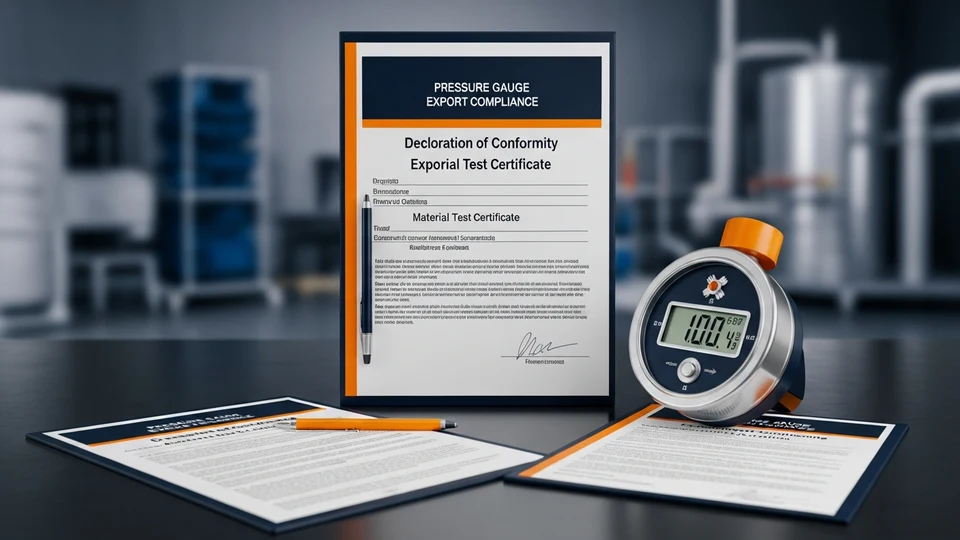
A comprehensive documentation package is essential for smooth customs clearance and demonstrating compliance in international markets. This typically includes: a Certificate of Conformance (CoC) issued by Manogauge, confirming the product meets specified standards; Material Certificates (MTRs) for wetted parts (e.g., 316L stainless steel), often required for traceability and material compatibility; and Test Certificates, detailing performance parameters like accuracy, pressure proof, and leak tests. For certified products, a Declaration of Conformity (DoC) (e.g., for CE marking) or a third-party certificate (e.g., ATEX, CSA/UL) is mandatory.
Manogauge's ISO 9001:2015 certified quality management system is the bedrock of our export compliance strategy. This internationally recognized standard ensures consistent product quality, robust manufacturing processes, and effective documentation control. Our QMS covers everything from design and material procurement to production, testing, and final inspection, providing a traceable framework that underpins all our product certifications. This systematic approach minimizes risks of non-compliance and supports the integrity of our declared conformity.
Understanding the total landed-cost impact of certification choices is vital. While obtaining certifications adds initial costs, it significantly reduces risks of market access barriers, product recalls, and legal liabilities. Distributors and OEMs should factor in these costs, as well as the time required for certification processes, when planning international sales. Manogauge actively manages these processes to provide compliant products efficiently, ensuring our partners receive the necessary documentation for seamless global distribution.
For ordinary industrial RFQs, connect certification requests back to the industrial pressure gauge selection guide.
Key takeaways
- Always verify the specific national and regional certification requirements for your target market before specifying pressure gauges.
- For the EU, ensure CE marking under PED 2014/68/EU, matching the correct category and conformity module for the gauge's PS×DN and fluid group.
- In North America, prioritize ASME B40.100 compliance for mechanical gauges and CSA/UL recognition for any electrical components in hazardous locations.
- For specialized applications, specify 3-A Sanitary Standard 74-07 for hygienic processes and ATEX/IECEx for explosive atmospheres.
- Maintain a complete documentation package, including CoC, material certs, test reports, and DoC, to facilitate customs and demonstrate compliance.
Related products
- Stainless Steel Pressure Gauge - Radial (ZX-01-R) — 0–100 MPa
- General Pressure Gauge - Radial (ZX-08-R) — 0–40 MPa
Frequently asked questions
What is the primary standard for pressure gauges in the US?
The primary standard is ASME B40.100, which covers construction, performance, and testing. While not a mandatory certification mark, adherence is widely expected and often specified in industrial projects across North America.
When is CE marking required for a pressure gauge?
CE marking is required for pressure gauges sold in the European Economic Area (EEA) if their maximum allowable pressure (PS) is greater than 0.5 bar, falling under the Pressure Equipment Directive (PED) 2014/68/EU.
What is the significance of ISO 9001 for pressure gauge exports?
ISO 9001:2015 certification demonstrates a robust quality management system. It underpins the reliability of product conformity declarations and is often a prerequisite for certain conformity assessment modules (e.g., PED Modules D or H), streamlining export compliance.
Do pressure gauges need ATEX or IECEx certification?
Yes, if they contain electrical components (like switches or transmitters) and are intended for use in potentially explosive atmospheres (e.g., Zone 1 or 2). These certifications ensure the gauge meets specific safety requirements for hazardous locations.
What documents are typically needed for customs clearance of pressure gauges?
A typical package includes the Certificate of Conformance (CoC), Material Certificates (MTRs), Test Certificates, and any mandatory Declarations of Conformity (DoC) or third-party certification certificates (e.g., CE, ATEX, CSA/UL).