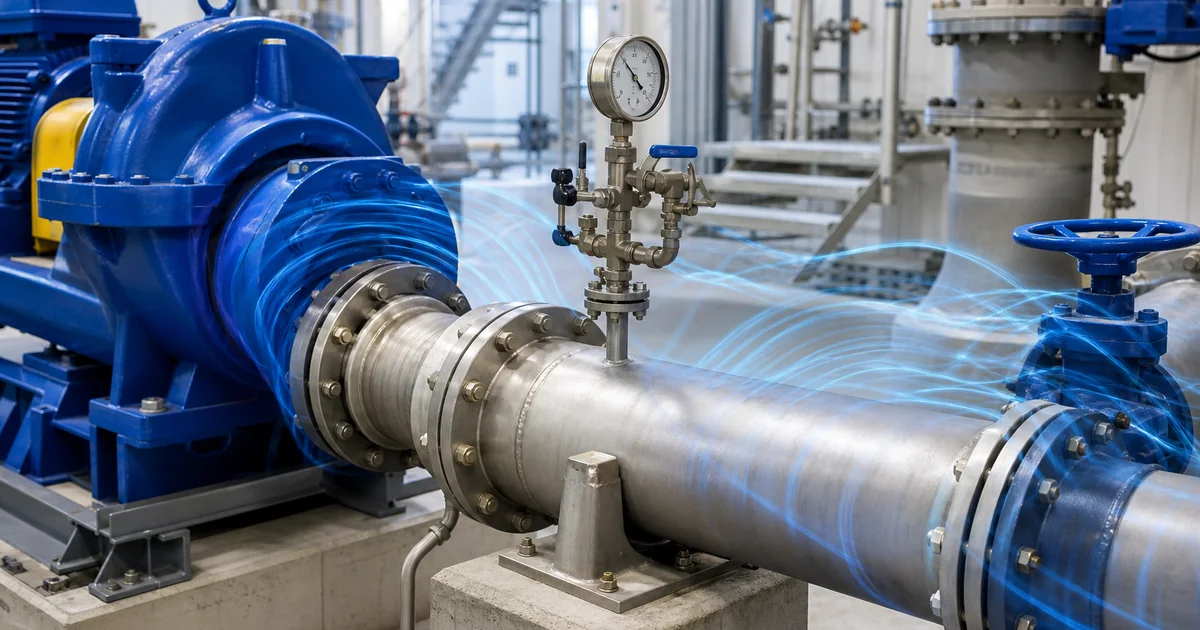
Pressure gauge overpressure protection is the practice of selecting the gauge range, safety case and accessories so a mechanical gauge can survive credible pressure spikes without misleading operators or creating avoidable leak points. It matters on pump discharge lines, compressor skids, hydraulic power units, fire-water packages and water-treatment systems where valve closure, startup transients or blocked outlets can briefly push pressure far above steady operation.
What pressure gauge overpressure protection means
Pressure gauge overpressure protection does not mean choosing the largest range on the shelf. It means identifying how high the process can rise, how quickly the rise occurs, and whether the gauge should keep reading, survive a transient, or isolate itself during an abnormal event. A Bourdon tube gauge is an elastic mechanical instrument; repeated excursions above the calibrated range can deform the tube, shift the pointer, damage the movement or rupture a weak case.
Overpressure can come from water hammer after fast valve closure, pump dead-heading, compressor pulsation, thermal expansion in a blocked-in liquid line, pressure relief setpoint errors, or commissioning mistakes. Public pump-system guidance from the Hydraulic Institute on mitigating water hammer notes that water hammer control may involve valve-closure control, diaphragm tanks, relief valves and hydraulic analysis. Those system measures protect the pipework first; the gauge still needs its own range and accessory decision.
Use the gauge as a measurement device, not as the system pressure-relief device. Relief valves, rupture discs and control logic protect the pressure system. Snubbers, pressure limiters, valves and safety cases protect the pressure instrument and the operator interface.
Review Snubber Selection for Pulsation →→Pressure gauge overpressure protection starts with range selection
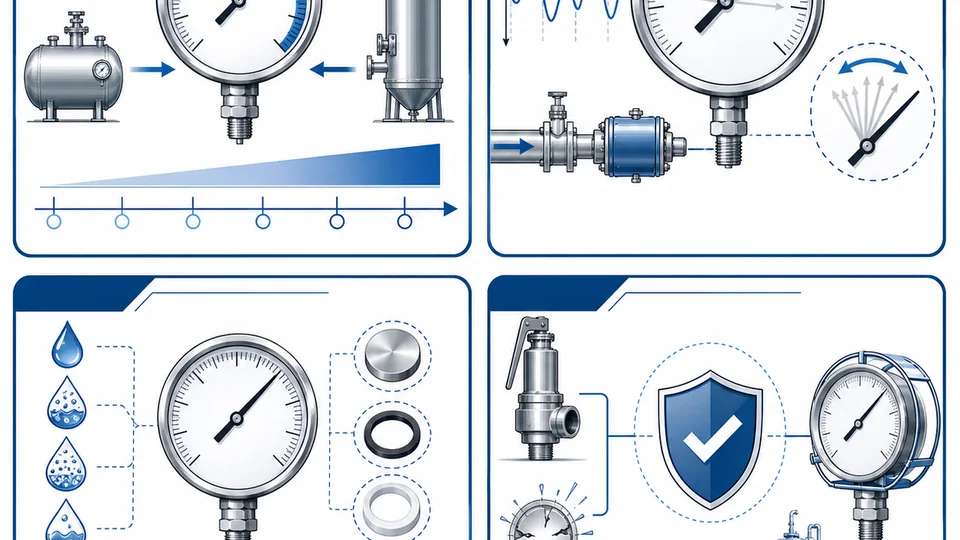
The first protection layer is the selected dial range. Normal steady pressure should sit in a readable middle portion of the scale, commonly around 50-75% of full scale for steady service. If normal operation sits near the top of the dial, even a modest surge can overload the sensing element. If the range is oversized too far, the operator loses useful resolution and accuracy because mechanical-gauge accuracy is normally stated as a percentage of full scale.
| Condition to define | Why it matters | RFQ wording to add |
|---|---|---|
| Normal operating pressure | Sets readable working zone. | State normal min/max pressure and preferred unit. |
| Maximum credible pressure | Reveals dead-head, relief or blocked-line risk. | State startup peak, shutoff head and relief setpoint. |
| Transient speed | Fast spikes need damping; slow overpressure may need limiting. | Describe water hammer, compressor pulsation or hydraulic cycling. |
| Medium and temperature | Accessories add wetted materials and seals. | Confirm water, oil, steam, gas, chemical concentration and temperature. |
| Operator exposure | Influences safety case and vent direction. | Specify front access, panel mounting or remote reading need. |
For deeper range and accuracy background, compare Manogauge's pressure gauge accuracy class selection guide and pressure gauge snubber selection guide.
Snubbers, restrictors and pressure limiters are not the same
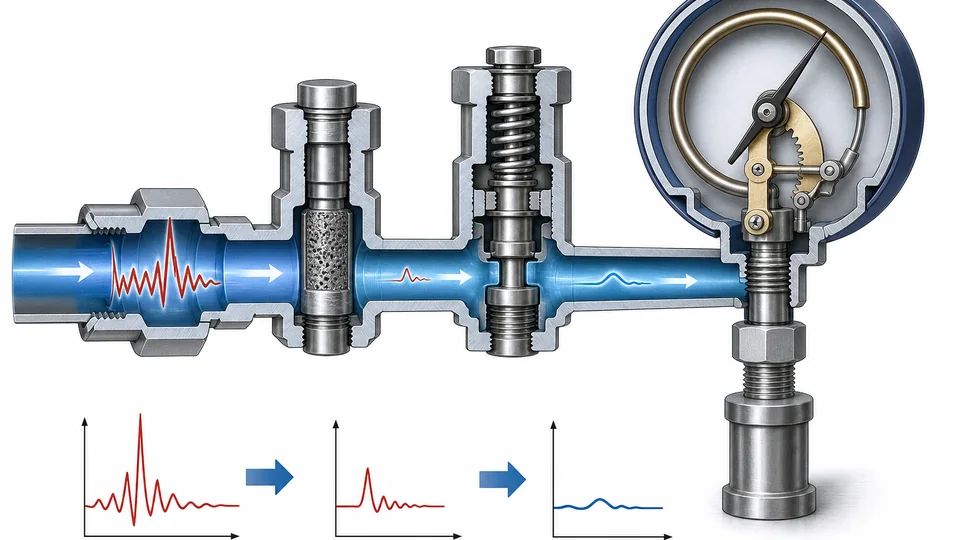
A snubber or restrictor reduces the rate at which pressure changes reach the gauge movement. It is useful for pulsation and spikes, especially on reciprocating pumps, compressors and hydraulic circuits. It may calm the pointer and reduce wear, but it can also slow the indication and clog if the medium carries solids, viscous oil or crystallizing chemicals.
A pressure limiter, also called an overpressure protector in many catalogs, is different. It closes or throttles when pressure exceeds a set value, then reopens when pressure returns. Supplier technical notes such as AMETEK's overview of snubbers and overpressure protectors describe this as a spring-loaded mechanism used to shield gauges or transducers from spikes and surges. The setpoint, reset behavior, wetted materials and maintenance access must match the process.
A siphon protects gauges from hot steam by forming a condensate barrier; it is not a general water-hammer solution. A diaphragm seal isolates the gauge from corrosive, viscous, sanitary or crystallizing media; it does not automatically solve excessive pressure unless paired with a suitable fill, range and protector. Name the accessory function precisely in the RFQ.
Request an Overpressure Gauge RFQ Reviewيرد مهندسونا خلال 24 ساعة→Where overpressure protection is commonly needed
Pump discharge lines are a common starting point because valve movement and shutoff head can create short high-pressure events. On centrifugal pumps, check the maximum shutoff head and downstream valve behavior. On positive displacement pumps, a blocked outlet can build pressure rapidly, so system-level relief protection is normally critical before choosing the gauge accessory.
Compressed air and gas skids often combine pulsation, vibration and operator exposure. A liquid-filled gauge may improve readability, but high gas pressure can also raise safety-case concerns. Hydraulic power units add high cycle counts and oil compatibility questions. Chemical injection skids add small-bore fittings, pulsation dampeners, corrosion and cleaning requirements.
Water-treatment systems, cooling loops and fire-water packages may look simple, but fast valve closure and filter blockage can create misleading gauge failures. If the gauge pointer drifts after each startup, returns slowly, vibrates heavily or repeatedly pegs at the stop pin, treat it as a system transient symptom rather than only a product-quality complaint.
Safety case, wetted materials and installation details
Overpressure protection is not only about the Bourdon tube. If the medium is gas, steam, toxic, flammable or high pressure, the case design and blow-out path matter. A solid-front safety pattern with rear relief can direct failure energy away from the operator. The mounting orientation must leave the relief path unobstructed; installing a safety case tight against a wall can defeat the design intent.
Accessories introduce extra wetted parts. A brass snubber may be acceptable on clean water but unsuitable for chloride-rich cooling water, ammonia, oxygen service or aggressive chemicals. Stainless steel 316L, PTFE seals, oxygen-clean components or diaphragm seals may be required depending on the medium. Do not infer compatibility from the pressure range alone.
Keep the instrument takeoff serviceable. Use an isolation valve where maintenance is expected, support small-bore tubing against vibration, avoid mounting the gauge where drain water can freeze, and confirm whether the pointer must remain readable during startup or only during steady operation.
RFQ checklist for pressure gauge overpressure protection
Before ordering, write the abnormal conditions into the RFQ instead of simply asking for a more rugged gauge. Include operating pressure, maximum credible pressure, relief setpoint, pulsation source, medium, temperature, connection, material, vibration, safety pattern, filling, accessories and certificate needs.
- Define whether the gauge must measure the full surge or only survive it.
- State the expected pressure limiter setpoint if isolation is required.
- Confirm whether the process contains solids, wax, scale or crystallizing chemicals that can clog a restrictor.
- Specify connection thread and sealing method, such as NPT, BSP, G or metric.
- Request calibration and inspection records when the gauge is used for acceptance testing.
Manogauge, based in Zhejiang, China, manufactures industrial pressure gauges under an ISO 9001 quality system for OEM and export projects. Final pressure gauge overpressure protection still depends on confirmed site data; for high-pressure gas, oxygen, steam, hazardous-area or corrosive service, have the project engineer approve the range, accessory setpoint and material selection before production.
Key takeaways
- Do not use a pressure gauge as the system pressure-relief device.
- Select the dial range from normal pressure and credible abnormal pressure, not from normal pressure alone.
- Use snubbers for pulsation and pressure limiters for defined overpressure isolation.
- Check accessory wetted materials, seals and clogging risk before approving the RFQ.
- Safety-case vent direction and operator exposure matter in gas, steam and high-pressure service.
Часто задаваемые вопросы
What causes pressure gauge overpressure damage?
Common causes include water hammer, pump dead-heading, compressor pulsation, thermal expansion in blocked liquid lines, relief valve setpoint errors and startup mistakes. The damage may appear as pointer drift, a bent stop pin, loss of accuracy, movement wear or Bourdon tube rupture.
Is a snubber enough for pressure gauge overpressure protection?
A snubber helps damp fast pulsation and spikes, but it does not always limit slow sustained overpressure. If the process can exceed the gauge range for longer periods, consider a pressure limiter, correct system relief protection or a higher range approved by the engineer.
When should I use a pressure limiter instead of only a higher gauge range?
Use a pressure limiter when normal pressure needs good resolution but credible abnormal pressure is high enough to damage the gauge. The limiter setpoint, reset behavior and wetted materials must be specified so it protects the instrument without hiding important operating information.
Can a liquid-filled pressure gauge solve overpressure?
Liquid filling improves pointer stability and vibration resistance, but it does not by itself raise the pressure rating of the Bourdon tube. It should be paired with proper range selection, compatible fill fluid, snubber or pressure limiter when surges are expected.
What information should be in an RFQ for overpressure-protected gauges?
Include normal pressure, maximum credible pressure, surge source, relief setpoint, medium, temperature, connection thread, wetted material, case safety pattern, vibration level, liquid filling, snubber or limiter requirement, calibration certificate and inspection record needs.