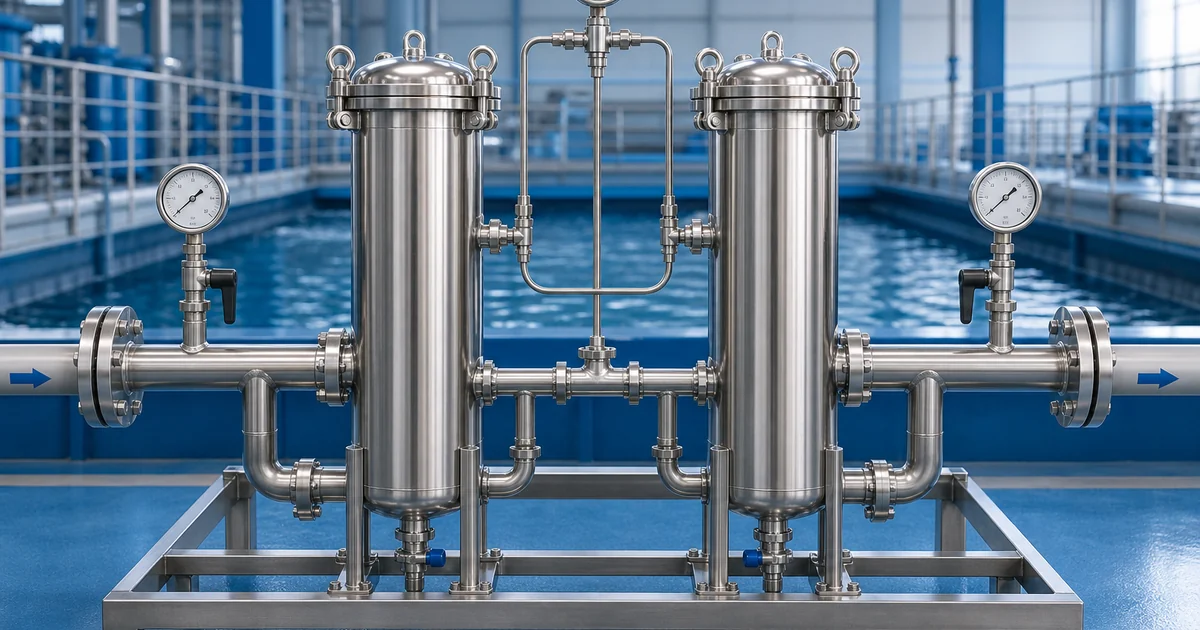
Differential pressure gauge filter selection starts with one practical question: how much pressure drop across the filter is normal, and when does that drop prove that cleaning, backwash or replacement is needed?
What a differential pressure gauge tells you in filtration
Differential pressure gauge filter selection is the process of matching a DP instrument to the pressure drop across a filter element, vessel, strainer or membrane train. Differential pressure, often written as ΔP or DP, is the difference between upstream pressure and downstream pressure. In filtration, that number is a direct indicator of hydraulic resistance, not a direct measurement of dirt mass or water quality.
A clean cartridge, bag filter or membrane module has a normal pressure drop at a known flow, viscosity and temperature. As solids, biofilm, scale or product residue accumulate, the same flow usually needs more pressure, so DP rises. The U.S. EPA Membrane Filtration Guidance Manual defines membrane units and operating concepts that depend on pressure relationships, which is why DP should be treated as part of the process record rather than only a local dial reading.
The gauge does not decide maintenance by itself. Operators still need flow rate, filter manufacturer limits, product quality requirements and site baseline readings after commissioning or cleaning.
تصفح خيارات مقاييس الضغط منخفضة المدى ←استكشف أكثر من 143 نموذجاً من المقاييس الصناعية→Start with clean baseline, dirty limit and flow condition
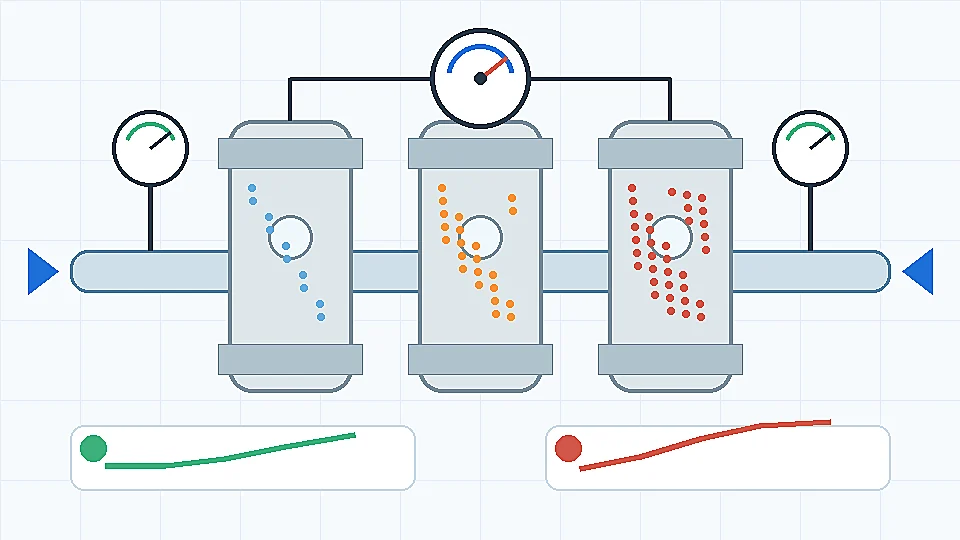
Before choosing the dial range, define three numbers: clean pressure drop, normal operating DP and maximum allowable dirty-filter DP. These should be tied to a specific flow condition. A filter at double the flow may show a much higher pressure drop even when it is not loaded, so a DP alarm copied from another line can be misleading.
| Selection input | Why it matters | RFQ wording |
|---|---|---|
| Clean ΔP at normal flow | Creates the commissioning baseline | State clean filter DP after startup or cleaning |
| Recommended changeout or backwash DP | Prevents excessive element stress and flow loss | Use filter maker limit where available |
| Maximum line pressure | Protects the gauge body and ports, not only the DP capsule | List static pressure and hydrotest exposure separately |
| Fluid temperature and viscosity | Changes pressure drop and material compatibility | Give normal and cleaning-cycle conditions |
For many low-pressure filter applications, a capsule or diaphragm differential design may be more readable than two standard gauges because the useful DP span can be only a few kPa or mbar. For high static pressure with low DP, confirm whether the instrument is rated for both values.
Choose the differential pressure gauge type for the filter duty
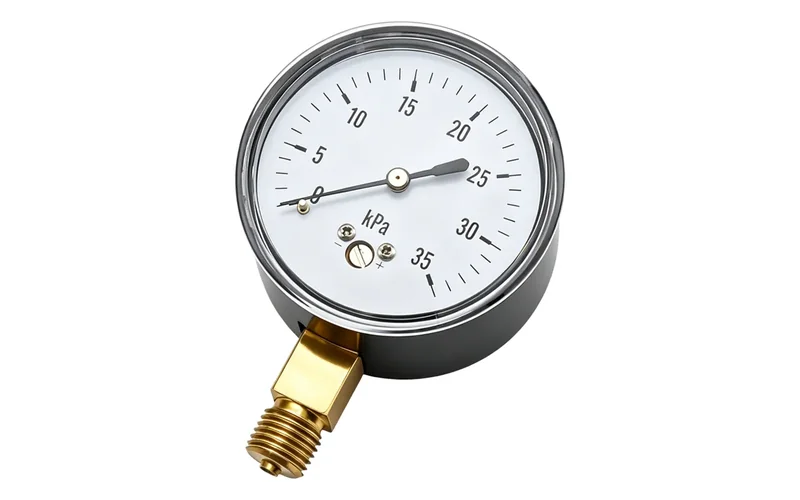
Simple water or air filters can use two local gauges, one upstream and one downstream, if operators record readings consistently. A single differential pressure gauge is easier to scan because it displays the pressure loss directly. A differential pressure switch is useful when the filter only needs a local alarm or backwash trigger. A DP transmitter is preferred when the plant wants trends, PLC logic or remote maintenance dashboards.
Manogauge product data lists a dual-capsule differential option for the ZX-07 capsule pressure gauge up to 0-60 kPa DP, while diaphragm pressure gauges such as ZX-05 diaphragm pressure gauge support low ranges where process isolation and wetted material choice matter. These data points are selection references only; the final model, connection and pressure rating must match the actual filter vessel and medium.
If the system has vibration, pulsation or rapid valve movement, also review snubber selection for pulsation protection before specifying the impulse lines and root valves.
اطلب قائمة RFQ لمقياس DP للفلتر ←يرد مهندسونا خلال 24 ساعة→Wetted materials and ports matter as much as the DP span
Filter service often looks harmless until cleaning chemistry is included. Cooling water may contain chloride, biocide and corrosion inhibitor. Food and beverage filters may see caustic CIP and hot water. Pharmaceutical vents and sterile filters may require sanitary fittings and calibration evidence. Chemical filtration may contain solvents, acids, slurries or crystallizing media.
State the wetted material requirement for every part touching the medium: process ports, diaphragms or capsules, seals, valve manifolds and impulse tubing. Brass may be suitable for mild air or clean water, while 304 or 316L stainless steel, PTFE seals, sanitary clamp connections or isolating diaphragm seals may be needed for corrosive, hygienic or viscous service. Do not infer compatibility from the pressure range alone.
Port geometry also affects maintenance. Two separate impulse lines need equal length where practical, drain or vent points where needed, and isolation valves so the instrument can be zeroed or removed. Direct-mounted DP gauges reduce tubing but may make the dial harder to read or expose it to vibration.
What differential pressure cannot prove
A high DP normally indicates restriction, but it does not identify the cause by itself. The cause may be loaded filter media, closed downstream valve, wrong element grade, excessive flow, high viscosity, air binding, frozen condensate, plugged impulse line or a damaged instrument. A low DP does not always mean the filter is healthy; it can also mean bypass flow, torn media, missing element, low flow or an open drain path.
For membrane filtration, DP must be interpreted together with transmembrane pressure, flux, temperature correction, cleaning history and integrity testing. For sterilizing-grade pharmaceutical filtration, the pressure instrument supports process understanding, but it does not replace validated filter integrity tests, bioburden control or quality release requirements.
This boundary is important in procurement. Ask for a gauge that can survive and display the required DP, but do not ask the gauge supplier to certify filtration performance unless a separate validated test method and process owner are involved.
RFQ checklist for differential pressure gauge filter selection
A useful RFQ should include medium, suspended solids or product residue, filter type, clean DP, dirty-filter DP limit, normal flow, maximum flow, static line pressure, process temperature, cleaning temperature, viscosity if relevant, connection thread or flange, mounting orientation, vibration, outdoor or washdown exposure, required accuracy, dial size, case material, wetted material, liquid fill, alarm or transmitter requirement and calibration certificate needs.
For export purchasing, separate confirmed product data from assumptions. Manogauge is a Zhejiang, China manufacturer with ISO 9001 quality management and pressure gauge export experience, but material certificates, CE declarations, special cleaning, sanitary finish, calibration reports and private-label documentation should be requested explicitly in the RFQ. A good differential pressure gauge filter selection decision starts with the filter maker’s limits, then checks whether the instrument can read those limits reliably in the actual plant environment.
Key takeaways
- Specify clean DP, dirty-filter DP and flow together.
- Check static pressure rating separately from differential span.
- Use material compatibility data for cleaning chemicals, not only process fluid.
- Treat DP as a maintenance indicator, not proof of filtration quality.
Часто задаваемые вопросы
What range should a differential pressure gauge use for a filter?
Start with the filter maker’s clean pressure drop and recommended changeout or backwash pressure drop at the specified flow. Choose a range that makes the normal operating area readable while still covering the dirty-filter limit.
Can two pressure gauges replace one differential pressure gauge?
Yes for manual checks if both gauges are accurate, installed at equivalent points and recorded consistently. One differential pressure gauge is usually easier to read because it displays pressure loss directly.
Does high differential pressure always mean the filter is dirty?
No. High DP can also come from excessive flow, high viscosity, a closed downstream valve, a plugged impulse line or an instrument fault. Confirm flow, valve position and baseline before replacing the element.
What materials are common for filter DP gauge wetted parts?
Mild air or clean water may allow brass, while cooling water, chemical filtration, food CIP or hygienic service may require 304/316L stainless steel, PTFE seals, sanitary connections or diaphragm isolation.
What should be listed in a filter DP gauge RFQ?
List medium, filter type, clean DP, dirty DP limit, flow, static line pressure, temperature, cleaning cycle, connection, mounting, vibration, material, accuracy, alarm or transmitter output and calibration requirement.