
Chilled water DP monitoring is the practice of measuring differential pressure across supply-return headers, pumps, filters, coils and heat exchangers in an HVAC chilled-water loop. It helps facility teams keep variable-speed pumps stable, confirm whether a remote coil has enough pressure, detect clogged strainers, and separate hydraulic problems from chiller or control-valve issues. This guide explains where pressure gauges and differential pressure transmitters belong, how to choose range and wetted materials, and what the readings cannot prove without flow, valve-position and commissioning data.
What chilled water DP monitoring means in HVAC plants
Chilled water DP monitoring compares pressure at two points in a hydronic cooling system. A differential pressure transmitter reports the difference directly for building automation, while two local pressure gauges let technicians compare supply and return readings during inspection. Both methods answer a hydraulic question: is enough pressure available at this location, and is a component creating more pressure drop than expected?
In variable-flow HVAC systems, pump speed is often controlled from differential pressure or valve-position logic. ASHRAE Guideline 36 material discusses differential-pressure-controlled chilled-water loops and plant reset logic; see the public ASHRAE Guideline 36 addendum on chilled-water plant reset. A gauge alone does not optimize the plant, but it gives field visibility when a BAS value looks wrong.
Use local indication for commissioning, maintenance rounds and troubleshooting. Use a transmitter when the signal must drive alarms, trend logs or pump control. The two are complementary rather than interchangeable.
قارن خيارات مقاييس فرق الضغط ←استكشف أكثر من 143 نموذجاً من المقاييس الصناعية→Where to place pressure gauges and DP transmitters
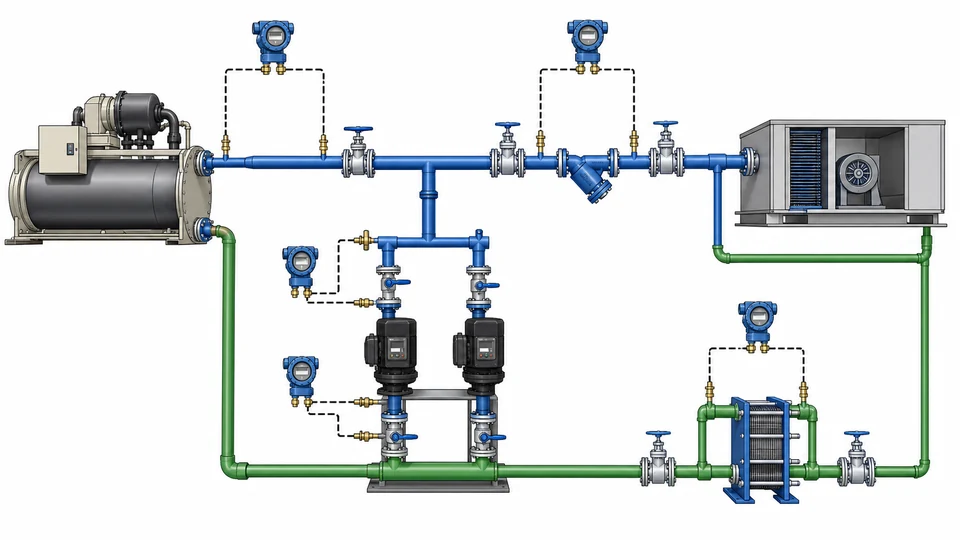
The best measurement point depends on the question. Remote supply-return DP near the hydraulically critical coil helps pump control. Pump suction and discharge gauges help verify pump head and suction conditions. Differential pressure across strainers, side-stream filters or plate heat exchangers helps detect fouling. Chiller evaporator pressure drop can support commissioning, but it should be interpreted with flow and manufacturer data.
| Measurement location | Typical purpose | Instrument choice |
|---|---|---|
| Remote supply and return mains | Confirm available pressure at critical zones | DP transmitter for BAS plus test ports |
| Pump suction and discharge | Check pump head, suction pressure and abnormal restriction | Two pressure gauges or pressure transmitters |
| Strainer or filter | Detect clogging before flow drops | DP gauge or DP transmitter |
| Chiller evaporator or heat exchanger | Compare pressure drop with commissioning data | Gauge pair or DP transmitter with isolation valves |
For instrument fundamentals, compare the differential pressure gauge selection guide and the pressure transmitter vs pressure gauge selection guide.
Choose range, accuracy and wetted materials for chilled water DP monitoring
Chilled-water loops usually operate at moderate pressure, but the useful differential may be much smaller than the static line pressure. If a system runs near 6 bar static pressure and the useful differential is only 20-80 kPa, a full-line pressure gauge cannot show small control changes clearly. A DP transmitter or DP gauge with an appropriate low differential range gives better resolution.
Confirm maximum static pressure, expected pump head, normal DP setpoint, cleaning pressure, test pressure and freeze-protection fluid. Glycol blends, water treatment chemicals and oxygen ingress can affect wetted material choices. Stainless steel wetted parts are often preferred where corrosion risk or water treatment chemistry is uncertain; brass may be acceptable only after compatibility is confirmed.
Accuracy class should match the decision. A commissioning instrument may need tighter accuracy than a local trend indicator. For general selection logic, review pressure gauge accuracy class selection and 316L stainless steel vs brass wetted parts.
حضّر طلب عرض سعر لأدوات ضغط HVAC ←يرد مهندسونا خلال 24 ساعة→Installation details that keep readings useful
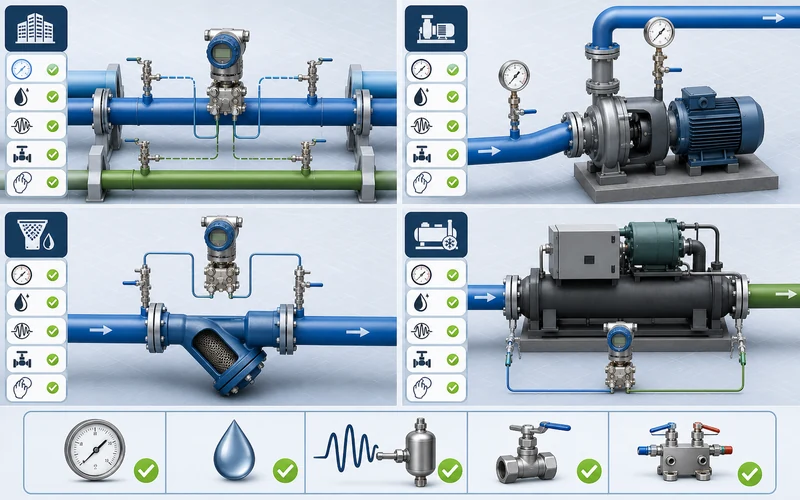
Pressure taps should be accessible, stable and protected from turbulence where practical. Near pump discharges, elbows, control valves and partially closed balancing valves, the reading may fluctuate or represent local velocity effects rather than the broader loop condition. Isolation valves, drain or vent provisions and clear labels make calibration and replacement safer.
For a DP transmitter, keep impulse lines short and protected, avoid trapped air where it distorts a liquid reading, and mount the manifold so technicians can zero, isolate and equalize the transmitter. For local pressure gauges, choose a dial size that technicians can read from the normal service position and protect the movement from vibration if installed near pump skids.
These practices align with broader pressure gauge installation best practices and centrifugal pump pressure gauge selection.
What chilled water pressure readings cannot prove
A pressure or DP reading cannot prove flow by itself. A coil with a high differential may still have low flow if a valve, strainer or balancing device is restricting the branch. A low differential may be normal at low load if the control sequence has reset pump pressure downward. A stable gauge also cannot prove that sensors are calibrated, control valves are authority-correct, or the chiller evaporator is within its flow limits.
Do not use chilled water DP monitoring as a substitute for commissioning. Final acceptance should compare pressure, flow, valve position, pump speed, temperature difference, air-side load and the approved control sequence. In large campuses, district cooling plants or critical facilities, the engineer should verify sensor locations and ranges against the hydraulic model and TAB report.
Manogauge can support local indication and pressure instrument selection from Zhejiang manufacturing, but project data must still come from the building engineer: fluid, glycol percentage, pressure class, temperature, range, thread or flange, IP rating, vibration level and documentation needs.
RFQ checklist for chilled water pressure instruments
An RFQ for chilled water instruments should describe the measurement purpose before listing model numbers. A supplier can only recommend the right pressure gauge, DP gauge or transmitter when the hydraulic question is clear.
- State the point: remote loop DP, pump suction-discharge, filter pressure drop, evaporator pressure drop or local indication only.
- Provide static pressure, expected differential pressure, maximum pump head and test pressure.
- Confirm fluid: water, glycol percentage, corrosion inhibitor, treatment chemicals and operating temperature.
- Specify connection, isolation valve or manifold requirement, dial size, output signal, IP rating and mounting position.
- Ask what the instrument cannot prove without flow or commissioning data.
With these inputs, chilled water DP monitoring becomes a useful maintenance and control signal rather than a decorative number on the pipe.
Часто задаваемые вопросы
Is chilled water DP monitoring the same as measuring flow?
No. Differential pressure is a hydraulic signal, not a direct flow measurement. It must be interpreted with valve position, pump speed, temperature difference and commissioning flow data.
Where should the main chilled water DP transmitter be installed?
It is commonly placed near the hydraulically critical zone or remote supply-return mains, but the final location should follow the control sequence, hydraulic model and TAB report.
Do I need a DP gauge or two pressure gauges across a filter?
A DP gauge or transmitter gives a direct pressure-drop value. Two pressure gauges are useful for local comparison, but small differences are harder to read when static pressure is high.
What range is typical for chilled water differential pressure?
There is no universal value. The range should be based on expected pump head, coil requirement, filter pressure drop and static pressure, often much lower than the full line pressure.
Can a local gauge control variable-speed pumps?
A local mechanical gauge cannot provide a BAS control signal. Use a differential pressure transmitter for pump control and keep local gauges or test ports for field verification.