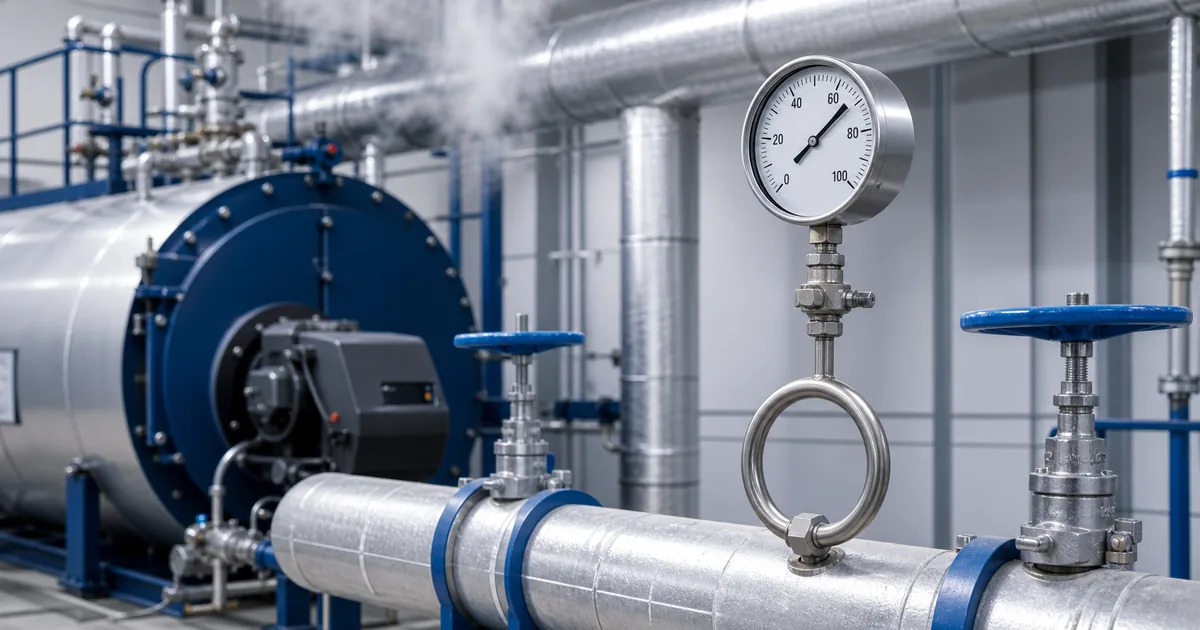
Steam pressure gauge siphon selection is a small accessory decision with a large reliability effect. A siphon, sometimes called a pigtail, coil or U-type syphon, creates a condensate barrier between live steam and the Bourdon tube gauge so the gauge sees pressure without direct steam temperature. This guide explains how to choose the siphon form, gauge range, material, valve arrangement and RFQ data for boiler rooms, heat exchangers, steam tracing and plant utility headers.
What steam pressure gauge siphon selection means
Steam pressure gauge siphon selection starts with a definition: a siphon is a short looped or U-shaped tube installed between a hot steam process and a pressure instrument. Its job is to hold condensate so live steam does not enter the pressure gauge socket and overheat the Bourdon tube, movement, seals or fill fluid. The gauge still reads pressure because pressure is transmitted through the trapped liquid column.
This accessory is common on boiler outlets, steam distribution headers, heat exchanger steam inlets, condensate return lines, steam tracing manifolds and sterilization utilities. It is not a substitute for a pressure relief valve, a certified boiler control, a temperature rating check or a safe isolation procedure. Treat the siphon as one protective layer for the instrument.
Public manufacturer references such as WIKA syphons and connecting pipes describe the same operating idea: condensate collects inside the syphon and prevents hot media from entering the measuring instrument. The practical RFQ question is whether the selected form, material and installation actually fit the site steam service.
Review Stainless Steel Steam Gauge Options ->Compare range, material, dial size and thread choices→How the condensate barrier protects a steam pressure gauge
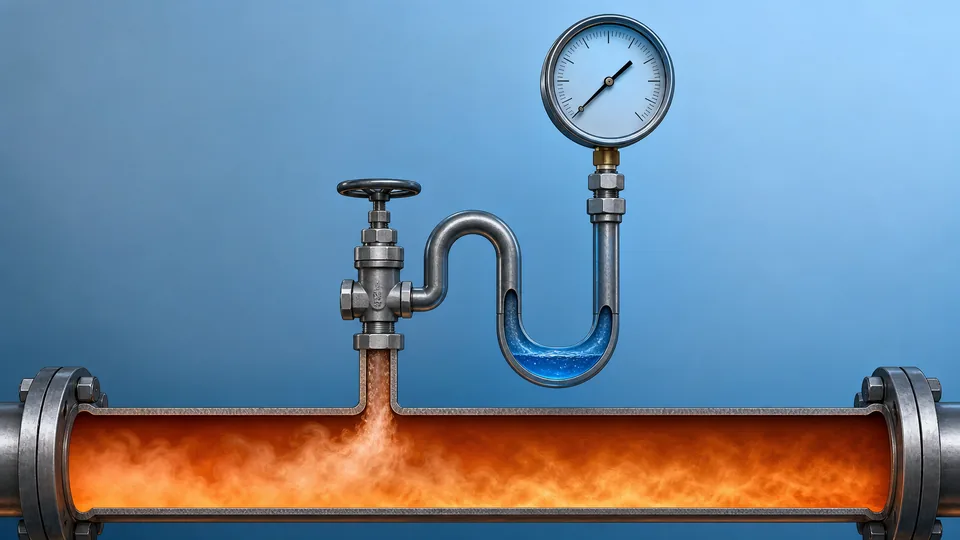
When a siphon is commissioned correctly, the loop contains water or another suitable separating liquid before live steam reaches the instrument. Steam condenses in the cooler section of the loop, maintaining a water seal. The gauge sees process pressure through that liquid, but the instrument body is exposed to a much lower temperature than the steam header.
The barrier must be present before startup. If a dry siphon is opened suddenly to steam, the gauge may be exposed to high temperature until enough condensate forms. For critical service, commissioning procedure should define filling, venting, warm-up and leak checks. Operators should also confirm that the siphon loop is not blocked by scale, sludge, frozen condensate or incorrect valve position.
| Selection point | Why it matters | RFQ wording to add |
|---|---|---|
| Steam pressure and temperature | Controls gauge range, siphon wall rating and material. | State normal pressure, maximum pressure and saturated or superheated condition. |
| Siphon form | Pigtail and U-type forms suit different tapping orientations. | State vertical or horizontal pressure tapping and available clearance. |
| Condensate condition | Scale, corrosion or freezing can defeat the barrier. | State water treatment, ambient temperature and shutdown exposure. |
| Isolation valve | Needed for maintenance but can hide pressure if misused. | State valve type, lock-open rule and vent/test requirement. |
Pigtail, coil and U-type siphon choices for steam pressure gauge siphon selection
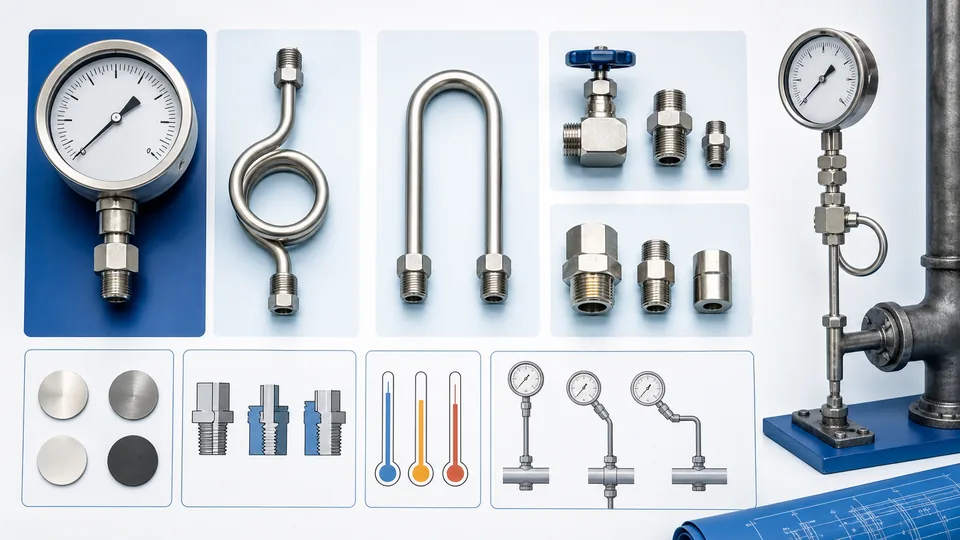
There is no universal best shape. A pigtail or coil siphon is often used when the pressure tapping is vertical and the gauge is mounted above the line. A U-type siphon is commonly reviewed for horizontal tapping or compact layouts where a straight vertical loop would be awkward. The geometry must leave enough condensate volume, allow drainage or filling where required, and avoid mechanical stress on the gauge socket.
Material selection follows steam condition and plant practice. Carbon steel may be acceptable for many utility steam services, while stainless steel is often requested for corrosive atmospheres, clean utility rooms, pharmaceutical steam areas or export documentation consistency. Brass should not be assumed suitable for every steam application; confirm pressure, temperature and local code expectations before specifying it.
For local indication, Manogauge product data lists stainless steel pressure gauges with 0-100 MPa range options, Ø40-100 mm dial sizes, 304 / 316L stainless steel construction and G/PT/NPT 1/2 connections. The catalog range is only a starting point: final steam service requires confirmed siphon, valve, connection and temperature details.
Send Steam Gauge Siphon RFQ Data ->Include steam pressure, temperature, connection, siphon form and valve needs→Range, accuracy and accessory checks for steam service
The gauge range should match operating pressure and expected transients, not the boiler nameplate alone. For steady mechanical-gauge service, many engineers keep normal pressure in a readable middle part of the scale, then check startup, pressure-reducing station behavior and relief setting separately. Mechanical gauge accuracy is normally a percentage of full scale, so an oversized range can make normal steam pressure hard to read.
Steam systems also create vibration, thermal cycling and occasional pressure pulsation. A liquid-filled case can calm pointer movement in some environments, but fill fluid temperature limits and case venting must be checked. A snubber may reduce pulsation, but it can clog if condensate carries scale. A siphon protects against heat; it does not automatically solve water hammer, relief sizing, poor pipe support or excessive vibration.
For related instrument choices, compare the pressure gauge overpressure protection guide and the pressure gauge thread connection guide. Use semantic RFQ wording such as steam pressure gauge range, pigtail siphon material, NPT or BSP connection, isolation valve and calibration certificate requirement.
What a siphon cannot prove in boiler and steam systems
A siphon cannot prove that the boiler is safe, that relief valves are correctly sized, that the pressure gauge is calibrated, or that a steam line is free from water hammer. It also cannot prove that the condensate barrier is present after maintenance unless the commissioning procedure verifies filling and venting. Treat a stable reading as local indication, not as proof of full steam-system integrity.
High-pressure steam, superheated steam, oxygen-enriched service, hazardous areas, pharmaceutical clean steam and food sterilization utilities need additional engineering review. The project engineer should confirm pressure class, connection standard, wetted material, cleaning method, certificate package and whether a diaphragm seal or remote instrument line is safer than a local gauge.
Manogauge, based in Zhejiang, China, manufactures industrial pressure gauges under an ISO 9001 quality system for OEM and export projects. That manufacturing capability supports steam pressure gauge sourcing, but the final steam pressure gauge siphon selection still depends on real site data rather than a generic catalog picture.
Steam pressure gauge siphon RFQ checklist
A useful RFQ for steam pressure gauge siphon selection should include the steam service, normal pressure, maximum pressure, operating temperature, saturated or superheated condition, tapping orientation, connection thread, siphon form, siphon material, valve arrangement, gauge dial size, accuracy class, case material, filling requirement, calibration document and any local inspection rule.
- State whether the point is a boiler outlet, main steam header, heat exchanger inlet, pressure-reducing station, steam tracing manifold or condensate return line.
- Confirm whether the siphon must be pigtail, U-type, coil or supplier-recommended based on installation orientation.
- Specify NPT, BSP, G or metric threads, plus sealing practice and pressure class.
- Tell the supplier if freezing, scale, vibration, water hammer or outdoor installation is expected.
- Ask for drawings or dimensions when clearance around insulation, valves and gauge dial readability is limited.
With these inputs, suppliers can recommend a gauge, siphon and valve set that protects the instrument from steam temperature while keeping maintenance and operator visibility practical.
Key takeaways
- A siphon protects a steam pressure gauge by holding condensate between live steam and the instrument.
- Pigtail, coil and U-type siphons should be selected by pressure tapping orientation, clearance, material and maintenance practice.
- A siphon is not a boiler safety device; relief sizing, calibration and steam-system integrity still need engineering review.
Часто задаваемые вопросы
Why does a steam pressure gauge need a siphon?
A siphon holds condensate between live steam and the gauge. This liquid barrier transmits pressure while reducing direct steam temperature at the Bourdon tube and movement.
Should a pigtail or U-type siphon be used?
Use the installation orientation as the first filter. Pigtail or coil siphons are often used on vertical tapping; U-type siphons are commonly reviewed for horizontal tapping or compact layouts.
Does a siphon replace a snubber or pressure limiter?
No. A siphon mainly protects against heat from steam. Snubbers, pressure limiters and safety cases address pulsation, overpressure or operator protection and must be selected separately.
What data should be in a steam pressure gauge siphon RFQ?
Include steam pressure, temperature, saturated or superheated condition, tapping orientation, connection thread, siphon form and material, isolation valve, gauge range, dial size, accuracy class and certificate needs.