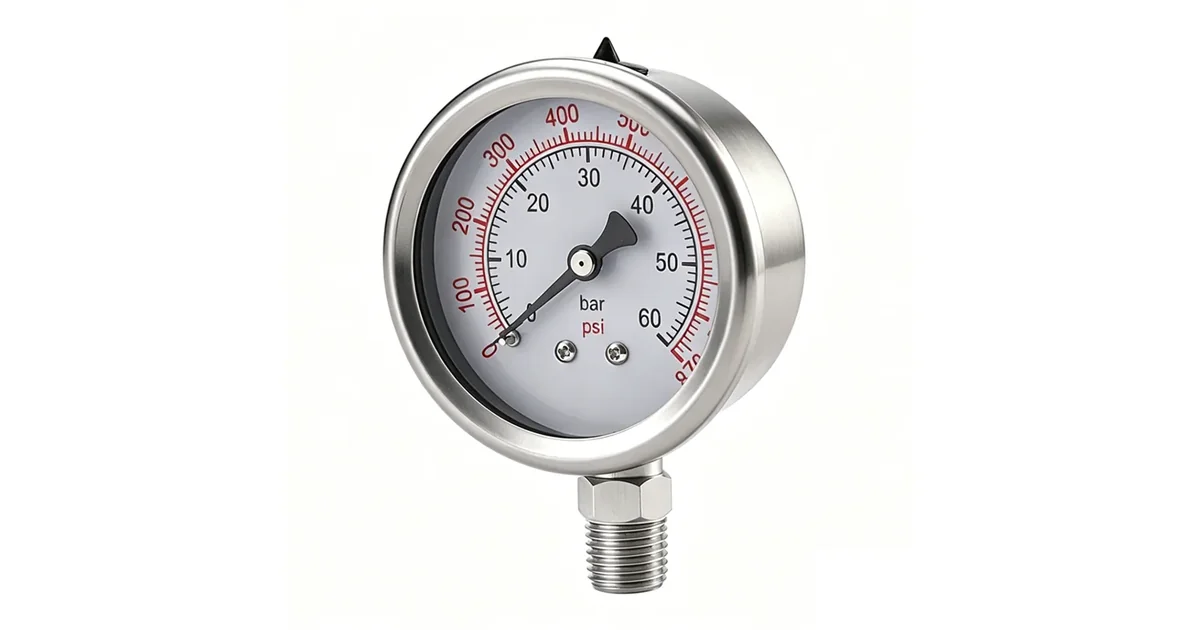
Pressure gauge dial size selection is the process of matching the visible dial diameter to the operator viewing distance, required accuracy, vibration level, mounting space and maintenance task. A larger dial is not automatically better, and a compact dial is not automatically wrong. The right choice makes the pressure reading easy to verify without overstating what the instrument can prove about the process.
What pressure gauge dial size selection means
Pressure gauge dial size selection starts with a practical question: can the person who needs the reading see the pointer, scale marks and units from the real inspection position? The dial size is the nominal case or visible face diameter, commonly expressed in millimeters such as 40, 50, 63, 80, 100 or 150 mm. It is not the pressure range, accuracy class or connection size, although all of those variables affect the final choice.
Manogauge catalog data confirms several real size families: ZX-01 stainless steel pressure gauges cover Ø40-100mm, ZX-08 general pressure gauges cover Ø40-80mm, ZX-06 liquid-filled pressure gauges cover Ø40-100mm, ZX-07 capsule gauges cover Ø60-150mm, and ZX-09 digital pressure gauges cover Ø60-100mm. These ranges should be treated as available product envelopes, not as automatic recommendations for every duty.
For terminology and safety context, ASME describes B40.100 as covering dial and digital pressure indicating gauges, diaphragm seals and gauge attachments. See the official ASME B40.100 pressure gauges and gauge attachments page.
Ver famílias de manômetros →Mais de 143 modelos de manômetros industriais→How viewing distance changes the best dial diameter
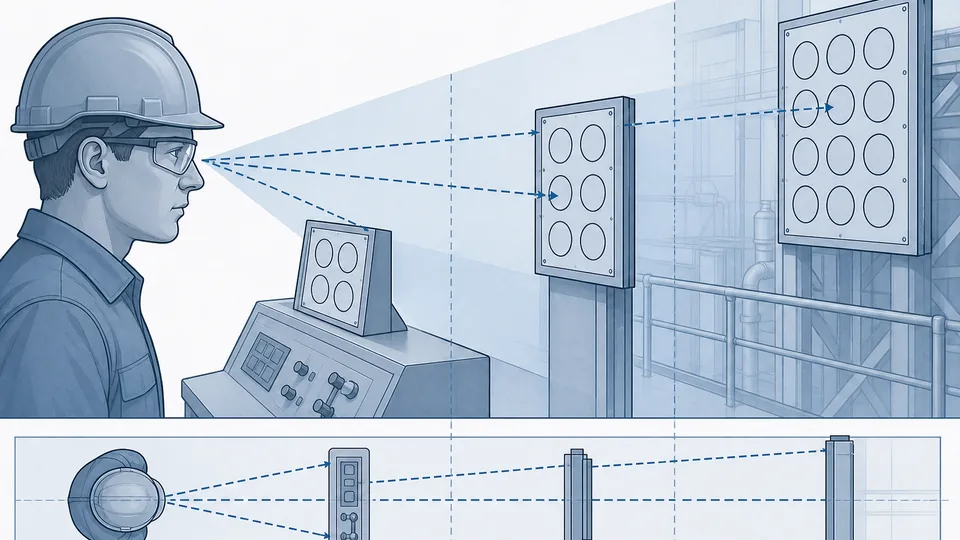
The same gauge can be readable at arm length and hard to use from a walkway. Viewing distance is therefore the first field variable. A compact 40 or 50 mm pressure gauge may be reasonable on a small compressor, test fixture, HVAC manifold or OEM panel where the operator stands close. A 63 or 80 mm dial is often easier for general machine rooms and pump skids. A 100 or 150 mm dial becomes useful when readings are taken from farther away, when the pointer movement is small, or when operators must compare several gauges quickly.
The goal is not to make every gauge large. Oversized gauges can crowd panels, increase impact risk, add weight to small connections and make guards or covers harder to close. Undersized gauges can cause misreading, missed trends and unsafe body position during inspection. A sight-line check from the real walkway or service platform is better than selecting only from a catalog photo.
This is also why pressure gauge dial size selection should be reviewed together with mounting height, lighting, vibration, pointer contrast and the number of scale arcs printed on the dial.
Pressure gauge dial size selection table for common duties
The table below is a selection starting point. It does not replace plant standards, inspection rules or a manufacturer confirmation for high-pressure, corrosive, hygienic or hazardous-area service.
| Typical dial size | Where it is commonly useful | Main caution |
|---|---|---|
| Ø40-50 mm | Compact OEM equipment, small HVAC manifolds, close-range service points | Limited readability from a walkway |
| Ø63 mm | General machine panels and pump packages with close inspection | Confirm scale marks are not crowded |
| Ø80-100 mm | Process skids, utility rooms, larger compressors and hydraulic stations | Check mounting weight and vibration support |
| Ø150 mm | Remote local indication, low-pressure capsule gauges and supervisor walkdown points | Needs enough space and mechanical support |
When pressure changes are small, a larger dial can make pointer movement easier to interpret. When the range is broad and the process normally operates in a narrow band, dial size alone will not solve readability; the selected range must also place the normal value in a useful part of the scale.
Confirmar tamanho do mostrador e faixaNossos engenheiros respondem em 24 horas→Match dial size with range, accuracy class and environment
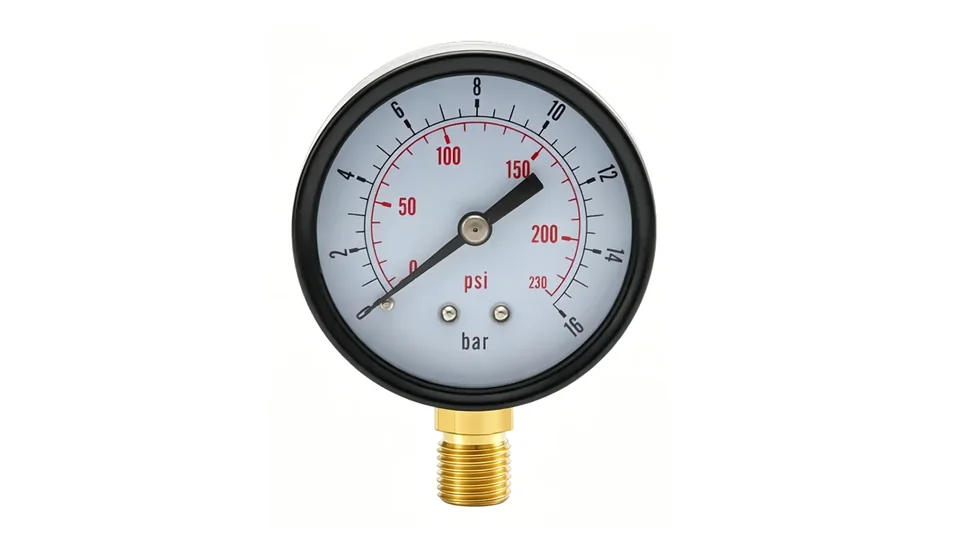
Dial size is only one part of the specification. Range determines where the pointer sits. Accuracy class describes the permitted error, commonly as a percentage of full scale. Case material, window, connection and filling determine whether the gauge survives the environment. A 100 mm dial with the wrong range or wrong wetted material is still the wrong instrument.
For Manogauge product families, the choice may lead to different constructions. ZX-01 stainless steel gauges are relevant when corrosion resistance and 304 or 316L stainless construction matter. ZX-08 general gauges fit simpler dry service where iron or plastic construction is acceptable. ZX-06 liquid-filled gauges are considered when vibration or pulsation makes a dry pointer unstable. ZX-07 capsule gauges serve low-pressure ranges where the larger 60-150 mm dial options can support fine readings. ZX-09 digital gauges may be selected where numerical display and 0.5% accuracy are more important than analog pointer trend.
For material decisions, see 316L stainless steel vs brass pressure gauge wetted parts. For basic range and accuracy checks, see selecting pressure gauge accuracy class.
Common mistakes when choosing a gauge face size
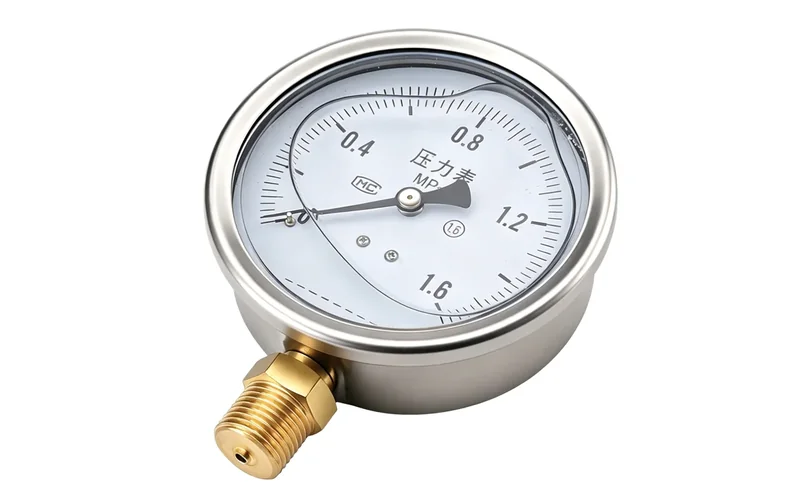
The first mistake is selecting the smallest gauge that physically fits. This can work on a bench but fail in a plant where the reader stands farther away, wears eye protection, or reads through a guard window. The second mistake is selecting the largest dial without checking pipe loading, panel clearance or vibration support. A large gauge on a small unsupported fitting can become a mechanical problem.
The third mistake is confusing dial size with accuracy. A larger dial may make graduations easier to see, but it does not improve the accuracy class by itself. The fourth mistake is adding too many scales or units to a compact dial. Dual units such as bar and psi are useful for export equipment, but crowded markings can reduce practical readability.
A good purchase request should therefore name dial diameter, pressure range, accuracy class, connection thread, mounting style, wetted material, filling requirement and operating environment. Weak RFQs that say only "pressure gauge 10 bar" invite mismatched products.
What the dial size cannot prove
A readable pressure gauge helps operators verify local pressure, but it cannot prove process safety by itself. It cannot confirm media compatibility, relief-device sizing, calibration status, fatigue life, overpressure history or hazardous-area suitability. Those items require engineering review, inspection records and confirmed product documentation.
For difficult duties such as high vibration, corrosive wastewater, steam, oxygen, food processing, hydrogen or explosive atmospheres, pressure gauge dial size selection should come after the process conditions are known. Confirm pressure range, temperature, media, pulsation, mounting position and applicable standards before choosing the final dial diameter.
The practical conclusion is simple: choose the smallest dial that can be read reliably and maintained safely in the real installation, then verify that the selected Manogauge model family supports the required range, material, connection and accuracy class.
Key takeaways
- Dial size is a readability and maintenance decision, not a substitute for correct range, material or accuracy class.
- Use confirmed product families: ZX-01 and ZX-06 cover Ø40-100mm, ZX-08 covers Ø40-80mm, ZX-07 covers Ø60-150mm, and ZX-09 covers Ø60-100mm.
- Avoid AI-generated gauge photos for product visuals; use real product images and only schematic graphics for abstract selection concepts.
Часто задаваемые вопросы
What is pressure gauge dial size selection?
It is the process of matching the gauge face diameter to viewing distance, range, accuracy class, mounting space, vibration and maintenance access.
Is a 100 mm pressure gauge always better than a 63 mm gauge?
No. A 100 mm dial may be easier to read, but it can add weight and space demand. A 63 mm dial may be correct for close inspection points.
Which Manogauge series support larger dial sizes?
Catalog data shows ZX-07 capsule gauges cover Ø60-150mm, while ZX-01, ZX-06 and ZX-09 cover up to Ø100mm depending on model family.
Does dial size improve accuracy class?
No. Dial size improves practical readability, while accuracy class is a separate specification that must be selected and verified.
What should be included in an RFQ for dial size selection?
Specify dial diameter, pressure range, accuracy, connection thread, mounting style, wetted material, filling, vibration level and reading distance.