
CCUS CO2 pipeline pressure monitoring is becoming more important as carbon capture projects move from concept to infrastructure. Pressure data helps operators understand compression, dehydration, transport and injection behavior, but it must be interpreted with temperature, composition, gas detection and pipeline integrity records.
Why CCUS CO2 pipeline pressure monitoring is becoming a practical instrumentation topic
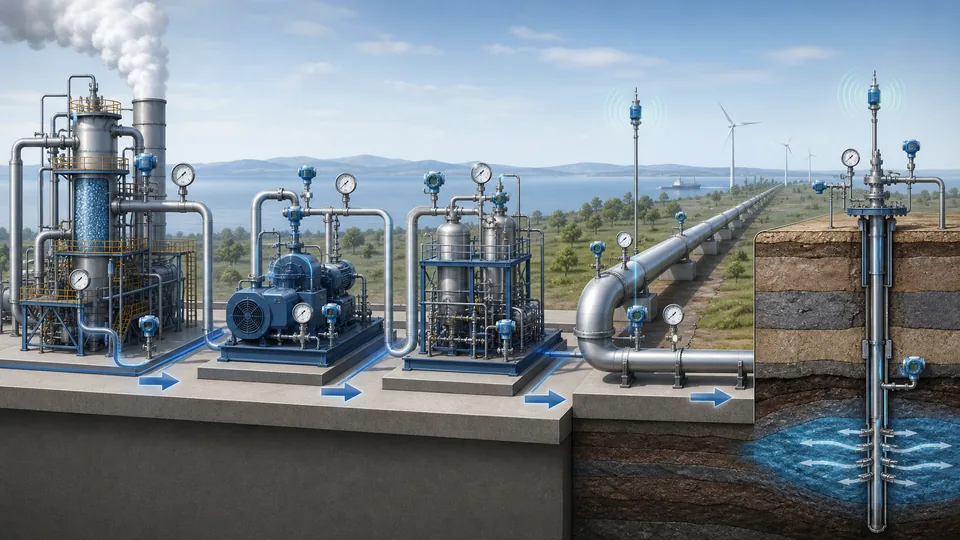
Carbon capture, utilisation and storage (CCUS) is moving from pilot language into larger industrial planning. Public trackers such as the IEA CCUS Projects Explorer and the Global CCS Institute status report show an expanding project pipeline, while 2026 industry events continue to focus on CO2 capture, storage and transport. That makes CCUS CO2 pipeline pressure monitoring a practical engineering topic rather than a distant climate slogan.
In a CCUS chain, captured CO2 is compressed, dried, transported and injected or used. Pressure is not the only variable, but it is one of the quickest ways to see whether compression, valves, filters, pipeline hydraulics and injection conditions are behaving as expected. A pressure gauge, pressure transmitter or differential pressure transmitter cannot prove storage integrity by itself. It can, however, provide local verification, trend data and alarm evidence that helps operators investigate abnormal conditions early.
The main keyword for this article is CCUS CO2 pipeline pressure monitoring. Related terms include CO2 transport pressure gauge, carbon capture pressure transmitter, supercritical CO2 pressure monitoring and pipeline pressure safety.
Review Pressure Gauge Selection Fundamentals →→What pressure data can and cannot tell operators in CO2 transport
CO2 transport is sensitive because carbon dioxide changes physical behavior with pressure and temperature. Dense phase or supercritical CO2 transport may be selected to move large volumes efficiently, but this also means that pressure, temperature and composition must be interpreted together. Water content, impurities and rapid depressurization behavior can affect corrosion risk, hydrate or dry-ice formation, valve response and emergency planning.
Pressure data is useful for identifying compressor trips, unexpected valve closure, blocked filters, pressure drop growth, abnormal injection resistance, suspected leakage and control instability. Differential pressure across filters, dehydration beds or metering elements can warn of fouling or restriction before flow is visibly affected. Local analog gauges give maintenance teams an independent reference during startup, isolation and calibration checks.
Pressure data cannot identify every leak location, cannot replace gas detection, cannot confirm CO2 purity and cannot prove reservoir containment. For high-pressure CO2 service, the final instrument choice must be reviewed against the project design basis, maximum allowable pressure, temperature range, CO2 phase behavior, impurity profile, hazardous area classification and applicable local code.
Where gauges and transmitters fit in a CCUS CO2 pressure monitoring chain
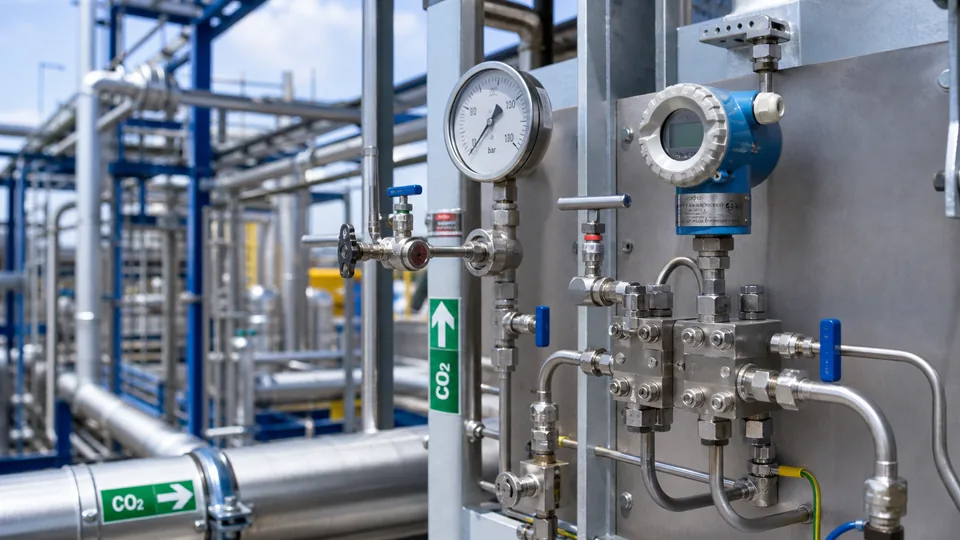
Useful monitoring points are usually selected by process function. Typical locations include compressor discharge, after-cooler outlet, dehydration package inlet and outlet, filter or coalescer differential pressure, custody transfer or metering skid pressure, block valve stations, pipeline low points, injection wellhead pressure and annulus monitoring where required by the storage design.
A mechanical pressure gauge is still valuable where an operator needs an immediate local reading during commissioning or maintenance. A pressure transmitter is better where the value must be trended in a PLC, DCS, SCADA or safety-related alarm system. Differential pressure transmitters are common across filters, dryers and flow elements. For fundamentals that apply beyond CCUS, see the Manogauge industrial pressure gauge selection guide and differential pressure gauge selection guide.
The instrument location matters as much as the model. Impulse lines should avoid liquid traps unless the design intentionally uses them, isolation valves should allow calibration without unsafe venting, and vents or drains must be handled according to the plant CO2 release procedure. Remote mounting can reduce vibration and temperature exposure, but it also adds response lag and more fittings that must be leak-checked.
Confirm CO2 Pressure Instrument Requirementsエンジニアが24時間以内に返答→Selection variables for CO2 transport pressure gauges and transmitters
Instrument selection should start with the operating envelope, not with a catalog picture. Confirm normal pressure, startup pressure, shutdown pressure, relief set points, maximum allowable working pressure, temperature range, CO2 phase, water content and expected impurities. Then evaluate materials, connection type and accuracy.
<div style="overflow-x: auto;"><table width="100%"><thead><tr><th>Selection variable</th><th>Why it matters in CO2 service</th><th>Practical check</th></tr></thead><tbody><tr><td>Range</td><td>Normal readings should sit in a readable part of scale</td><td>Compare normal, upset and relief conditions before choosing full scale</td></tr><tr><td>Wetted materials</td><td>CO2 with water or impurities can change corrosion risk</td><td>Confirm stainless steel grade, seals and gasket compatibility with the process specification</td></tr><tr><td>Connection</td><td>High-pressure service needs robust sealing</td><td>Match NPT, G, BSP, flange or compression fitting rules to site piping standards</td></tr><tr><td>Output signal</td><td>Alarms and trending need electronic data</td><td>Select transmitter output, protocol and hazardous-area approval only from confirmed project requirements</td></tr><tr><td>Installation</td><td>Poor mounting can create false readings or maintenance risk</td><td>Review isolation, venting, calibration access and vibration exposure</td></tr></tbody></table></div>
Never treat a general-purpose pressure gauge as suitable just because the pressure range matches. The manufacturer or project engineer must confirm CO2 compatibility, seal material, overpressure limit, enclosure rating and any required documentation for the installation country.
Alarm design, maintenance and risk boundaries
A good pressure alarm is tied to operating context. Compressor startup, valve sequencing, injection rate changes and planned maintenance can all create pressure changes that are normal for a short time. A useful alarm strategy separates warning, trip and investigation states, and it correlates pressure with temperature, flow, valve position, gas detection and compressor status.
Maintenance should include zero checks, calibration intervals, leak checks on impulse tubing, inspection of gauge windows and pointer stability, and verification that isolation valves return to their correct operating position. Mechanical gauges near vibration sources may need liquid filling, a snubber or remote mounting. Transmitters may need manifold checks, loop verification and comparison against a trusted reference gauge.
The strongest use of CCUS CO2 pipeline pressure monitoring is as part of a layered operating record. It supports safer troubleshooting and better uptime, but it does not replace pipeline integrity management, corrosion control, emergency response planning, gas detection, reservoir monitoring or engineering review. For installation basics that still apply, compare the pressure gauge installation best practices article before specifying field hardware.
Key takeaways
- Pressure, temperature, CO2 composition and flow context must be read together.
- Local gauges help field verification; transmitters provide alarms and trends.
- CO2 compatibility, pressure rating, sealing and installation details require project confirmation.
Related products
- Isolating-Diaphragm Gauge - Radial Type 1 (ZX-04-R1) — 0–60 MPa
- Stainless Steel Pressure Gauge - Radial (ZX-01-R) — 0–100 MPa
Часто задаваемые вопросы
What is CCUS CO2 pipeline pressure monitoring?
It is the use of pressure gauges, pressure transmitters and differential pressure instruments to observe CO2 compression, dehydration, pipeline transport and injection conditions in a carbon capture chain.
Can a pressure gauge prove that a CO2 pipeline is safe?
No. A gauge supports local verification, but pipeline safety also requires design review, integrity management, corrosion control, gas detection, emergency procedures and code compliance.
Where are pressure instruments usually installed in CCUS transport?
Common points include compressor discharge, dehydration skids, filter DP points, metering skids, block valve stations, pipeline low points and injection wellheads.
What materials should be checked for CO2 pressure instruments?
Confirm wetted metal, seals, gaskets, window, case and connection materials against dry or wet CO2, impurities, pressure, temperature and site standards.
Why use both gauges and transmitters?
A local gauge gives field crews an immediate reference, while transmitters provide continuous trends, alarms and integration with PLC, DCS or SCADA systems.