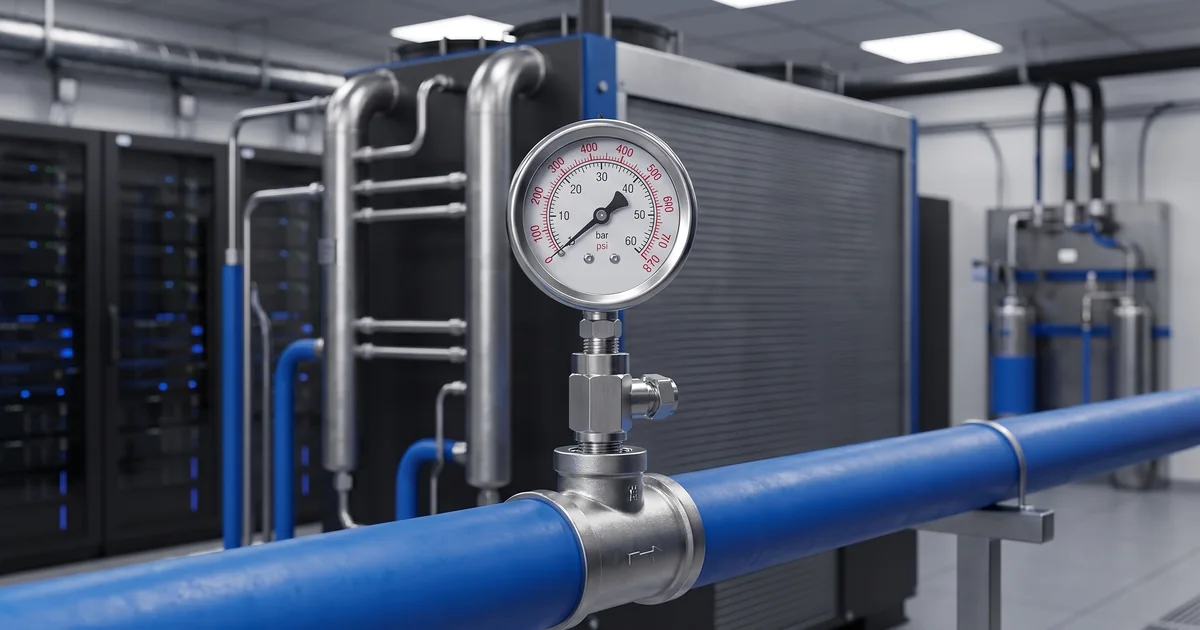
AI data center liquid cooling pressure monitoring has become a practical requirement as GPU clusters push rack power density beyond what traditional air cooling can handle. In direct-to-chip and CDU-based loops, pressure is not just a number on a dial: it confirms pump discharge, supply and return stability, rack manifold balance, filter loading, and early leak symptoms. This guide explains where mechanical pressure gauges, differential pressure gauges, and pressure transmitters fit in high-density AI cooling loops, and how buyers can specify suitable wetted materials, ranges, connections, and documentation when sourcing from a China pressure gauge manufacturer such as Manogauge.
Why AI Data Center Liquid Cooling Pressure Monitoring Matters Now
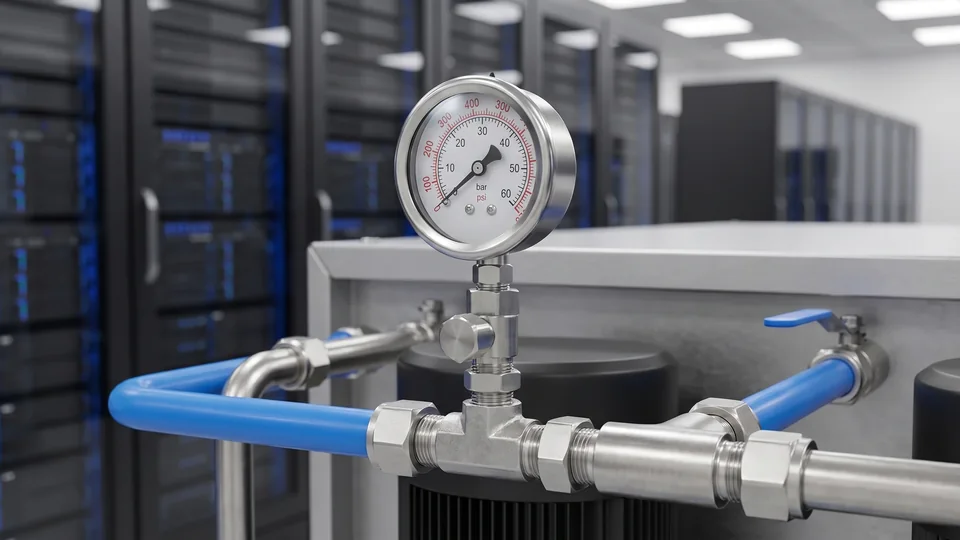
AI training clusters and inference racks are pushing power density higher, so many facilities are moving from air cooling to direct-to-chip liquid cooling, rear-door heat exchangers, immersion cooling, or hybrid systems. In these architectures, the coolant distribution unit (CDU) becomes part of the reliability chain. Stable pressure helps verify that pumps are delivering flow, cold plates are not starved, and rack manifolds are balanced. A local pressure gauge near a CDU or manifold gives maintenance teams a fast visual check, while a pressure transmitter feeds continuous data to BMS, DCIM, or PLC systems for alarms and trend analysis. For exporters and procurement teams, this is also a specification issue: the instrument must match coolant chemistry, operating range, connection thread, mounting position, and documentation requirements before it is approved for a data center project.
For current data-center thermal guidance, consult the ASHRAE Datacom Series.
Browse Our Pressure Gauge Catalog ->Explore 143+ industrial gauge models→Where Pressure Gauges Fit in CDU, Pump, and Rack Manifold Loops
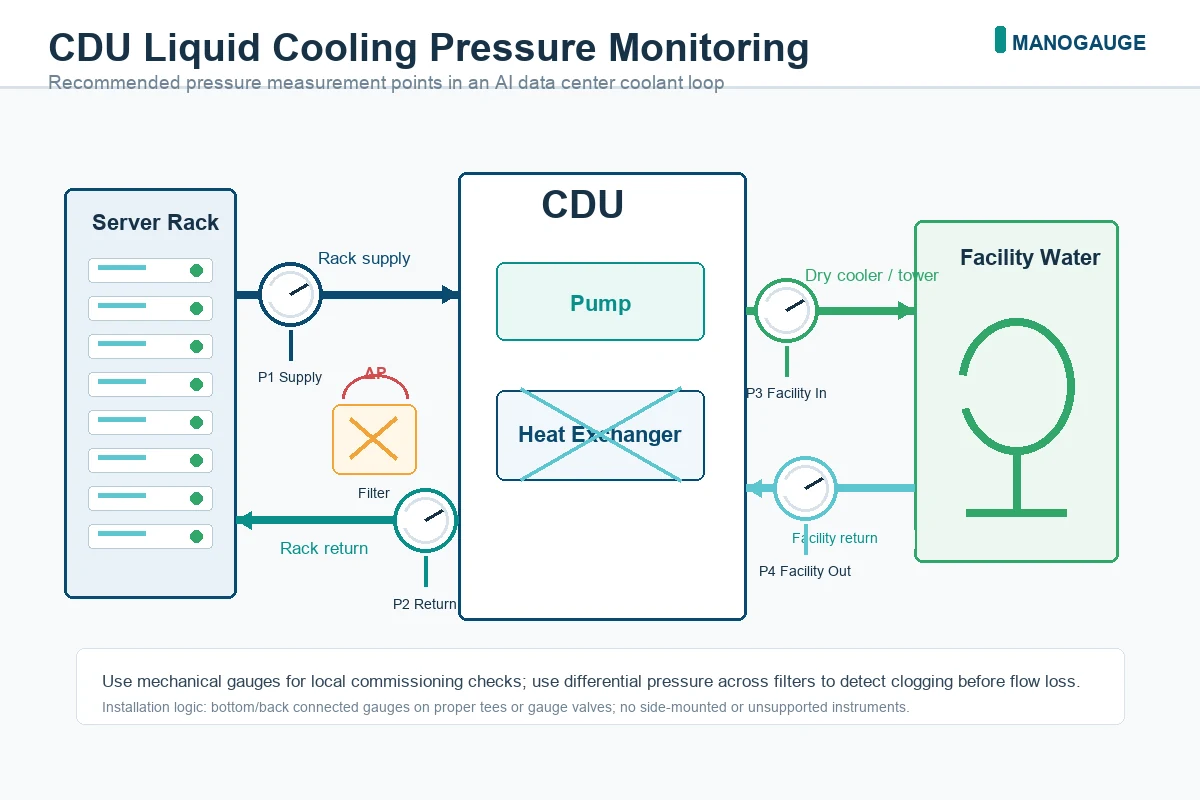
Pressure measurement should be planned around the hydraulic behavior of the liquid cooling loop. CDU supply pressure confirms whether the pump is delivering sufficient head to the rack row. Return pressure helps identify abnormal backpressure or restrictions. Pump discharge gauges are useful during commissioning because they can show cavitation symptoms, blocked valves, or unexpected pressure drop before the electronic system is fully tuned. Rack inlet and outlet manifold points help technicians compare zones and verify whether a specific GPU rack is receiving stable flow. For critical loops, a mechanical gauge and a transmitter are often used together: the gauge supports local inspection, while the transmitter records alarms and historical data.
Filter DP points should be specified with the differential pressure gauge selection guide.
Selecting Coolant Pressure Gauges and Transmitters for AI Data Centers
Instrument selection starts with the coolant. Many data center loops use water-glycol mixtures, but some designs use dielectric fluids or proprietary additives. Wetted parts, seals, and process connections must be confirmed against that exact fluid. Stainless steel wetted parts are often preferred for corrosion resistance, but the final choice should be checked against the coolant supplier and the instrument manufacturer. Buyers should define normal operating pressure, maximum pressure, expected temperature, vibration, accuracy class, dial size, output signal, thread type, and whether calibration records are needed. As a China pressure gauge manufacturer, Manogauge can support mechanical gauges, digital gauges, and pressure-instrument selection discussions, but final specifications must be confirmed against the project’s actual CDU and rack-loop design. For cross-border sourcing, ask for a written confirmation of wetted material, dial marking, pressure range, thread standard, inspection method, and packing method before approving mass production. This helps avoid a common mismatch where the gauge appears suitable in a catalog photo but the connection, seal, or pressure range does not match the CDU manifold.
Coolant compatibility depends on wetted material; compare 316L stainless steel vs. brass wetted parts compatibility.
Request a Free QuoteOur engineers respond within 24 hours→Using Differential Pressure to Detect Filter Loading and Flow Restriction
Differential pressure monitoring is one of the most useful maintenance signals in a liquid cooling system. A filter may look normal from the outside while debris gradually increases pressure drop across the element. A differential pressure gauge or transmitter across the filter gives operators a measurable trigger for cleaning or replacement. The same method can be applied across heat exchangers, coolant strainers, or selected manifold sections to detect fouling and flow restriction. For AI data centers, this matters because poor coolant distribution can quickly turn into thermal throttling, equipment shutdown, or unplanned service windows.
Facility teams can map these locations against BICSI 002 data center design practices.
RFQ Checklist for Global Buyers Sourcing Data Center Cooling Instruments
Before issuing an RFQ for AI data center liquid cooling pressure monitoring, buyers should provide the coolant type, pressure range, maximum temperature, connection thread, required dial diameter, installation position, ingress protection needs, output signal, alarm requirements, and quantity. If the project requires export packing, private label, calibration documentation, sample approval, or staged delivery, these should be stated early. Avoid selecting a gauge only by appearance; the same dial style can be unsuitable if the wetted material, seal, pressure range, or thread is wrong. For high-density data center projects, the safest workflow is to send the CDU or piping drawing, confirm the instrument specification with the manufacturer, test samples where possible, and then approve production. Buyers serving North America, Europe, Southeast Asia, or the Middle East should also clarify label language, carton marks, spare quantity, and whether the shipment is for pilot installation or long-term maintenance stock. These details improve RFQ accuracy and make the page useful for both search engines and AI answer engines looking for concrete procurement criteria.
Commissioning and service checks should follow pressure gauge installation best practices.
Key takeaways
- AI data center liquid cooling pressure monitoring should cover CDU supply/return, pump discharge, rack manifolds, filters, and heat exchangers.
- Mechanical gauges give local commissioning visibility, while transmitters provide BMS/DCIM alarms and trend data.
- For water-glycol or dielectric coolant loops, confirm wetted material compatibility, seal choice, pressure range, and connection thread before ordering.
- Differential pressure across filters and heat exchangers turns pressure data into a maintenance trigger for clogging, fouling, or flow restriction.
- International buyers should request factory-confirmed specifications, drawings, calibration options, packaging, MOQ, and lead time before approving bulk orders.
Related products
- Liquid-Filled Pressure Gauge - Radial (ZX-06-R) — 0–60 MPa
- Stainless Steel Pressure Gauge - Radial (ZX-01-R) — 0–100 MPa
Frequently asked questions
What is AI data center liquid cooling pressure monitoring?
AI data center liquid cooling pressure monitoring means measuring pressure at CDU supply and return lines, pump discharge, rack manifolds, filters, and heat exchangers so operators can verify flow stability, detect restrictions, and respond to leak or pump problems before they affect GPU cooling.
Where should a coolant pressure gauge be installed in a CDU loop?
Common locations include CDU supply and return headers, pump discharge, rack inlet/outlet manifolds, and service points near filters or heat exchangers. The final location should follow the CDU piping drawing and the data center maintenance workflow.
Should a data center use mechanical gauges or pressure transmitters?
Both are useful. Mechanical gauges provide local visual confirmation during commissioning and maintenance, while pressure transmitters send continuous data to BMS, DCIM, PLC, or alarm systems. Critical loops often use both.
Which wetted material is suitable for liquid cooling pressure instruments?
The correct wetted material depends on the coolant. Stainless steel is commonly selected for corrosion resistance in water-glycol systems, but compatibility must be confirmed with the coolant supplier and instrument manufacturer, including seals and thread materials.
What should overseas buyers include in an RFQ for cooling-loop gauges?
Include coolant type, pressure range, maximum temperature, connection thread, dial size, accuracy, output signal if needed, installation drawings, calibration or documentation needs, quantity, packaging, branding requirements, and target delivery schedule.