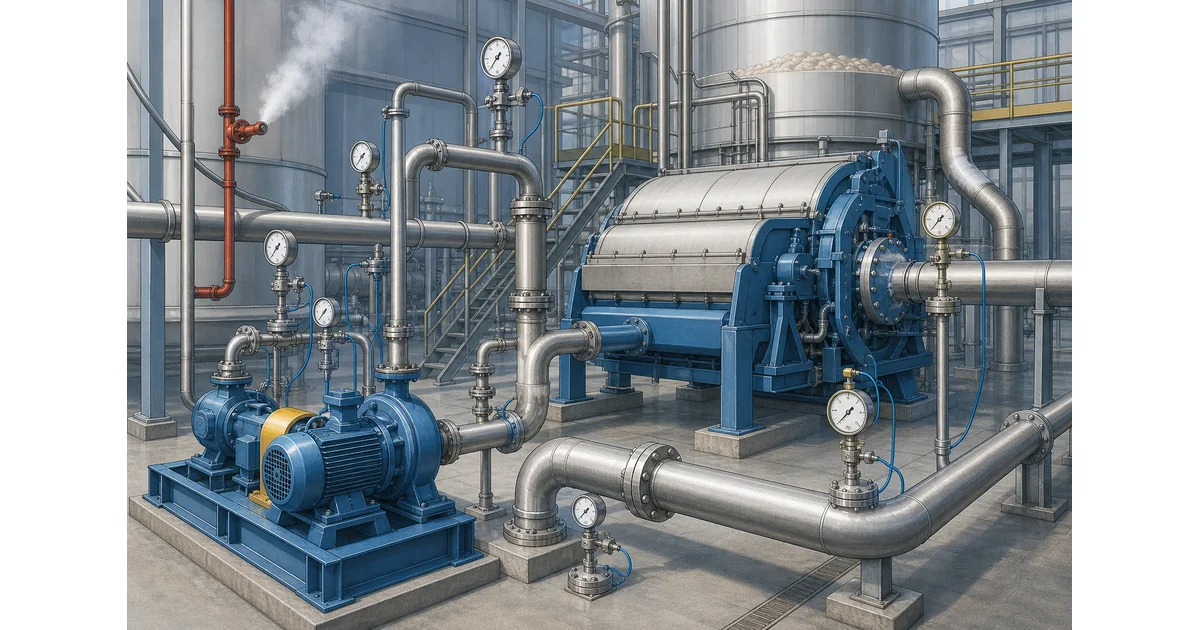
Pulp and paper pressure gauge selection means choosing local pressure instruments for stock preparation, pulp screening, paper machine approach flow, steam dryers, coating kitchens and chemical dosing systems. In a mill, the pressure value is rarely a simple utility number. It can reveal pump loading, screen plugging, steam header stability, coating filter restriction or a closed valve before product quality and uptime are affected.
What pulp and paper pressure gauge selection has to prove
Pulp and paper pressure gauge selection starts with the medium and the diagnostic purpose. Pulp stock is a fibre slurry, coating colour can be abrasive or viscous, steam carries temperature risk, and chemical lines may contain caustic, acid, bleach, starch, dye or retention aid. A gauge that works on clean water may plug, corrode or read slowly when installed on these services.
Industry application notes for paper production commonly describe severe media such as abrasive sludge, chemicals and high temperature. VEGA, for example, lists pulp digesters, pulpers and coating processes as pressure measurement applications in the paper industry; see its paper industry instrumentation overview. The useful buyer question is therefore not “what pressure range is printed on the dial?” but “what failure mode should this point reveal?”
For a paper mill pressure gauge, final specification should be confirmed against the mill piping class, process medium, cleaning practice and safety rules. Local indication helps operators, but it does not replace flow, consistency, level, temperature or quality measurements.
Ver manómetros con sello de diafragma ->Más de 143 modelos de manómetros industriales→Measurement points across stock preparation, screens and steam
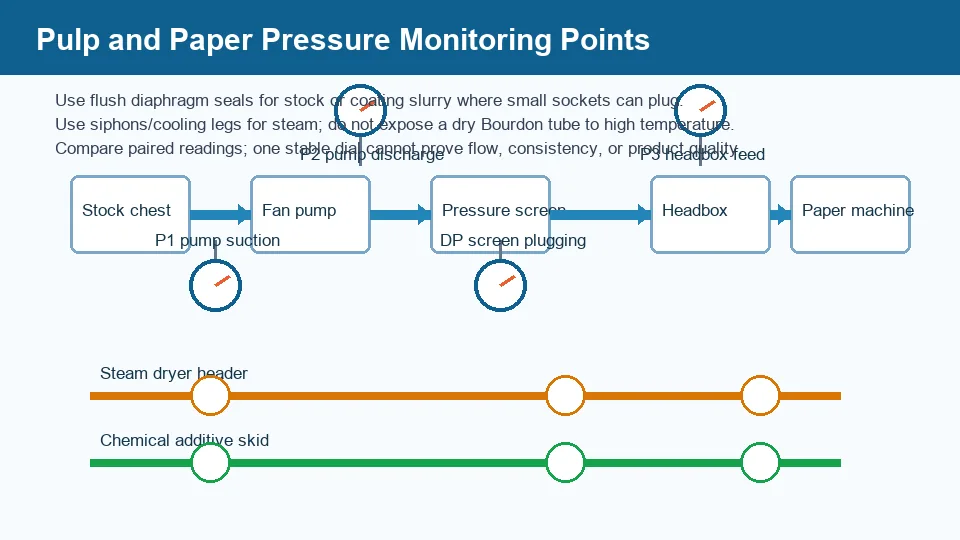
Stock preparation and approach-flow systems often need paired pressure readings. A pump suction gauge helps identify starvation or a blocked chest outlet. A pump discharge gauge shows pump loading. A pressure difference across a screen, strainer or filter can indicate plugging before flow falls enough to disturb the paper machine.
| Mill area | Typical pressure question | Instrument concern |
|---|---|---|
| Stock chest and fan pump | Is suction stable and is pump discharge normal? | Vibration, fibre build-up, readable range |
| Pressure screen | Is the basket plugging or rejects load rising? | Paired gauges or DP method, cleanable taps |
| Headbox approach line | Is the feed pressure stable enough for process control? | Do not confuse local indication with control signal quality |
| Steam dryer header | Is steam pressure available and safely reduced? | Siphon or cooling leg, temperature rating |
| Coating or starch kitchen | Is a filter, nozzle or feed line restricting? | Viscosity, abrasion, diaphragm seal need |
A single stable pointer cannot prove flow through a screen or uniform sheet quality. Use the gauge reading with pump amps, valve position, consistency data, flowmeter readings and operator inspection.
Diaphragm seal pressure gauge choices for pulp slurry
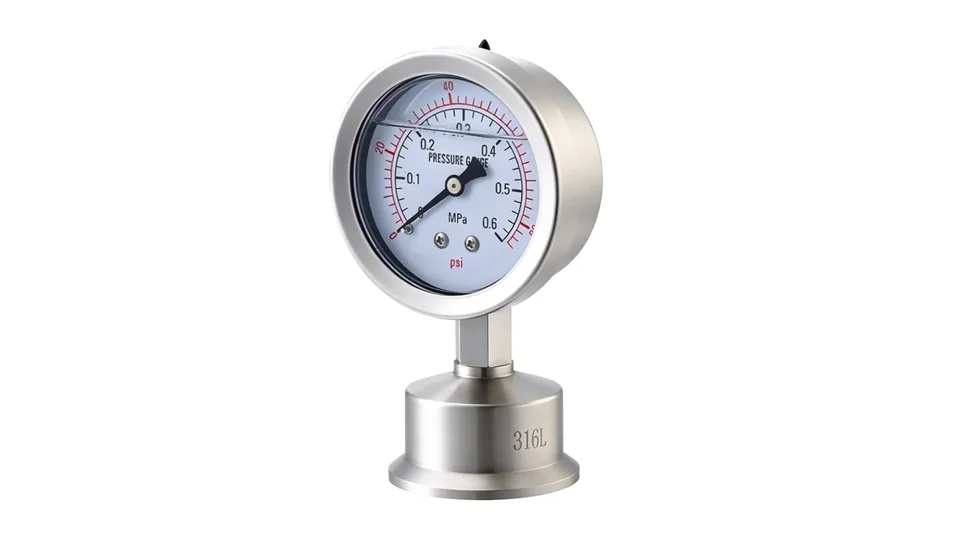
A diaphragm seal pressure gauge uses a flexible diaphragm and fill fluid to keep the process medium out of the Bourdon tube or sensing element. In pulp slurry pressure monitoring, that separation can be important because fibres, fillers, coating solids or scale can pack into a small gauge socket and isolate the instrument from real process pressure.
Use a flush or extended diaphragm arrangement where the line contains fibres, coating colour, sludge, black liquor residue or crystallizing chemical. The diaphragm material, gasket, fill fluid and connection geometry must be checked against temperature, cleaning chemicals and abrasion. A seal is not a cure for every installation problem: it can add temperature limits, slower response and maintenance needs.
For Manogauge product families, compare isolating diaphragm gauges for dirty or corrosive services and stainless steel pressure gauges for cleaner water, air or utility positions. Catalog data lists isolating diaphragm gauge range options up to 0-60 MPa, Ø40-100 mm dial sizes, ±1.6% accuracy and flange or threaded connections; confirm the exact model before ordering.
Preparar RFQ de manómetros para papel ->Nuestros ingenieros responden en 24 horas→Range, materials and accessories for a paper mill pressure gauge
Range selection should keep normal operating pressure in the readable middle part of the dial while allowing for pump shutoff pressure, relief settings, steam reduction pressure and cleaning cycles. For pulsating pump discharge, vibration from stock pumps or pressure swings around screens, consider liquid filling, remote mounting, a damped line or a snubber only when clogging risk has been reviewed.
Wetted material selection depends on actual service. 316L stainless steel can be a good starting point for many water and utility points, but it should not be assumed compatible with bleach chemicals, high-chloride water, black liquor, acidic cleaning, caustic service or coating additives. For steam, a siphon or cooling leg protects the gauge from direct high temperature, but the arrangement must be installed so condensate protection actually works.
Thread and mounting details matter in maintenance-heavy mills. Specify NPT, BSP, G or metric thread exactly, define bottom or back connection, and keep the gauge visible from the operator side. The pressure gauge thread connection guide explains why near-fit thread families are a sealing risk, especially around chemical and steam systems.
What the gauge cannot prove in pulp and paper service
A pressure gauge is local evidence, not a full process analyzer. It cannot prove fibre consistency, coating solids, steam dryness, chemical concentration, paper basis weight, product moisture or final sheet quality. It can also hide a problem if the process tap is plugged, the isolation valve is closed, the snubber is clogged, or the diaphragm seal has lost fill fluid.
For critical safety or quality control, use the gauge as one field signal within a documented measurement strategy. A high-pressure steam line, corrosive chemical, black liquor service or rotating-machine location needs engineering review before selecting accessories. Do not invent certificates or safety claims from a catalog image; request drawings, material statements and calibration documents where the project requires them.
Manogauge is a Zhejiang, China manufacturer operating under ISO 9001 quality management with export experience, but the installed specification still belongs to the mill engineer or system integrator because pulp and paper pressure gauge selection depends on real media, piping class and site maintenance practice.
RFQ checklist for pulp and paper pressure gauge selection
A useful RFQ for pulp and paper pressure gauge selection should describe each measurement point before asking for a price. State whether the gauge is for stock slurry, white water, steam, condensate, coating colour, starch, caustic, acid, bleach chemical, compressed air or hydraulic service.
- Provide normal pressure, maximum pressure, pump shutoff pressure, relief setting and test pressure where available.
- State medium, temperature, solids or fibre content, viscosity, cleaning chemicals and whether the tap may plug.
- Specify dial size, accuracy class, case material, wetted material, process connection, mounting orientation and visibility requirement.
- Confirm whether a diaphragm seal, siphon, cooling leg, isolation valve, remote line, snubber or liquid-filled case is allowed.
- Ask the supplier to state what the selected gauge cannot prove without flow, consistency, temperature or quality data.
With those inputs, a supplier can recommend a maintainable paper mill pressure gauge instead of guessing from pipe size alone.
Key takeaways
- Define the medium first: pulp slurry, coating colour, steam and chemicals create different gauge risks.
- Use diaphragm seals where fibres, solids or corrosive liquids can plug or damage a small socket.
- A local pressure gauge supports troubleshooting but cannot prove flow, consistency or final paper quality.
Часто задаваемые вопросы
q
a
q
a
q
a
q
a