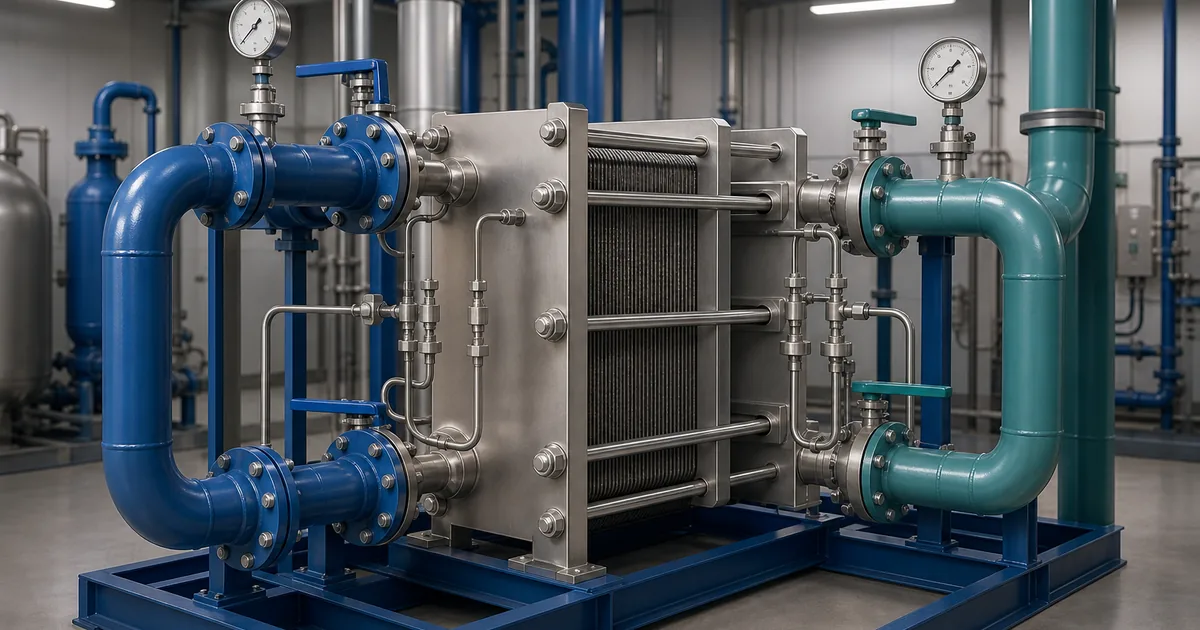
Plakalı eşanjör diferansiyel basınç izleme, giriş ve çıkış basıncını karşılaştırarak akış kısıtını görmektir.
1. What plate heat exchanger differential pressure monitoring actually tells you
Plate heat exchanger differential pressure monitoring compares pressure upstream and downstream of a plate heat exchanger. The difference is pressure drop, often written as ΔP. In clean operation, ΔP mainly reflects flow rate, plate pattern, channel geometry, fluid viscosity, strainers and valve position. When the same flow produces a higher ΔP than the clean baseline, the operator should suspect fouling, plugging, air binding, valve restriction or a pump-control change.
External heat-transfer references support this practical view. Alfa Laval explains that pressure drop is part of gasketed plate heat exchanger design economics, because a very low design pressure drop can increase heat exchanger size while a higher pressure drop affects pumping cost. The Heat Exchange Institute also notes that plugging can raise pressure drop and should be considered separately from heat-transfer fouling. See the Alfa Laval pressure drop paper and the HEI plate heat exchanger fouling tech sheet for context.
The main keyword for this article is plate heat exchanger differential pressure monitoring. Related terms include plate heat exchanger pressure drop, heat exchanger fouling pressure gauge, differential pressure gauge for heat exchanger and pressure transmitter for heat exchanger maintenance.
Paslanmaz Manometreleri İncele ->143'ten fazla endüstriyel manometre modeli→2. Where to install gauges, transmitters and tapping points
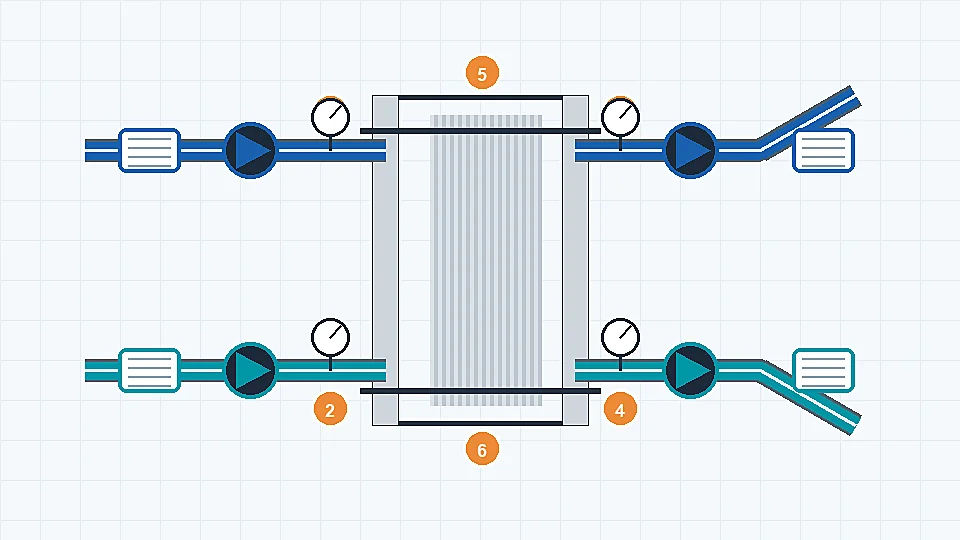
A useful measurement starts with two clean, comparable pressure points: one on the inlet side and one on the outlet side of the same fluid circuit. Do not compare the hot side inlet with the cold side outlet. For a plate heat exchanger, the usual choices are local pressure gauges on isolation/gauge valves, a differential pressure gauge with two impulse lines, or two pressure transmitters whose signals are subtracted in the controller.
Install points where readings are not dominated by a nearby elbow, throttling valve or pump discharge turbulence. Include isolation valves for maintenance, drain/vent points where air can be trapped, and enough straight pipe or stable manifold volume when the process allows it. For dirty water, glycol, food cleaning fluids or chemicals, confirm whether impulse lines may plug and whether diaphragm seals are needed.
For adjacent instrumentation examples, compare this topic with chilled water differential pressure monitoring and pressure transmitter vs pressure gauge selection. Those articles cover loop control and local-versus-remote reading decisions that also apply to heat exchanger skids.
3. Selecting range for plate heat exchanger pressure drop
The range should come from the clean design pressure drop, maximum allowable pressure drop, pump curve, relief settings and expected operating flow. A gauge that is too wide may hide a slow fouling trend. A gauge that is too narrow may peg during start-up, backflush or abnormal valve positions. As a practical starting point, keep normal operating pressure in the middle part of the scale where the pointer or transmitter resolution is useful, then verify against the site maximum.
For two local gauges, select each gauge by the actual line pressure, not only by ΔP. For example, a system may have 6 bar inlet pressure and 5.4 bar outlet pressure, so ΔP is only 0.6 bar, but each gauge still needs a line-pressure range suitable for the pipe. For a true differential pressure gauge or transmitter, select the differential range and also verify the static pressure rating of both ports.
Manogauge can supply local mechanical pressure gauges for skid verification, while the final specification should identify whether the plant needs local indication, a 4-20 mA pressure transmitter, a differential pressure transmitter, or a combination.
Eşanjör Manometre RFQ Hazırla ->Mühendislerimiz 24 saat içinde yanıtlar→4. Material, connection and protection choices
Material choice depends on the measured fluid, not on the words “heat exchanger” alone. Chilled water and glycol systems often use stainless steel or copper-alloy wetted parts depending on water treatment and project standards. Brine, chemical cleaning fluids, caustic, acids, food CIP solutions and seawater circuits may require stainless steel wetted parts, diaphragm seals or other compatible materials. If the fluid can crystallize or carry solids, a small impulse line may become the weak point.
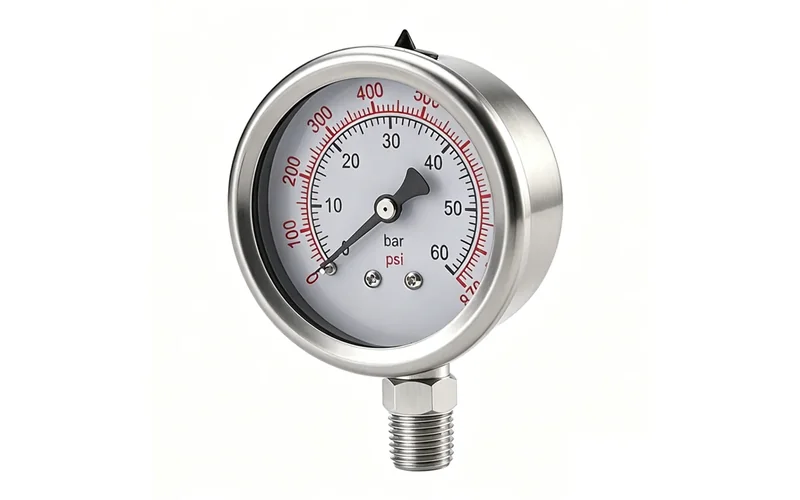
Connections should match the skid drawing: NPT, BSP, G thread, metric thread, flange or sanitary connection where required. Use a siphon only for steam or very hot service where the gauge must be protected from temperature. Use snubbers or pulsation dampers if a pump creates pointer vibration. For product options, review the stainless steel pressure gauge and diaphragm pressure gauge pages before preparing a heat exchanger RFQ.
5. What differential pressure cannot prove by itself

Differential pressure is a restriction signal, not a complete heat-transfer performance test. A rising ΔP can indicate fouling or plugging, but it can also come from higher flow, colder and more viscous fluid, a partly closed valve, trapped air, a blocked strainer upstream, or a pump-control change. A stable ΔP does not prove the plates are clean; some fouling reduces heat transfer before it creates a large pressure drop.
For that reason, compare ΔP with flow rate, inlet/outlet temperatures, valve position, pump speed, strainer status and water-quality records. Cleaning decisions should be based on the exchanger baseline, the plant energy cost, production risk and the manufacturer’s allowable pressure drop, not on a single gauge reading.
6. RFQ checklist for a heat exchanger pressure gauge or transmitter
Before ordering, prepare the following data: fluid name and concentration, normal and maximum line pressure, expected clean ΔP, alarm or cleaning threshold, operating temperature, connection size and thread, wetted material, accuracy requirement, vibration level, indoor/outdoor location, need for diaphragm seals, and whether the reading must be local, remote or both.
For high temperature, corrosive fluids, food or pharmaceutical cleaning cycles, and pressure equipment under formal inspection rules, the instrument selection must be confirmed by the skid builder or project engineer. Plate heat exchanger differential pressure monitoring is valuable because it turns a hidden flow restriction into a visible maintenance trend, but the final gauge range and material must match the real site conditions.
Key takeaways
- Plate heat exchanger differential pressure monitoring compares two points on the same fluid circuit, not two different sides of the exchanger.
- Rising ΔP can indicate fouling or plugging, but it must be checked against flow, temperature, valve position and pump speed.
- Gauge range, static pressure rating, wetted material, connection and impulse-line plugging risk should be specified before RFQ.
Часто задаваемые вопросы
What is a normal pressure drop across a plate heat exchanger?
There is no universal normal value. Use the heat exchanger design sheet, clean commissioning data, flow rate and fluid temperature. A normal value for one exchanger may be too high or too low for another plate pattern or flow rate.
Can two pressure gauges replace a differential pressure transmitter?
Two gauges can support local maintenance checks if technicians read them at the same operating condition. A differential pressure transmitter is better for alarms, trend logging and automatic cleaning decisions.
Does high differential pressure always mean fouling?
No. High ΔP can also come from high flow, cold viscous fluid, a partly closed valve, trapped air, a dirty upstream strainer or pump control changes. Confirm with flow and temperature data.
What materials are best for heat exchanger pressure gauges?
Match the wetted material to the fluid. Stainless steel is often conservative for treated water, glycol, outdoor skids and washdown areas, but chemicals, brine, seawater or CIP fluids may need diaphragm seals or special materials.
Where should pressure taps be placed on a plate heat exchanger?
Place taps on the inlet and outlet of the same circuit, far enough from severe turbulence when possible, with isolation valves and service access. Follow the skid builder’s drawing when provided.