
Battery dry room differential pressure monitoring is a practical way to protect lithium-ion cell assembly from moisture ingress. Dew point control remains the primary quality variable, but pressure cascade data helps show whether dry air, airlocks, doors and adjacent corridors are behaving as designed.
1. Battery dry room differential pressure monitoring starts with moisture risk
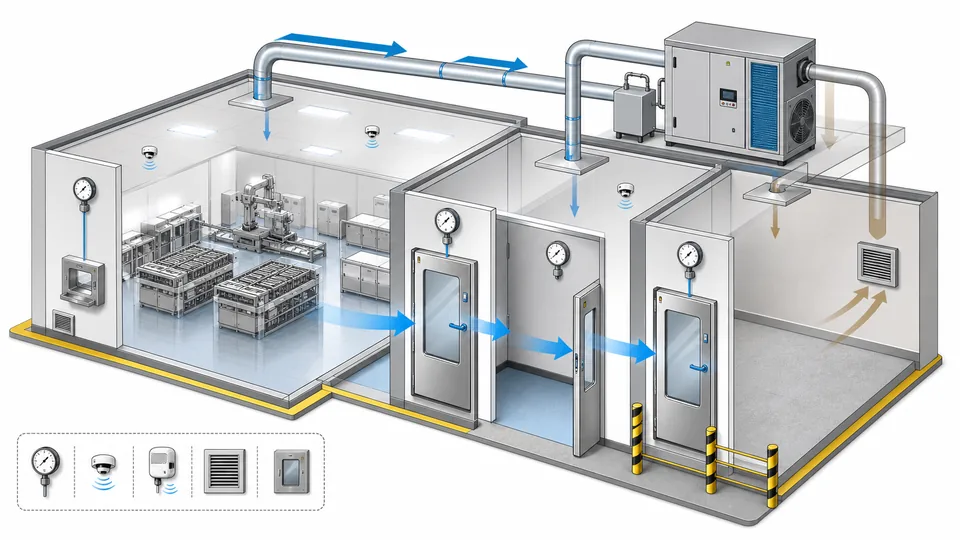
Lithium-ion cell assembly is sensitive to moisture because water can react with cell materials, reduce product performance and create quality variation. A battery dry room is therefore designed around very low dew point air, controlled leakage, airlocks and disciplined door behavior. Battery dry room differential pressure monitoring does not measure moisture directly. It measures whether the room is likely to resist moisture ingress from less dry adjacent spaces.
External dry-room references describe typical lithium-ion battery assembly dew points around -35 °C to -45 °C, with some next-generation chemistries moving lower. Vaisala also notes that battery dry rooms and dehumidifier units need real-time dew point measurement because manufacturing areas can be large and energy-intensive. Useful external context: AFRY on clean and dry room atmosphere requirements, Vaisala battery manufacturing measurement, and the Argonne publication page for Study of a Dry Room in a Battery Manufacturing Plant using a Process Model.
The primary keyword for this article is battery dry room differential pressure monitoring. Related search terms include dry room pressure cascade, lithium battery dry room instrumentation, low differential pressure gauge, dry room dew point monitoring and battery manufacturing pressure transmitter.
Diferansiyel basınç göstergesi seçimini karşılaştırın ->Use range, accuracy and installation position to avoid false dry-room pressure readings.→2. What a pressure cascade can and cannot prove
A pressure cascade means arranging connected spaces so air tends to move from the cleaner or drier zone toward the less critical zone. In a battery plant, the dry room is often kept slightly positive to the airlock, and the airlock is managed relative to a corridor or gowning area. The exact values must come from the HVAC and process design, not from a generic blog article.
Pressure cascade data can show door-open disturbances, fan or damper problems, blocked filters, unbalanced exhaust, failed seals, airlock misuse or dehumidifier airflow changes. It cannot prove the dry room has the correct dew point, cannot prove battery cell quality, and cannot replace particle, dew point, temperature, ESD or process audits. Treat differential pressure as an early warning signal that supports the dry-room control narrative.
This boundary is important for procurement. A low differential pressure gauge near the airlock can help operators see local room behavior, but a pressure transmitter tied to the building management system or PLC is needed when the value must be trended, alarmed and correlated with dew point spikes.
3. Where to measure pressure in lithium battery dry rooms
The best measurement points are selected from room function and moisture pathways. Common points include dry room to airlock, airlock to corridor, process room to maintenance chase, dehumidifier supply duct to room, return path, and local points near frequently used doors. A large gigafactory may also monitor zones around electrolyte filling, cell assembly, material staging and gowning.
Pressure taps should be positioned where they represent room pressure rather than direct supply jet velocity. Avoid locations immediately beside supply diffusers, high-speed doors, exhaust grilles or fans unless the design specifically calls for duct pressure. Tubing should be short, protected, sloped or routed to avoid condensation or damage, and clearly assigned to high and low sides.
For instrumentation fundamentals, compare the site guide to differential pressure gauge selection and the broader industrial pressure gauge selection guide.
Endüstriyel manometre temellerini inceleyin ->Check range, media, connection, accuracy and environment before writing an RFQ.→4. DP gauge and transmitter selection for dry-room pressure cascade
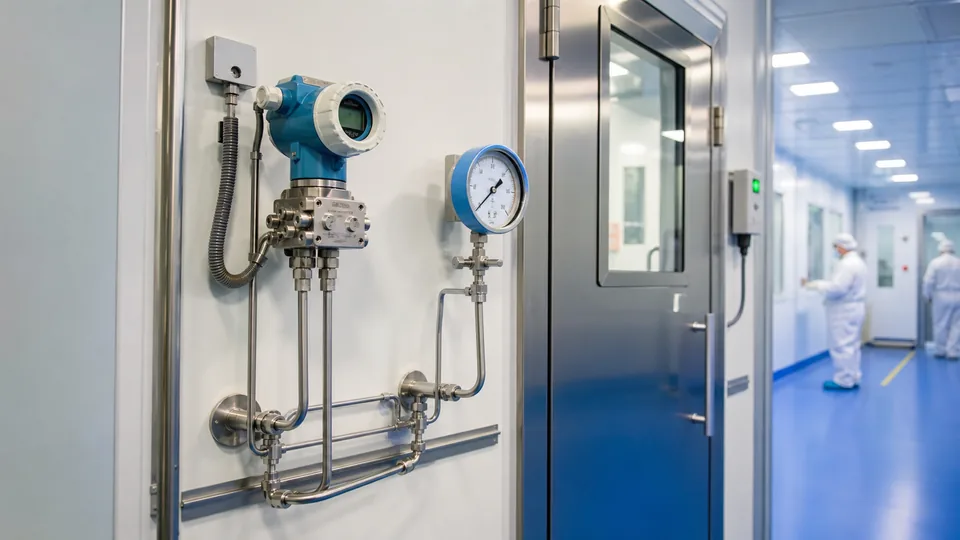
Battery dry room differential pressure monitoring usually involves low pressure differences, so the instrument range must be selected carefully. A range that is too wide makes small cascade changes hard to read. A range that is too narrow can overload or nuisance-alarm during door openings, filter loading or fan transitions.
| Selection variable | Why it matters in a battery dry room | Practical check |
|---|---|---|
| Range | Room pressure differences are small | Match normal, alarm and door-open values from HVAC design |
| Accuracy and resolution | Small errors can hide cascade drift | Confirm full-scale accuracy, zero stability and display readability |
| Output signal | Trending and alarms need electronic data | Use transmitter output for BMS, PLC or historian records |
| Installation | Poor taps create false pressure readings | Keep taps away from direct airflow and protect tubing |
| Environment | Dry rooms may have cleanroom and ESD requirements | Confirm enclosure, materials, cleaning exposure and documentation |
A local analog differential pressure gauge is useful for quick visual confirmation at an airlock. A differential pressure transmitter is better for continuous records, alarms and cross-checking with dew point, temperature, door state and dehumidifier operation. Many projects use both.
5. Linking pressure alarms with dew point and door events
Pressure alarms should not be designed as isolated numbers. They work best when linked to dew point trend, door state, airlock occupancy, supply airflow, return airflow, filter differential pressure and dehumidifier status. For example, a short pressure drop when a door opens may be acceptable. A long pressure loss followed by a dew point rise is a stronger warning that wet air entered the dry room.
Alarm logic should separate commissioning, normal production, maintenance, cleaning and emergency modes. A maintenance door opening should not create the same response as a production airlock failure. Likewise, a filter change or dehumidifier service event may require temporary alarm suppression with documented authorization.
The most useful records answer practical questions: when did pressure collapse, which door or fan state changed, how long did recovery take, and did dew point move outside the validated operating window? That combination gives engineers a better root-cause path than pressure alone.
6. Specification checklist for battery dry room instrumentation
A neutral specification should begin with the room and process requirement, not the gauge catalog. Document the dry room area, adjacent spaces, target dew point, pressure cascade philosophy, airlock sequence, HVAC mode list, door behavior, alarm priority, calibration interval and data retention requirement. Then select the differential pressure gauge or transmitter.
Useful instrument information includes measuring range, allowed overpressure, accuracy, zero adjustment, response damping, display type, output signal, enclosure rating, tubing material, mounting location, calibration access and whether the device must meet any cleanroom, ESD or customer documentation rules. For process lines inside the plant, do not confuse room differential pressure instruments with hydraulic, compressed air or electrolyte pressure instruments.
Battery dry room differential pressure monitoring is strongest when pressure data is interpreted with dew point and production context. It helps reduce moisture ingress risk, supports faster troubleshooting and gives quality teams a clearer environmental record. It does not replace dew point measurement, material qualification, cell testing or the final engineering review of the dry-room HVAC design.
Key takeaways
- Battery dry room differential pressure monitoring supports moisture ingress control, but dew point measurement remains the primary dry-room quality variable.
- Use local DP gauges for visual checks and DP transmitters for alarms, trends and correlation with dew point, door state and HVAC data.
- Specify range, accuracy, tap location, tubing, output signal, cleanroom/ESD requirements and calibration access before choosing a device.
Related products
- Diaphragm Pressure Gauge - Type 1 (ZX-05-1) — 0–60 kPa
- Stainless Steel Pressure Gauge - Radial (ZX-01-R) — 0–100 MPa
Часто задаваемые вопросы
What is battery dry room differential pressure monitoring?
It is the measurement of small pressure differences between a battery dry room, airlock and adjacent spaces. It helps confirm that air tends to move from the dry controlled zone toward less critical zones, reducing moisture ingress risk.
Can differential pressure prove that a battery dry room is dry enough?
No. Differential pressure cannot prove dew point or cell quality. It supports the environmental control record, but dew point, temperature, particle, ESD and process checks are still required.
Where should DP gauges or transmitters be installed in a dry room?
Typical points include dry room to airlock, airlock to corridor, dehumidifier supply or return paths and local high-use doors. Pressure taps should avoid direct supply jets, exhaust grilles and locations that do not represent room pressure.
Should a dry room use a DP gauge or a DP transmitter?
Use a local DP gauge for quick visual confirmation at an airlock. Use a DP transmitter when values must be trended, alarmed and correlated with dew point, door state and HVAC data. Many projects use both.
What specification details are needed before selecting the instrument?
Confirm target pressure cascade, normal and alarm values, measuring range, accuracy, overpressure allowance, tap location, tubing, output signal, enclosure rating, cleanroom or ESD needs and calibration access.