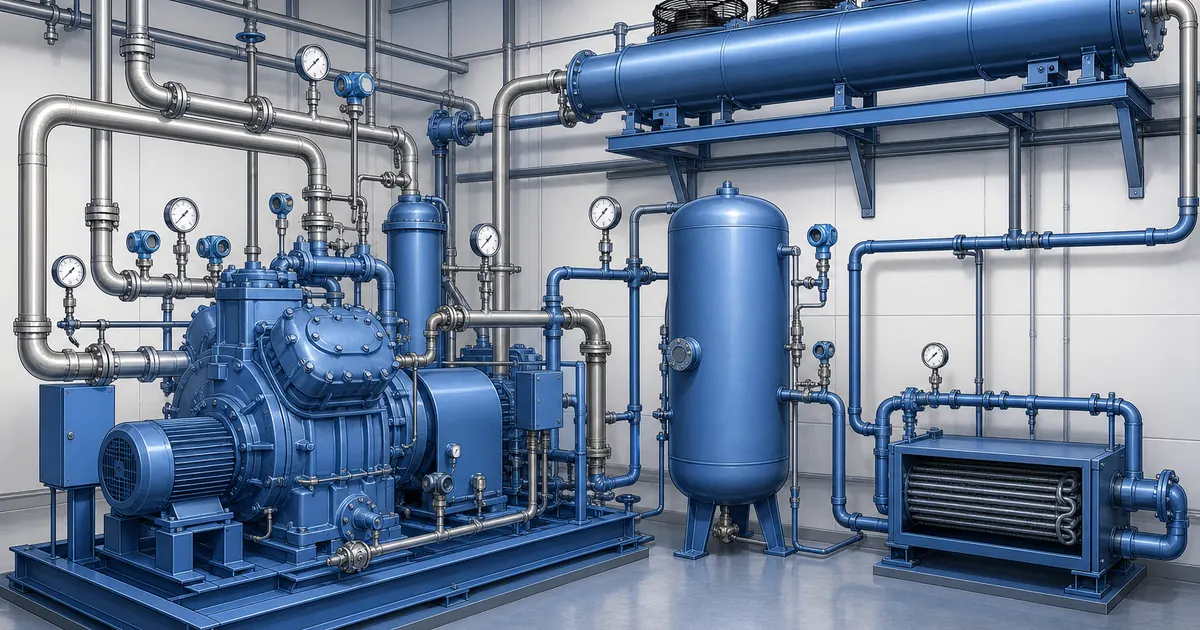
O monitoramento de pressão em refrigeração com amônia usa manômetros, transmissores e instrumentos de pressão diferencial para entender o sistema R717.
What ammonia refrigeration pressure monitoring means
Ammonia refrigeration pressure monitoring starts with a simple definition: it is the controlled measurement of pressure and pressure difference at the points that reveal how an R717 system is operating. A dial gauge gives local confirmation for operators standing near a compressor skid or receiver. A pressure transmitter sends a signal to the control system for trending, alarms and interlocks. A differential pressure gauge or transmitter compares two points, such as upstream and downstream of a filter, so maintenance teams can detect restriction before flow is lost.
The main keyword for this article is ammonia refrigeration pressure monitoring. Related terms include industrial refrigeration pressure gauge, R717 pressure transmitter, differential pressure monitoring for refrigeration filters and cold storage pressure instrumentation. The safety context matters because ammonia is an efficient natural refrigerant but also a hazardous chemical. Useful external references include the US EPA safety standards for ammonia refrigeration and OSHA's ammonia refrigeration standards page.
For instrument selection background, compare this guide with the Manogauge industrial pressure gauge selection guide and the differential pressure gauge selection guide. These internal references explain accuracy class, dial size, vibration damping and differential pressure logic in more general industrial terms.
Revisar seleção de manômetros industriais →→Where pressure and differential pressure points matter
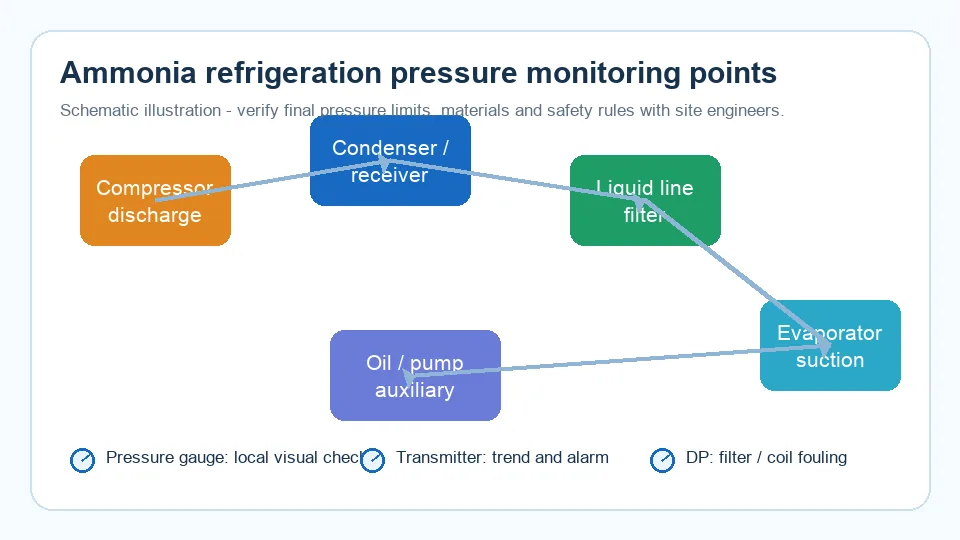
A refrigeration plant does not need instruments everywhere. It needs reliable readings at points where pressure changes explain system health, safety or maintenance decisions. Compressor suction pressure helps confirm load and evaporating conditions. Compressor discharge pressure helps operators recognize condenser problems, blocked flow, high ambient effects or abnormal compression. Receiver and liquid line pressure help verify stable supply to expansion devices. Evaporator pressure supports cooling performance checks. Differential pressure across filters, strainers, coils or oil circuits helps detect fouling and restriction.
| Monitoring point | Typical instrument | What the reading helps diagnose |
|---|---|---|
| Compressor suction | Gauge plus transmitter | Load condition, evaporating pressure, low suction risk |
| Compressor discharge | Safety-pattern gauge plus transmitter | High head pressure, condenser performance, blocked valves |
| Receiver or liquid line | Stainless steel gauge or transmitter | Liquid supply stability and abnormal pressure rise |
| Filter or strainer | Differential pressure gauge or DP transmitter | Fouling, ice, debris or maintenance timing |
| Evaporator branch | Gauge or transmitter | Coil performance and expansion valve behavior |
| Oil circuit | Gauge with vibration damping | Lubrication pressure and pump condition |
The table is a starting checklist, not a fixed design. A small packaged refrigeration unit and a large engine room serving multiple cold rooms will need different instrument counts, pressure ranges and control integration.
Ammonia refrigeration pressure monitoring instrument selection
Instrument selection should begin with the real operating envelope. Normal pressure, maximum allowable pressure, start-up conditions, pump-down, defrost and maintenance states can all differ. A common gauge rule is to place normal operating pressure in the middle third of the dial when possible, while ensuring the instrument can tolerate expected overpressure. The final range must be confirmed against the system design pressure and the site procedure, not guessed from a generic refrigerant chart.
Material selection is also application-specific. Ammonia service commonly drives buyers toward steel or stainless steel wetted parts, but the correct material depends on dryness, oil carryover, water content, cleaning chemicals, temperature and the connection standard used by the plant. For corrosive cleaning environments or outdoor condenser areas, a stainless steel case and bezel can improve external durability. For vibration near compressors or pumps, a liquid-filled pressure gauge, restrictor, snubber or remote mounting may be required to reduce pointer flutter and movement wear.
Do not treat a refrigeration gauge as automatically suitable for every ammonia point. A service manifold gauge designed for small refrigerant charging work is different from a fixed industrial instrument on a closed-circuit ammonia plant. Verify pressure rating, connection thread, window material, blow-out protection, filling liquid compatibility and whether a transmitter needs hazardous-area approval.
For R-717 ammonia-compatible gauges, see the Refrigerant Pressure Gauge ZX-10 and Liquid-Filled Pressure Gauge ZX-06 for vibration-prone compressor areas.
Preparar RFQ de instrumentação frigoríficaNossos engenheiros respondem em 24 horas→Installation details that protect readings and people
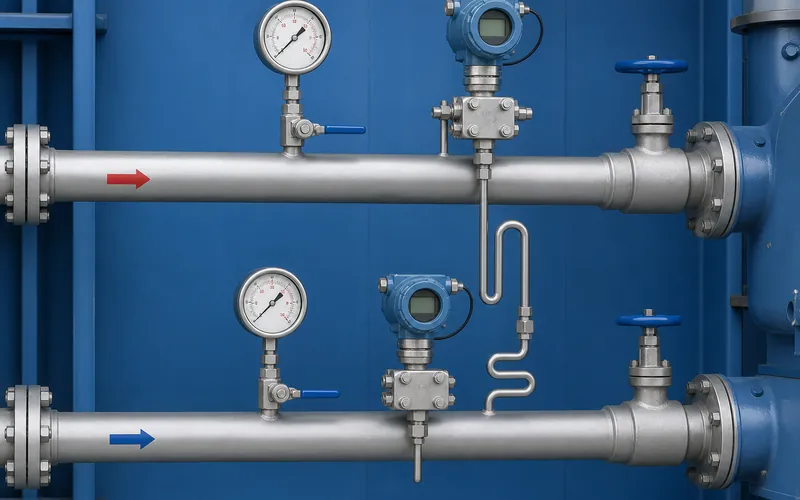
Installation quality often decides whether ammonia refrigeration pressure monitoring remains useful after commissioning. Gauges should be readable from the operator's normal position, isolated with appropriate valves, protected from direct mechanical impact and installed where liquid traps or oil pockets will not create misleading readings. Long unsupported impulse lines can vibrate, fatigue or collect condensate. A transmitter mounted directly on a vibrating compressor nozzle may fail sooner than one mounted on a bracket with suitable tubing.
High side and discharge points require particular caution. Pressure instruments do not replace relief valves, pressure controls or the facility's operating procedure. They only make pressure visible or available to the control system. If a reading is used for alarm or trip logic, the transmitter range, accuracy, response time, wiring, calibration interval and proof-test procedure need formal review.
For ammonia, personal protection, ventilation, emergency shutdown and lockout rules are outside the scope of a gauge article but inside the scope of safe work. Any installation or replacement should be reviewed by a qualified refrigeration engineer or the facility safety owner, especially when the system falls under local process safety, pressure equipment or hazardous chemical regulations.
Using differential pressure for filters, coils and oil circuits
Differential pressure is often more useful than single-point pressure for maintenance. A filter can have acceptable inlet pressure while still becoming restricted; the pressure drop across it tells a clearer story. The same principle applies to strainers, evaporator coils, heat exchangers and oil circuits. A rising differential pressure trend may indicate debris, ice formation, oil migration or a valve position problem.
The instrument range should match the expected clean and dirty pressure drop. If the range is too wide, operators cannot see early fouling. If the range is too narrow, normal transients may peg the pointer or saturate the signal. Differential pressure instruments also need proper high-side and low-side connections, equalizing valves where required, and protection against one-sided overpressure during maintenance.
For facilities moving toward digital maintenance, a DP transmitter can feed trend data into a building management system, PLC or IIoT dashboard. That data is useful only when the tag name, units, alarm threshold, filter type and maintenance action are documented. Otherwise the system collects numbers without a decision rule.
RFQ checklist and risk boundaries
A practical RFQ for ammonia refrigeration pressure monitoring should list the refrigerant, normal and maximum pressure, temperature range, connection thread or flange, mounting location, vibration level, required accuracy, case material, wetted material, dial size, signal output, alarm use, certificate requirement and destination market. If differential pressure is needed, include both tap locations, expected clean pressure drop and the maintenance threshold.
Manogauge can discuss stainless steel pressure gauges, liquid-filled gauges, differential pressure instruments, diaphragm seal assemblies and pressure transmitters for industrial refrigeration projects, but the article cannot approve a specific ammonia installation. Final approval belongs to the refrigeration designer, plant engineer and safety procedure owner. In high-pressure, high-temperature, corrosive cleaning, outdoor or regulated chemical service, confirm material compatibility, pressure rating, connection sealing, calibration and local code requirements before ordering.
The conclusion is deliberately narrow: ammonia refrigeration pressure monitoring improves visibility, troubleshooting and maintenance planning when instruments are selected for the actual system. It does not make an unsafe system safe, and it does not replace engineered relief protection, operating procedures or trained personnel.
Key takeaways
- Ammonia refrigeration pressure monitoring combines gauges, transmitters and DP instruments at points that support operation and maintenance decisions.
- Gauge range, wetted material, connection, vibration protection and safety pattern must be confirmed against the actual R717 system.
- Differential pressure is valuable for filter, coil, strainer and oil-circuit maintenance because it shows restriction directly.
- Pressure instruments improve visibility but do not replace relief protection, ammonia safety procedures or engineering approval.
Related products
- Refrigerant Pressure Gauge - Radial (ZX-10-R) — 0–800 psi
- Liquid-Filled Pressure Gauge - Radial (ZX-06-R) — 0–60 MPa
- Isolating-Diaphragm Gauge - Radial Type 1 (ZX-04-R1) — 0–60 MPa
Часто задаваемые вопросы
What pressure range should an ammonia refrigeration gauge use?
Select the range from the system design pressure and normal operating envelope. Normal pressure is often easiest to read in the middle third of the dial, but the final range must cover start-up, defrost, pump-down and expected overpressure conditions.
Can a standard refrigerant service gauge be used on fixed ammonia piping?
Do not assume it can. Fixed ammonia refrigeration pressure monitoring requires confirmation of pressure rating, materials, connection, window, safety pattern, vibration exposure and any hazardous-area or site approval requirements.
Where is differential pressure most useful in ammonia refrigeration?
Differential pressure is useful across filters, strainers, evaporator coils, heat exchangers and oil circuits because it shows restriction or fouling more directly than a single pressure point.
Does pressure monitoring make an ammonia refrigeration system safe?
No. It improves visibility and alarms, but it does not replace relief valves, ventilation, emergency shutdown procedures, ammonia safety training or engineering review.
What information should be included in an RFQ for ammonia pressure instruments?
Include refrigerant, normal and maximum pressure, temperature, connection, mounting location, vibration, materials, accuracy, output signal, alarm use, certificate needs and destination market.