
AI predictive maintenance is moving from pilot projects into daily factory reliability work. The 2026 manufacturing discussion is no longer only about adding sensors; it is about turning vibration, temperature, acoustic, current, flow and pressure signals into reliable maintenance decisions. Pressure monitoring matters because pumps, compressors and hydraulic systems often show process stress before a bearing fails, a seal leaks, a filter clogs or a relief valve starts cycling. A mechanical pressure gauge gives operators a trusted local reading, while a pressure transmitter or digital sensor feeds the time-series data that AI models need. The useful question is not whether AI replaces the gauge. The useful question is how pressure data becomes a clean, explainable signal inside an industrial maintenance stack.
1. AI predictive maintenance manufacturing and pressure monitoring trends
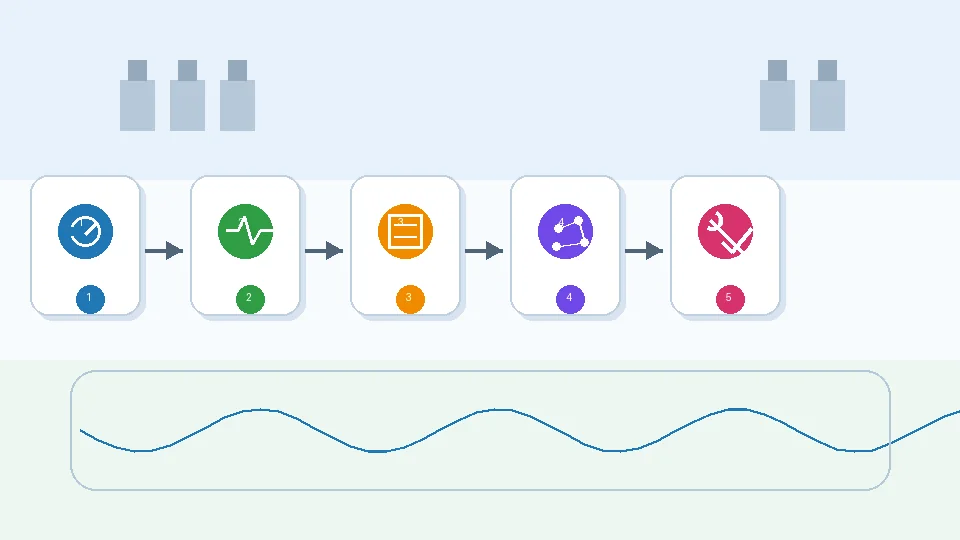
Manufacturers are under pressure to reduce unplanned downtime while keeping aging equipment, labor constraints and energy costs under control. Recent industry reporting points to a digital-first maintenance shift, with AI, mobile workflows and vendor-supported reliability programs becoming more common in plant operations. KPMG’s 2026 industrial manufacturing technology report describes manufacturers moving from AI ambition into execution, while Plant Engineering’s 2026 operations and maintenance study highlights higher technology spending and stronger interest in predictive and preventive maintenance.
Predictive maintenance means estimating failure risk from equipment condition, not servicing every asset only by calendar. In practice, it is a stack: field instruments collect signals, PLCs or gateways time-stamp them, edge systems clean them, historians store them, models look for patterns, and maintenance teams confirm whether the alert is real. Pressure monitoring fits naturally into that stack because pressure is both a process variable and a machine-health signal. A pump that draws normal current but shows rising discharge pressure may be fighting a restriction. A hydraulic unit with unstable pressure may have air entrainment, valve wear or relief-valve cycling. A compressor with pressure pulsation may be developing a control, valve or capacity issue.
Useful external context: KPMG Global Tech Report 2026: Industrial Manufacturing and Plant Engineering 2026 State of Manufacturing Operations & Maintenance Study.
Ver instrumentos de monitoramento de pressão →Compare manômetros, transmissores de pressão e opções de pressão diferencial para manutenção industrial.→2. Predictive maintenance pressure monitoring signal stack
A pressure reading becomes useful to AI only after it becomes stable, traceable data. At the field level, the mechanical gauge gives a quick local reference. It helps operators see whether a digital value is plausible and whether a sudden alarm matches the real process. The transmitter or digital pressure sensor provides the continuous signal that enters the PLC, SCADA, historian or edge gateway.
The next layer is signal quality. AI models are weak when the pressure signal is noisy, uncalibrated, poorly sampled or missing operating context. A pump running at 40% speed and a pump running at 95% speed may show very different pressure behavior. A hydraulic press in idle, approach, dwell and return phases has different normal pressure bands. The model needs pressure, flow, motor current, valve command, speed, temperature and production state to avoid confusing normal operation with a fault.
For many plants, the first practical step is not a complex deep-learning model. It is building trustworthy pressure trends: timestamped data, consistent units, known sensor range, clean tags, calibration records and event labels. Once the baseline is clear, anomaly detection and remaining-useful-life models have something reliable to learn from.
3. Pump pressure monitoring, compressor pressure monitoring and hydraulic system pressure monitoring
Pressure is valuable because it connects mechanical health with process resistance. In a centrifugal pump, rising discharge pressure with falling flow can point toward a blocked downstream line, partially closed valve or fouled filter. Falling discharge pressure at the same speed can suggest impeller wear, cavitation, suction restriction or seal leakage. A repeated pressure ripple may indicate cavitation, air entrainment or a control loop that is hunting.
Compressors create another pattern set. Suction and discharge pressure trends help show load changes, valve leakage, fouling, unstable controls and abnormal cycling. Pressure pulsation does not replace vibration analysis, but it adds context: the vibration system may know that a machine is shaking, while pressure data explains whether the process is surging, starving or cycling.
Hydraulic systems are especially pressure-driven. Slow pressure rise can indicate internal leakage, pump wear or valve bypass. Pressure spikes may come from shock loads, fast valve shifts or blocked return lines. Frequent relief-valve activity turns wasted energy into heat and can shorten component life. AI becomes more useful when it sees those pressure events together with cylinder position, valve commands, oil temperature and machine cycle state.
Solicitar recomendação de monitoramento de pressão →Informe meio, faixa, saída de sinal e ponto de instalação para bomba, compressor ou sistema hidráulico.→4. IIoT pressure sensor data with vibration, temperature and acoustic signals
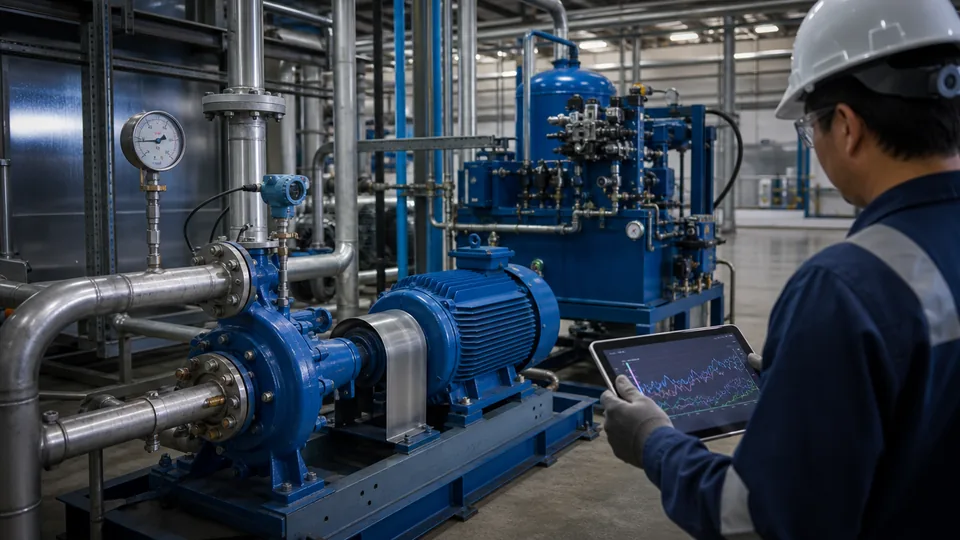
The strongest predictive maintenance programs rarely depend on one sensor type. Vibration is excellent for rotating components, bearing defects and imbalance. Temperature shows heat buildup from friction, electrical loss or hydraulic inefficiency. Acoustic and ultrasonic signals can reveal leaks, cavitation and compressed-air losses. Pressure gives the process side of the same story.
A pump cavitation case illustrates the point. Vibration may rise, acoustic signals may change and discharge pressure may become unstable. If the AI model sees only vibration, it may flag a mechanical problem. If it also sees suction pressure, discharge pressure, flow and temperature, it can separate bearing wear from process starvation. That separation matters because the repair action is different. Bearing replacement does not fix a suction restriction.
Recent research on IIoT-driven machine failure forecasting emphasizes real-time sensor streams and machine-learning failure prediction. A 2026 Scientific Reports paper on IIoT machine failure forecasting frames predictive maintenance around data streams that reduce unplanned downtime and improve resource utilization. For pressure monitoring, that means the gauge and transmitter are part of a larger evidence chain, not isolated accessories.
Reference: Scientific Reports 2026: Real-time IIoT-driven machine failure forecasting for Industry 4.0.
5. SEO knowledge: why AI maintenance projects fail without pressure data quality
The most common failure is treating AI as a dashboard project rather than a reliability process. A plant can collect pressure data from every pump and still get little value if tags are inconsistent, sensors are oversized, calibration history is missing, or maintenance teams never close the feedback loop after an alert.
Sensor placement is another weak point. A pressure transmitter far from the pump discharge may miss short pulses. A gauge installed on a vibrating line without protection may fail early or give unstable readings. A sensor with a range far above normal operating pressure may lose resolution exactly where the model needs detail. For pulsating service, damping, snubbers, remote mounting or suitable sensor selection may be needed so the data reflects the process instead of instrument abuse.
The maintenance workflow also matters. AI can rank risk, but technicians still need a clear action path: inspect suction strainer, check filter differential pressure, verify valve position, compare local gauge reading, review vibration trend, record the finding and label the outcome. Without that loop, the model never learns which pressure anomalies were real faults and which were normal process changes.
6. Pressure transmitter predictive maintenance selection by failure mode
AI-ready pressure monitoring starts with ordinary engineering discipline. The selected gauge or sensor range matches normal pressure and credible upset pressure. The wetted material matches the fluid. The connection fits the process. The dial or display is readable from the operator’s position. The transmitter output matches the control system. Calibration and replacement intervals are documented.
For pumps and hydraulic units, many buyers keep a mechanical pressure gauge at the equipment and add a transmitter for the digital signal. This dual approach gives the operator a local truth check and gives the AI system the time-series data it needs. For compressors and high-pulsation applications, pressure damping and response time become part of the selection discussion. For filters and heat exchangers, differential pressure often matters more than absolute pressure because the pressure drop reveals restriction and fouling.
A knowledge-driven specification does not start with the phrase “AI sensor.” It starts with the failure mode: cavitation, filter clogging, seal leakage, valve bypass, relief-valve cycling, air entrainment, pump wear or compressor instability. Once the failure mode is clear, pressure monitoring can be designed as a measurable, explainable input to the predictive maintenance program.
Key takeaways
- Predictive maintenance in 2026 depends on clean sensor streams and maintenance feedback, not AI dashboards alone.
- Pressure data is valuable because it links process resistance with machine health in pumps, compressors and hydraulic systems.
- Mechanical gauges give operators a local reality check; transmitters provide the time-series data used by AI models.
- Pressure becomes more useful when combined with vibration, temperature, acoustic, flow, motor current and operating-state data.
- Good specifications start from failure modes such as cavitation, filter clogging, seal leakage, valve bypass or relief-valve cycling.
Related products
- General Pressure Gauge - Radial (ZX-08-R) — 0–40 MPa
- Stainless Steel Pressure Gauge - Radial (ZX-01-R) — 0–100 MPa
Часто задаваемые вопросы
Why is predictive maintenance pressure monitoring useful for AI manufacturing?
Predictive maintenance pressure monitoring links process resistance with machine behavior. In pumps, compressors and hydraulic systems, pressure drift, pressure ripple, slow pressure rise or repeated pressure spikes can reveal restrictions, leakage, cavitation, valve cycling or control instability before a shutdown occurs.
Can a mechanical pressure gauge still matter in an AI maintenance program?
Yes. A mechanical gauge gives operators a local reading that can be compared with the digital signal. This helps identify sensor drift, wiring faults, bad tags or unrealistic dashboard values before maintenance decisions are made.
Which equipment benefits from pump pressure monitoring and compressor pressure monitoring?
Pump skids, hydraulic power units, compressors, filtration systems, heat exchangers and lubrication circuits are common candidates because pressure changes directly reflect load, restriction, leakage, flow limitation and control behavior.
What data should be paired with an IIoT pressure sensor?
An IIoT pressure sensor is stronger when paired with flow, vibration, motor current, temperature, acoustic or ultrasonic data, valve command, speed and operating state. These signals help separate real faults from normal production changes.
What is the first step before buying a pressure transmitter for predictive maintenance?
Define the failure mode first. Cavitation, filter clogging, seal leakage, valve bypass, air entrainment and compressor instability require different pressure ranges, sampling rates, damping choices and installation points for pressure transmitter predictive maintenance.