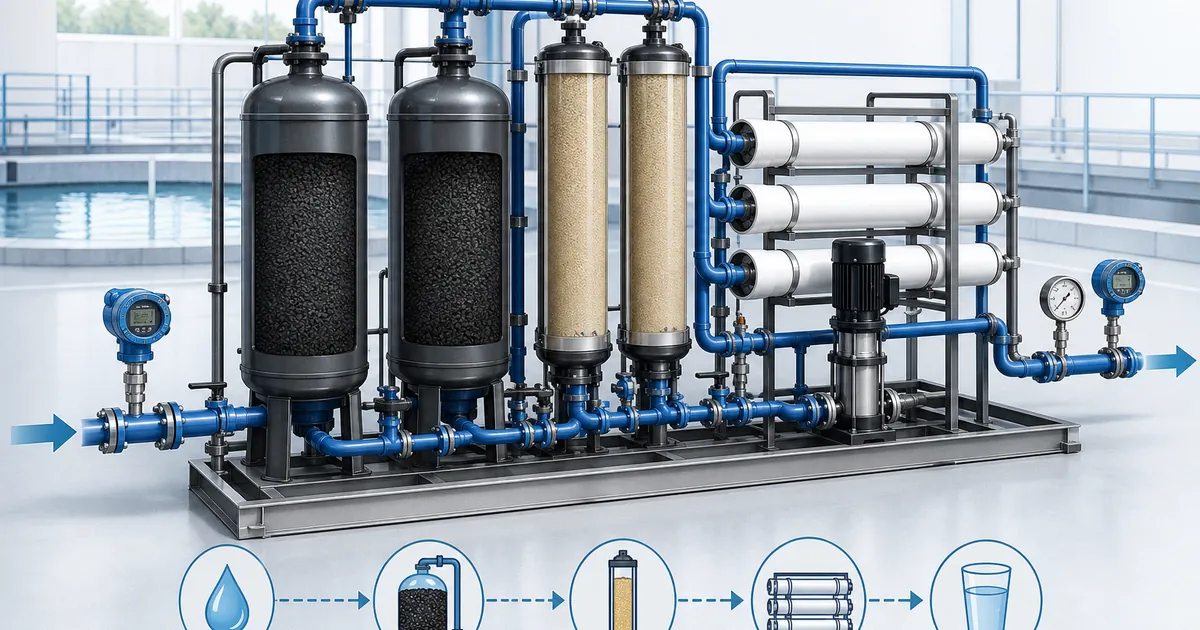
PFAS water treatment pressure monitoring helps operators see hydraulic problems in GAC, ion exchange and RO treatment trains before flow, media life or membrane performance is compromised. It is a pressure and differential pressure strategy, not a substitute for PFAS sampling.
What PFAS water treatment pressure monitoring means
PFAS water treatment pressure monitoring is the controlled use of pressure gauges, pressure transmitters and differential pressure instruments to understand hydraulic condition inside a PFAS removal system. PFAS means per- and polyfluoroalkyl substances, a group of persistent chemicals that may require adsorption, ion exchange, membrane separation or combined treatment before water is released or reused. Pressure readings do not measure PFAS concentration. They show whether the treatment train is flowing, clogging, fouling, bypassing or operating outside the pressure envelope assumed by the system designer.
This matters because PFAS treatment is moving from pilot projects into regular municipal, industrial and remediation duty. The U.S. EPA explains the current federal drinking-water rule and 2026 proposed implementation updates on its PFAS drinking water regulation page. For instrument engineers, the practical consequence is simple: granular activated carbon (GAC), ion exchange resin and reverse osmosis (RO) systems need reliable local readings and trendable signals at the points where hydraulic loss changes first.
The main keyword for this article is PFAS water treatment pressure monitoring. Related terms include differential pressure gauge for water treatment, PFAS filtration pressure gauge, GAC filter differential pressure and RO membrane pressure monitoring. Internal references that support this topic include membrane filtration differential pressure monitoring and pressure transmitter vs pressure gauge selection.
Review Water Treatment Pressure Gauge Options →Explore 143+ industrial gauge models→Where pressure and differential pressure points belong in PFAS systems
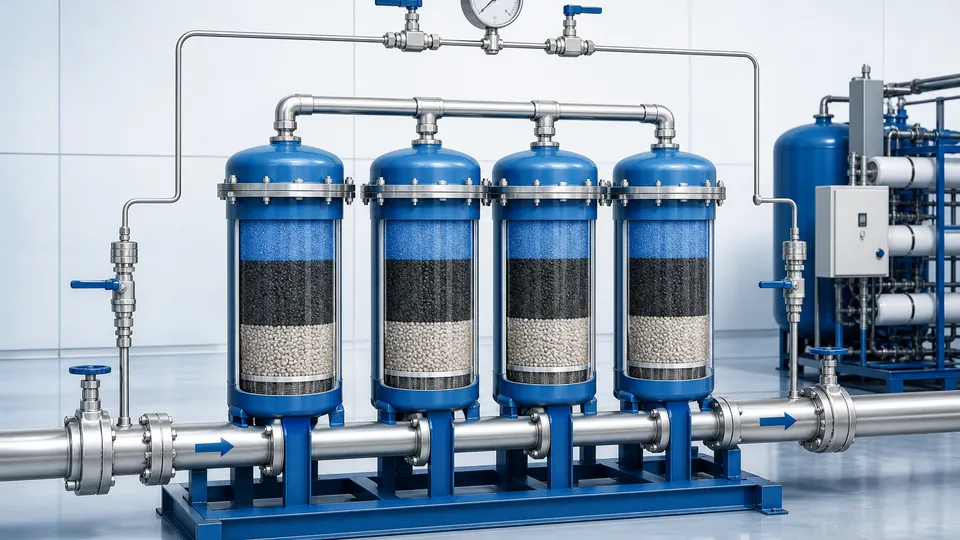
A PFAS treatment train may include pre-filtration, GAC vessels, ion exchange vessels, cartridge filters, RO membrane housings, recirculation pumps and final sampling points. The useful pressure points are not random. They are placed before and after components where restriction, media exhaustion, membrane fouling or valve position can change the pressure profile.
| Location | Typical instrument | What the reading helps diagnose |
|---|---|---|
| Pump discharge | Pressure gauge plus transmitter | Stable feed pressure, abnormal pump operation, closed downstream valve |
| GAC or resin vessel inlet and outlet | Differential pressure gauge or transmitter | Media fouling, channeling risk, backwash or replacement timing |
| Cartridge pre-filter | Differential pressure indicator | Solids loading before expensive media or membranes |
| RO feed and concentrate lines | Pressure transmitter and local gauge | Membrane fouling, recovery drift, pump stress |
| Sample panel or final line | Low-range gauge where useful | Flow confirmation during sampling and commissioning |
Differential pressure is often the more useful value than single-point pressure across media beds and filters. A rising differential pressure at constant flow suggests loading or fouling. A suddenly low differential pressure can indicate bypass, missing cartridge elements, open bypass valves or a failed measurement line. Operators should compare pressure readings with flow, conductivity, analytical PFAS sampling and maintenance records rather than treating one gauge as the whole diagnosis.
Selecting a differential pressure gauge for water treatment media
A differential pressure gauge for water treatment should be selected from the expected clean-bed pressure drop, alarm point and maximum possible differential pressure. The normal reading should sit in a readable part of the dial or transmitter span. If the range is too wide, early fouling is hard to see. If the range is too narrow, start-up, backwash or valve mistakes may over-range the instrument.
Material compatibility is also part of PFAS filtration pressure gauge selection. Many water-treatment skids use stainless steel piping, polymer housings, coated carbon steel vessels or PVC/CPVC auxiliary lines. The wetted parts of the gauge, transmitter, diaphragm seal, manifold and impulse tubing must match the water chemistry, cleaning chemicals, pressure rating and temperature. Do not assume that the instrument body material matches the process-wetted material.
For media vessels, a three-valve or five-valve manifold can make zero checks and isolation easier. Long impulse lines should avoid air pockets, sediment traps and freezing exposure. Where vibration from pumps is present, a liquid-filled gauge, snubber, capillary separation or transmitter with damping may be better than a dry gauge mounted directly on a vibrating line. The instrument should help maintenance make a clear decision: keep running, clean, backwash, replace media, inspect valves or investigate flow.
Request a PFAS Instrument Specification CheckOur engineers respond within 24 hours→Pressure gauges, transmitters and what each one proves
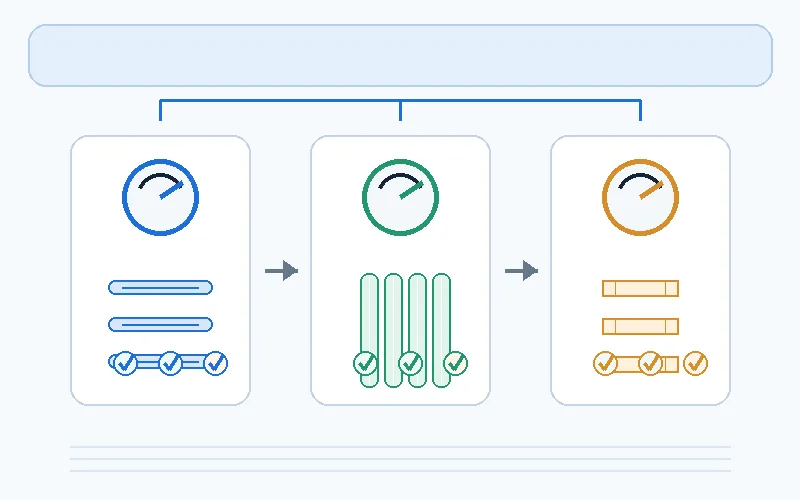
Mechanical pressure gauges are valuable in PFAS water treatment because a technician can read them during commissioning, flushing, isolation and manual valve checks without opening a control screen. A gauge on the pump discharge or vessel inlet can immediately show whether a line is pressurized before maintenance begins. For local panels, choose a dial size that can be read from the real standing position, not only from the catalog drawing.
Pressure transmitters are better when the value must become data. Trending pump discharge pressure, GAC differential pressure or RO feed pressure helps maintenance teams see slow fouling before a high-pressure alarm occurs. A 4-20 mA, HART or digital output should be scaled to the expected operating range, and the control system should record the operating state so data from start-up, backwash and normal production is not mixed together without context.
The two instruments answer different questions. A local gauge proves what a person near the skid can verify now. A transmitter proves what the control system can alarm, trend and archive. For critical PFAS trains, both can be justified at pump discharge, media vessels and RO feed points, provided the pressure tapping, isolation valve and maintenance access are designed correctly.
Limits: pressure does not prove PFAS removal performance
The most important risk boundary is that pressure readings do not prove PFAS removal. A GAC vessel can show normal pressure while adsorption capacity is exhausted. An ion exchange bed can have acceptable differential pressure while breakthrough has already started. An RO system can maintain pressure while recovery, temperature, membrane age or scaling changes separation performance. PFAS concentration must be confirmed by the sampling and laboratory method required for the project or regulation.
Pressure also cannot prove material compatibility, certification, sanitation or hazardous-area approval by itself. For high-pressure RO, corrosive water, chemical cleaning, outdoor freezing, pump pulsation or enclosed equipment rooms, confirm the pressure rating, overpressure protection, case safety pattern, IP rating, connection thread, seal material and any site standards before ordering. See the related guide on pressure gauge installation best practices for mounting and isolation details.
Manogauge is a Zhejiang-based industrial instrument manufacturer with ISO 9001 production management and export experience. That origin signal can help procurement teams, but the final specification still needs project confirmation: process pressure, test pressure, water chemistry, cleaning fluids, ambient temperature, connection, mounting position, signal output and documentation package.
PFAS water treatment pressure monitoring checklist
Use a checklist before releasing a PFAS treatment skid for procurement or commissioning. First, map every pressure point to a maintenance decision: pump health, filter loading, media vessel fouling, membrane feed pressure, sampling confirmation or safety isolation. Second, define the expected clean, normal, alarm and maximum pressure values. Third, select the instrument type: local gauge, transmitter, differential gauge, differential transmitter or a combination.
Then confirm the mechanical details. Check pressure range, accuracy class, overpressure tolerance, wetted material, process connection, manifold arrangement, fill fluid, vibration exposure, IP rating and installation orientation. For transmitters, confirm output signal, power supply, cable entry, grounding, scaling and alarm logic. For differential pressure, confirm high and low sides are connected correctly and that impulse lines can be drained, vented or protected against freezing.
The closing rule is conservative: PFAS water treatment pressure monitoring should make hydraulic problems visible early, but it should not be used as a substitute for PFAS sampling, media-life modeling or engineering review. When in doubt, specify the pressure instruments with the same discipline used for pumps, valves and analytical sampling points.
Key takeaways
- Pressure and differential pressure reveal hydraulic condition; they do not prove PFAS concentration or removal efficiency.
- Place instruments where a pressure change maps to a maintenance decision: pump discharge, media vessel inlet/outlet, cartridge filters and RO feed lines.
- Select wetted materials, range, manifold, vibration protection and transmitter scaling from the real water chemistry and operating envelope.
Frequently asked questions
Can pressure monitoring prove that PFAS has been removed?
No. Pressure and differential pressure show hydraulic condition, fouling and possible bypass. PFAS removal must be confirmed through the required sampling and laboratory analysis method.
Where is differential pressure most useful in a PFAS treatment train?
It is most useful across GAC vessels, ion exchange vessels, cartridge pre-filters and membrane housings because a pressure drop change often appears before flow or quality problems are obvious.
Should a PFAS skid use gauges or pressure transmitters?
Use gauges for local confirmation and transmitters when alarms, trends or records are needed. Critical pump discharge, media vessel and RO feed points often justify both.
What materials should be checked for PFAS filtration pressure gauges?
Confirm wetted parts, seals, manifold, diaphragm seal and impulse tubing against the water chemistry, cleaning chemicals, temperature, pressure rating and site standards.
What is a reasonable first step before ordering instruments?
Create a pressure-point list that defines normal pressure, clean-bed differential pressure, alarm point, maximum pressure, connection, material, output signal and maintenance access for each location.