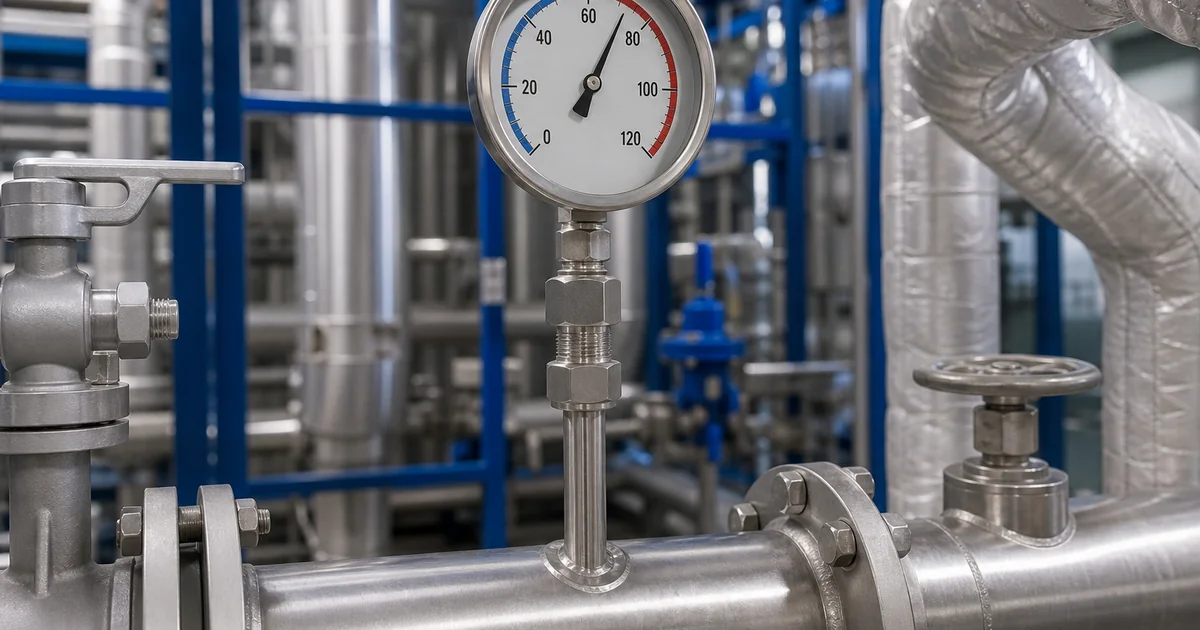
Bimetal thermometer thermowell selection starts with a simple maintenance question: can the thermometer be removed, calibrated or replaced without opening a hot, pressurised or contaminated process line?
What a thermowell changes in bimetal thermometer selection
Bimetal thermometer thermowell selection is not only an accessory decision. A thermowell is a pressure-retaining pocket installed in the pipe or vessel. The thermometer stem slides into that pocket, so the sensing element sees process temperature through the metal wall instead of contacting the medium directly.
That separation solves three practical problems: the thermometer can be removed while the line remains closed, the stem is protected from corrosion or erosion, and the plant can standardise one process connection while using different dial ranges. The tradeoff is response time. A bare stem responds faster; a heavy thermowell responds slower but is safer in steam, hot water, thermal oil and contaminated services.
For Manogauge ZX-14 bimetal thermometers, start with the visible indication requirement, then confirm the thermowell. Useful linked references include the bimetal thermometer product page and the broader stainless steel thermometer option for corrosive utility areas.
Compare Bimetal Thermometer Options →Check dial size, range, stem and connection options→Bimetal thermometer thermowell selection for insertion length
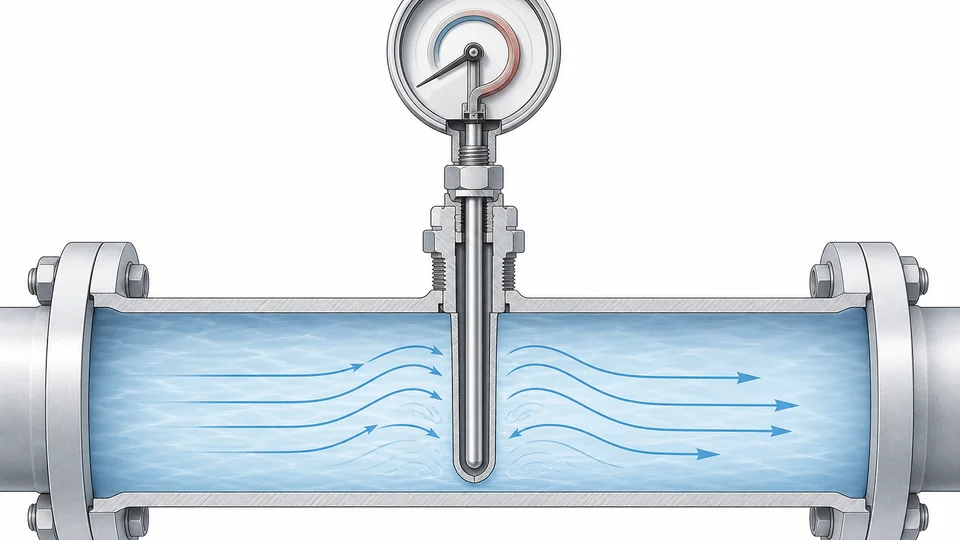
The sensing section must reach a representative part of the flow. If the tip sits in a stagnant branch, close to a pipe wall, or inside a short boss, the dial may look stable while reading a biased temperature. As a starting rule, place the tip near the centre third of the pipe for liquid service when mechanical strength allows it, and use an elbow installation when a small pipe cannot accept enough straight insertion length.
Insertion length depends on pipe size, insulation thickness, nozzle height, thermowell style and thermometer stem length. A long thermowell improves exposure but increases bending load and wake-frequency risk. A short thermowell is stronger but may under-read or over-read when the pipe wall is hotter or colder than the flowing medium.
Do not specify only the dial range. For a correct RFQ, include pipe size, nozzle height, insulation thickness, desired visible dial position, stem diameter, connection thread and whether the thermometer must be removable during operation.
Material, connection and process compatibility
Material choice should follow the medium, temperature and cleaning chemistry. 304 stainless steel is common for clean hot water and utility steam. 316L stainless steel is the safer default for condensate, treated water, many chemical utilities and outdoor washdown areas. Brass stems are economical in mild service but should not be used where dezincification, ammonia, strong cleaning chemicals or sanitary expectations are present.
| Service | Typical concern | Thermowell selection focus |
|---|---|---|
| Steam and condensate | High temperature, pressure and water hammer | Stainless thermowell, sealed thread or flange, enough lagging extension |
| Thermal oil | High temperature and oxidation deposits | Material rated for oil temperature, removable thermometer, conservative insertion length |
| Food or CIP utilities | Cleaning chemicals and hygiene expectations | 316L wetted material, sanitary connection if product-contact, avoid crevices |
| HVAC hot water | Corrosion inhibitors and low flow periods | Stainless or brass only when compatible, dial visible from walkway |
Threaded connections are compact and cost-effective. Flanged or welded connections are preferred when pressure class, plant standard or maintenance policy requires a fixed pressure boundary. Match NPT, BSP, G or metric threads deliberately; a nearly fitting thread is not a safe seal.
Send Thermowell Application Data →Include medium, temperature, pressure, velocity and connection→Wake-frequency and vibration checks for thermowells
A thermowell is a small cantilever in the flow. At sufficient velocity, vortices shed from the thermowell and create cyclic forces. If those forces approach the thermowell natural frequency, fatigue can damage the well, the process nozzle or the thermometer. This is why high-velocity steam, gas and light-liquid lines need more than a dimensional sketch.
The external reference most commonly used for this check is ASME PTC 19.3 TW. WIKA notes that wake-frequency calculation in accordance with ASME PTC 19.3 TW-2016 is used to evaluate thermometer thermowells. In practical RFQs, the supplier cannot run that check without process data: medium, density, pressure, temperature, velocity or flow rate, pipe size, thermowell profile and unsupported length.
When the calculation is unfavourable, the fix is usually engineering rather than guesswork: shorten the unsupported length, increase root diameter, use a tapered profile, move to an elbow, reduce velocity at the measurement point, or select a different measurement technology.
What a bimetal thermometer cannot prove
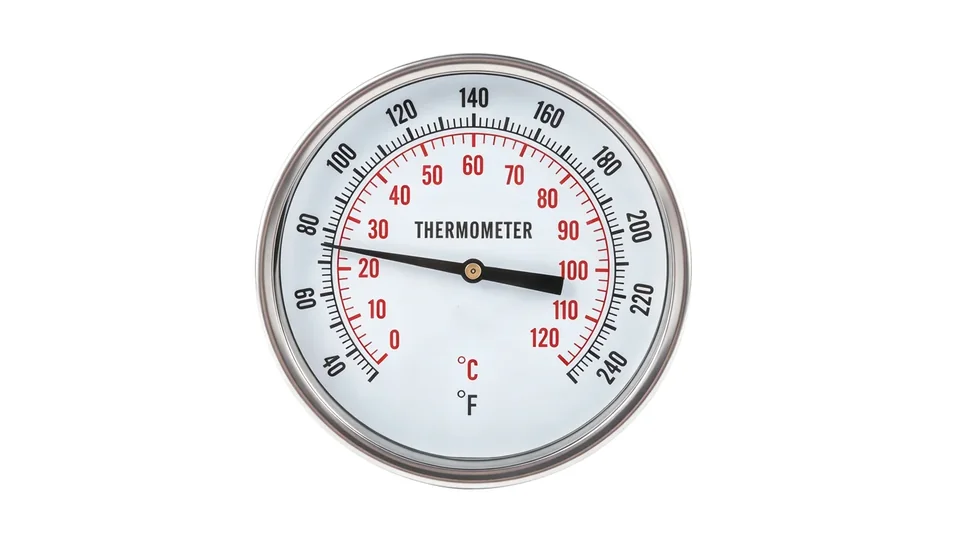
A local bimetal thermometer is useful because it is visible, self-powered and easy to verify during rounds. It does not prove the control-loop temperature, batch record temperature or safety interlock value unless it is installed at the same representative point and maintained under the same calibration plan.
Several errors are common: installing the thermowell after a dead leg, using a stem shorter than the thermowell bore, wrapping insulation around the dial case, placing the dial where radiant heat from a boiler front warms the case, or assuming a slow-moving thermal oil line has the same response as a turbulent water line. These are installation and process errors, not thermometer accuracy errors.
For critical boilers, fired heaters, pressure vessels, sanitary product contact, hazardous areas or high-pressure steam, this guide is only a selection reference. The final design should be confirmed by the plant engineer, vessel/nozzle designer and any applicable site standard.
RFQ checklist for bimetal thermometer thermowell selection
Before requesting a quote, collect the data that determines fit and risk. Send the normal and maximum temperature, pressure, medium, pipe size, flow velocity or flow rate, connection standard, insertion length target, insulation thickness, dial diameter, mounting orientation and any cleaning or corrosion concerns.
For Manogauge, also specify whether the target is an economical utility thermometer, a stainless steel outdoor unit, a sanitary-style assembly, or a removable thermometer for thermal oil or steam service. A complete checklist reduces back-and-forth and helps avoid the common mismatch where the dial looks correct but the stem, connection or thermowell cannot fit the process.
In short, bimetal thermometer thermowell selection should balance readable local indication, safe pressure retention, representative insertion length and verified mechanical strength.
Key takeaways
- A thermowell improves maintenance safety but slows temperature response.
- Insertion length must balance representative temperature reading against mechanical strength.
- High-velocity service needs process data for wake-frequency and vibration checks.
- Final selection should confirm stem fit, material, connection thread and site safety requirements.
Frequently asked questions
When is a thermowell required for a bimetal thermometer?
Use a thermowell when the line is pressurised, hot, corrosive, contaminated, or must stay closed while the thermometer is removed. Bare-stem installation is usually limited to low-risk tanks, ducts or non-pressurised service.
What data is needed for a thermowell wake-frequency check?
Provide medium, density, temperature, pressure, velocity or flow rate, pipe size, thermowell profile, material, root diameter and unsupported insertion length. Without those data, ASME PTC 19.3 TW-style evaluation cannot be meaningful.
How deep should a bimetal thermometer thermowell be inserted?
The sensing section should reach representative flow, often near the centre third of a liquid pipe when strength allows. Small pipes may need elbow installation or a reduced insertion length verified against expected response error.
Can one bimetal thermometer fit any thermowell?
No. Stem diameter, stem length, thread, lagging extension, tip clearance and dial orientation must match the thermowell bore and process connection. A wrong fit can slow response or prevent full insertion.
Is 316L stainless steel always required?
No. 316L is a conservative choice for corrosion, condensate and washdown, but clean HVAC water may allow brass or 304 stainless steel if compatible. Confirm medium chemistry, cleaning fluid and site standards before choosing.