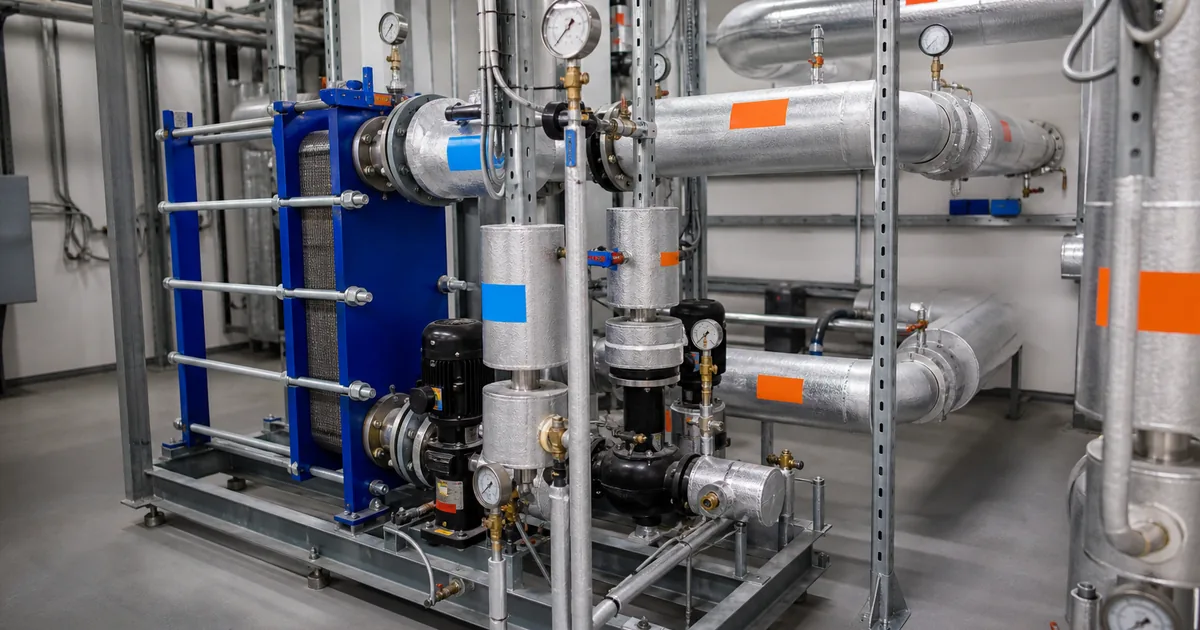
District heating pressure gauge selection means specifying local pressure gauges, differential pressure gauges and temperature instruments for the heat exchanger station that connects a district energy network to a building loop. The goal is not simply to add a dial. Correct instruments help operators compare primary and secondary pressure, confirm pump and strainer condition, protect plate heat exchangers, and document whether the station is operating within the limits set by the network owner and building engineer.
What district heating pressure gauge selection has to prove
District heating pressure gauge selection starts with the function of the substation. A district heating heat exchanger station transfers heat from the network primary side to a building secondary loop, usually through a plate heat exchanger. Pressure readings help operators see whether the network supply is available, whether the secondary pump is creating enough circulation, and whether the station is developing abnormal pressure drop.
Current district energy work is moving toward lower temperatures, renewable heat and better controls. The IEA notes that upgrades to pipes, substations and controls are important for greater flexibility and efficiency in district heating networks. See the IEA commentary on opportunities for district heating in the changing energy landscape. For an instrument buyer, that means pressure gauges should support troubleshooting and commissioning, not just meet a minimum price.
A local dial should be readable during routine inspection, but final limits must come from the network company, station designer, equipment supplier and applicable local code.
Voir les manomètres inox ->Plus de 143 modèles de manomètres industriels→Primary side, secondary side and differential pressure points
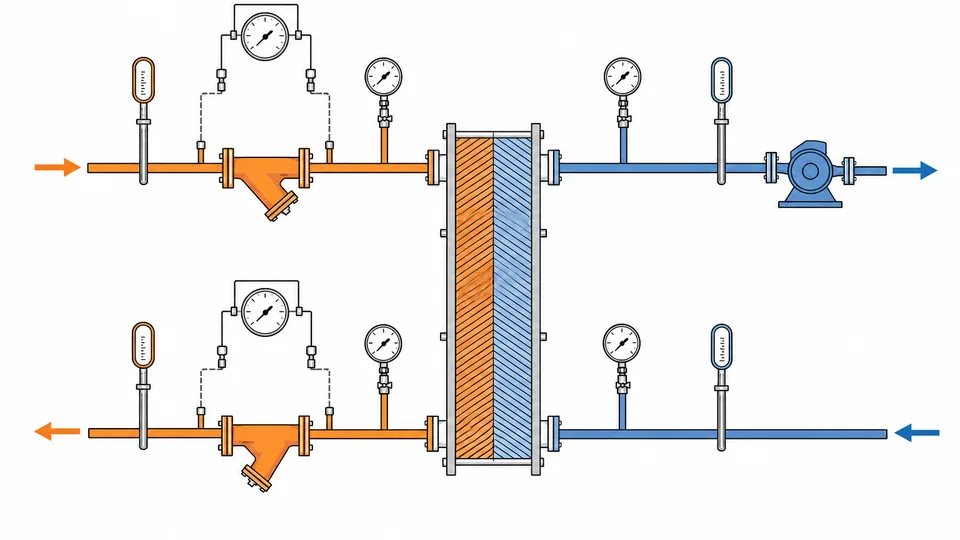
The most useful measuring points are normally arranged around the primary inlet and return, the secondary supply and return, the pump discharge and strainers. Pressure before and after a strainer can show whether debris is creating excessive loss. Primary and secondary readings help separate a network-side problem from a building-side circulation problem.
| Point | What it helps check | Instrument note |
|---|---|---|
| Primary supply and return | Network availability and pressure boundary at the station | Confirm maximum network pressure and temperature before choosing range. |
| Secondary supply and return | Building-loop circulation and pump condition | Use a readable range around normal operating pressure. |
| Across strainer or filter | Clogging trend and maintenance timing | A differential pressure gauge or two local gauges can be used. |
| Plate heat exchanger ports | Unexpected pressure drop or isolation-valve errors | Use service valves so gauges can be isolated or replaced safely. |
| Expansion and safety group | Static fill pressure and relief-valve context | Do not use a gauge reading alone to prove relief capacity. |
For related fundamentals, compare the pressure gauge installation best practices and the differential pressure gauge selection guide.
Range, temperature and material checks for district heating pressure gauge selection
Heat-transfer water can be hot, treated and sometimes dirty. The gauge range should cover normal operating pressure, pump head, static fill pressure, safety-valve setting and credible transients, while still keeping normal readings in a useful part of the dial. Do not copy a 0-10 bar or 0-16 bar gauge from another station unless the network pressure class and building loop are actually similar.
Temperature is equally important. A Bourdon tube gauge may need a pigtail siphon, cooling element or remote mounting if the process temperature at the gauge socket exceeds the instrument limit. For high-temperature heating water, confirm the ambient temperature, heat radiation from insulated pipes, isolation valve type and whether a bimetal thermometer or temperature transmitter should be specified at the same point.
Wetted parts should match water treatment chemistry, oxygen ingress risk and corrosion expectations. Brass internals may be acceptable in many closed heating loops, while stainless steel wetted parts are often preferred for harsher water chemistry, outdoor cabinets or owner standards. Manogauge product references include stainless steel pressure gauges and temperature-pressure gauges, but the final material and range must be verified against the project specification.
Préparer une RFQ manomètres réseau de chaleur ->Nos ingénieurs répondent en 24 heures→Inspection, commissioning and failure clues
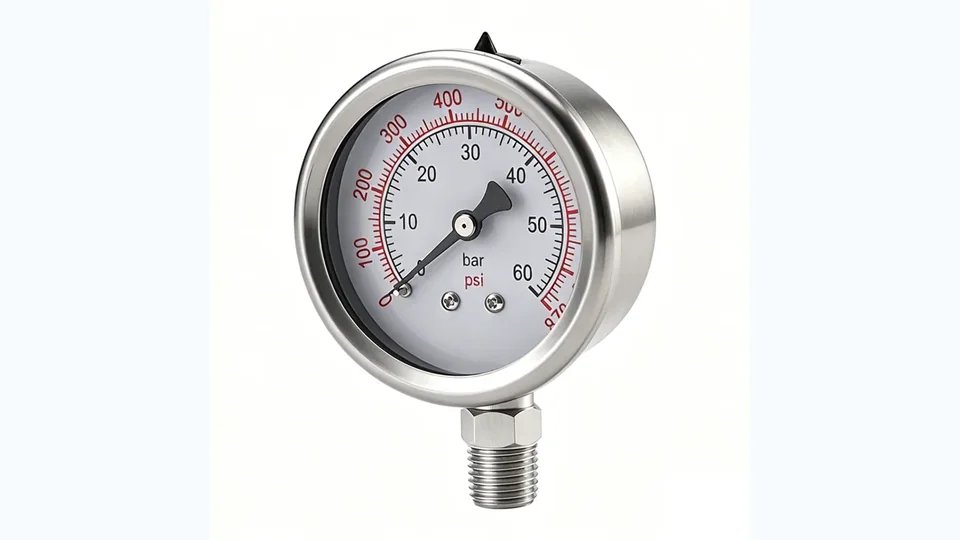
During commissioning, technicians compare gauge readings with pump curves, valve positions, heat-meter data and controller signals. A stable pressure profile does not prove heat transfer performance, but it can quickly show closed valves, undersized bypasses, blocked strainers, air pockets, failed expansion vessels or incorrect pump speed. KROHNE describes transfer-station instrumentation as monitoring flow, pressure and temperature in an energy transfer station, which is a useful reminder that pressure is one part of the measurement set.
In service, trend matters more than one isolated number. If a secondary loop that normally runs at a steady pressure begins to drift, the cause may be leakage, air removal, expansion tank failure or a make-up water issue. If differential pressure across a strainer rises, cleaning may be needed before flow becomes restricted. If the primary-side pressure is normal but the secondary side is unstable, the building loop deserves attention.
For traceable inspection decisions, see the pressure gauge calibration traceability guide. A field gauge should be compared with a suitable reference when readings affect safety, billing disputes or acceptance tests.
What a pressure gauge cannot prove in a heat exchanger station
A pressure gauge cannot prove heat quantity, flow rate, heat exchanger cleanliness, water chemistry, pump efficiency, relief-valve capacity or compliance with a district heating contract. It also cannot show whether the return temperature is low enough for network efficiency. Those judgments need flow measurement, temperature data, heat meters, water-quality checks, controller records and engineering review.
District heating pressure gauge selection should therefore be treated as a supporting layer in a monitored substation. Danfoss notes that pressure, differential pressure, temperature and flow are integrated and automatically controlled on many substations; that integrated view is the correct mindset. Local gauges help technicians, but they do not replace the controller, heat meter, safety devices or the network operator requirements.
Manogauge is a Zhejiang-based pressure gauge manufacturer with industrial gauge production experience for export markets. For district heating projects, the RFQ should still list the real station data instead of relying on a generic catalog item.
RFQ checklist for district heating gauges
A practical RFQ should include the measuring point, normal and maximum pressure, temperature at the gauge socket, connection thread, mounting orientation, dial diameter, scale units, accuracy class, wetted material, case material, window material, isolation valve requirement, calibration document requirement and expected quantity. If the gauge is installed outdoors or in an underground station, add ingress protection, condensation risk and vibration details.
For district heating substations, the buyer should also state whether the point is primary or secondary side, whether the medium is treated water or glycol mixture, whether the gauge will be used for commissioning only or permanent local indication, and whether a pressure transmitter is also required for BMS or SCADA. The conclusion is simple: district heating pressure gauge selection is reliable only when the dial, material and installation details are tied to the actual heat exchanger station.
Key takeaways
- Select district heating gauges by measuring point: primary side, secondary side, strainer DP, pump discharge and expansion group.
- Temperature protection is as important as pressure range when gauges are installed near hot water pipes.
- A pressure reading supports troubleshooting, but it does not prove heat quantity, flow, water chemistry or safety-valve capacity.
Часто задаваемые вопросы
What pressure range should a district heating gauge use?
There is no universal range. Use the station design pressure, normal operating pressure, pump head, safety-valve setting and maximum network pressure to choose a readable range with enough margin.
Do district heating pressure gauges need stainless steel wetted parts?
Not always. Brass or copper alloy wetted parts may suit many closed heating loops, but stainless steel is safer for harsh water chemistry, outdoor stations, owner standards or uncertain corrosion risk.
Where should a differential pressure gauge be installed in a heat exchanger station?
Common locations are across a strainer, filter, control valve or heat exchanger section where pressure loss indicates fouling, blockage or control problems. Final locations depend on station design.
Can one pressure gauge prove a heat exchanger station is working correctly?
No. Pressure is only one signal. Flow, supply and return temperature, heat-meter data, water chemistry, pump state and controller records are needed for a complete judgment.
What should be included in a district heating gauge RFQ?
List measuring point, pressure range, temperature, medium, thread, mounting orientation, dial size, scale units, accuracy, wetted material, case material, isolation valve and calibration documents.