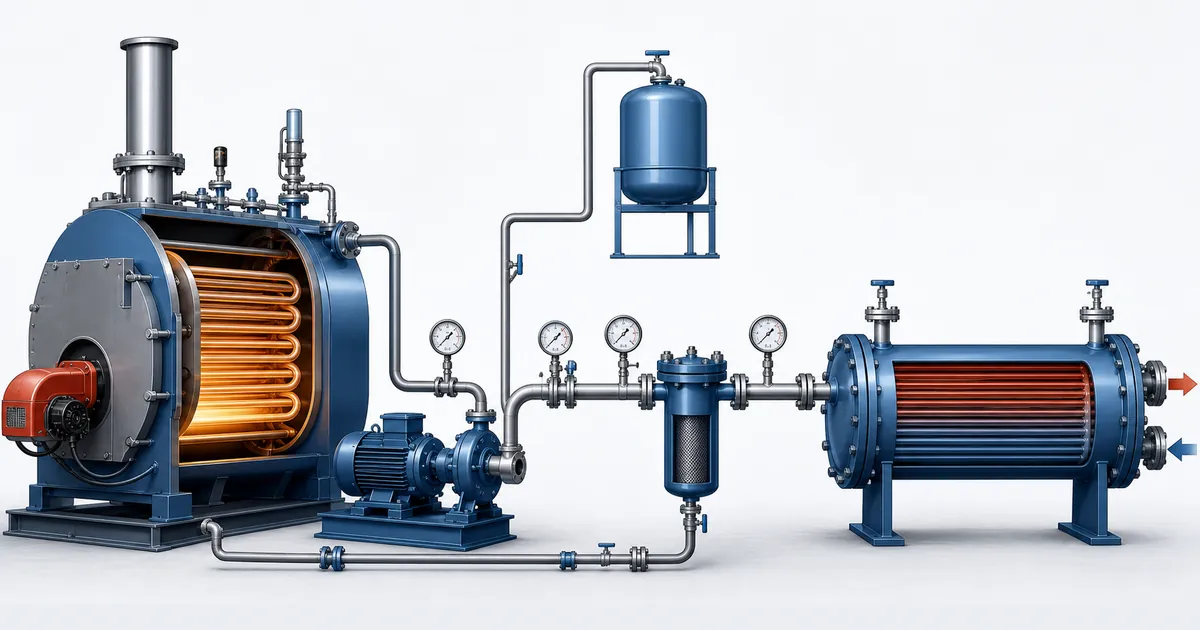
Thermal oil pressure gauge selection is the process of matching a pressure instrument to a closed heat transfer fluid loop, where high fluid temperature, pump circulation, expansion volume and strainer loading all affect the reading. A gauge on this service is not only a dial on a pipe. It helps operators see pump discharge, blocked strainers, abnormal expansion-tank pressure and loss of circulation before the heater or downstream process loses control.
What thermal oil pressure gauge selection means
Thermal oil pressure gauge selection starts with the service definition. Thermal oil, also called heat transfer fluid, circulates through a closed loop to carry heat from a heater to reactors, dryers, presses, asphalt equipment or other process users. These systems can run at high fluid temperature while the loop pressure is usually much lower than steam, so the gauge specification must treat temperature, pump head, fluid degradation and fire-risk controls as separate questions.
A recent industrial heating guide describes thermal fluid heating as a closed-loop method for supplying controlled heat, with common components such as a heater coil, burner, recirculation pump, fuel train, expansion tank and controls. See the Enerquip industrial heating systems guide for process background. For pressure instruments themselves, ASME B40.100 covers terminology, testing, safety considerations and gauge attachments including diaphragm seals, snubbers and pressure limiters.
Ver manómetros inoxidables ->Más de 143 modelos de manómetros industriales→Pressure points in a thermal oil loop
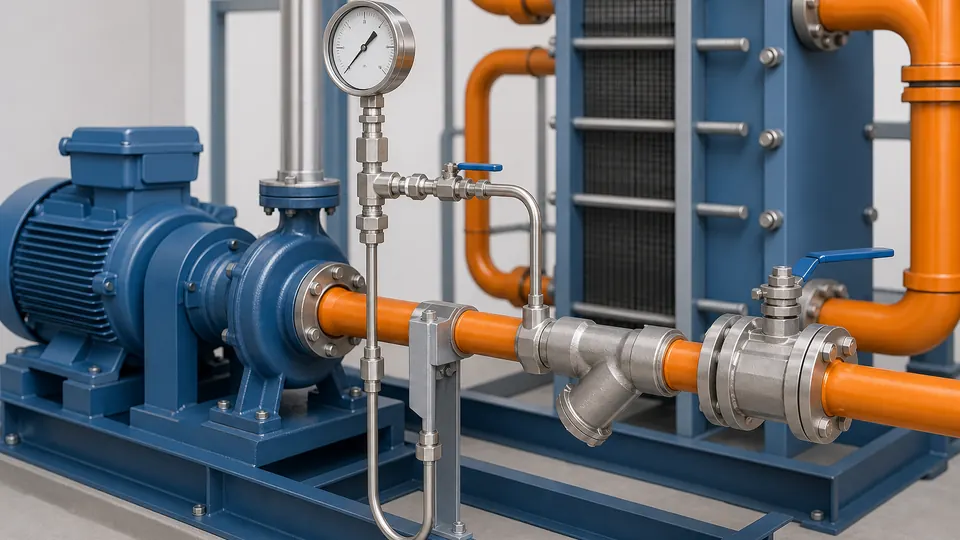
Useful pressure readings come from functions, not from random pipe access. Pump suction and discharge indicate circulation health. A pair of gauges across a Y-strainer or filter shows fouling and cleaning need. Heater inlet and outlet readings help identify unexpected restriction or vapor pockets. The expansion tank or nitrogen blanket pressure shows whether static head and expansion volume are stable.
| Location | What the reading can indicate | Gauge selection note |
|---|---|---|
| Pump suction | Low static head, blocked suction, cavitation risk. | Use a range that resolves low pressure and protect the gauge from heat. |
| Pump discharge | Developed head, closed valve, abnormal restriction. | Normal pressure should sit near the middle third of the dial when practical. |
| Strainer inlet / outlet | Fouling, wax or coke deposits, cleaning interval. | Use two gauges or a differential pressure gauge with isolation valves. |
| Expansion tank / blanket | Static head, nitrogen blanket stability, abnormal overpressure. | Confirm tank pressure class and venting philosophy before selecting a low range. |
Temperature isolation and wetted material choices
The hardest part of thermal oil pressure gauge selection is often not pressure; it is temperature at the socket. Many mechanical gauges are not intended to have very hot oil directly inside the Bourdon tube. A siphon, cooling leg, capillary, diaphragm seal or remote mounting can lower the temperature reaching the sensing element. The arrangement must still avoid trapped sludge and must allow safe isolation before maintenance.
Material selection depends on the heat transfer fluid, oxidation by-products, cleaning method and outdoor exposure. Stainless steel cases and 316L wetted parts are common starting points for durability. Manogauge catalog data includes stainless steel pressure gauges with 304 / 316L stainless construction, dial sizes from 40 to 100 mm, accuracy classes of +/-1.0 / 1.6%, and G, PT or NPT process connections. For dirty, viscous or crystallizing oil residue, a diaphragm seal pressure gauge can keep deposits away from the movement, but fill fluid and temperature limits still require engineering confirmation.
Preparar RFQ de manómetro para aceite térmico ->Nuestros ingenieros responden en 24 horas→Thermal oil pressure gauge range and vibration checks
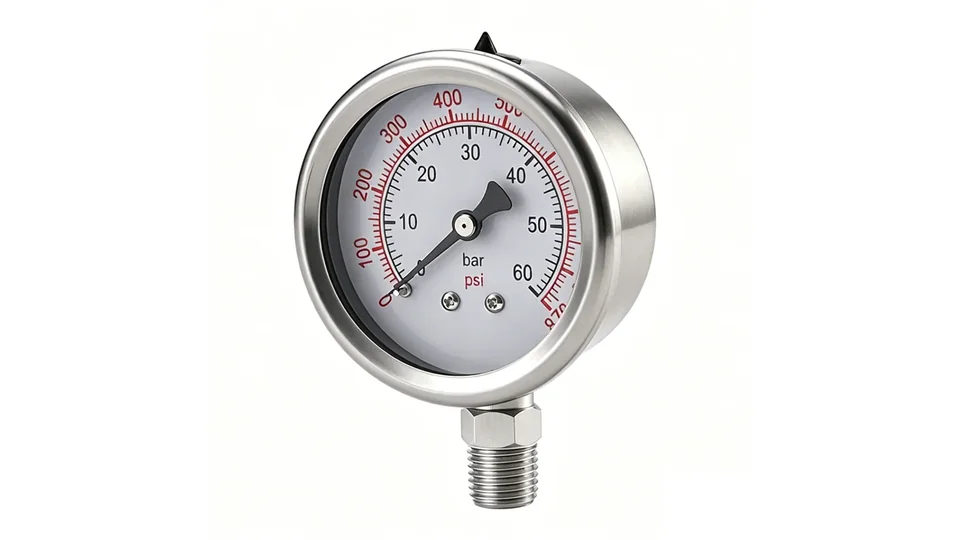
Range selection should start from the pump curve, static head, expansion-tank pressure and maximum allowable pressure of the heater skid. A common practice is to place the normal operating reading in the middle third of the dial and leave margin for cold start viscosity, valve transients and strainer fouling. Do not choose a very low range just to make small changes easier to see unless overpressure protection is defined.
Circulation pumps can create pointer flutter. A liquid-filled gauge, snubber or pulsation damper can improve readability, but it does not solve a wrong range, blocked gauge cock or overheating socket. Where operators read the gauge from a platform or behind insulation, dial size matters: 63 mm is compact, while 100 mm is easier to read in a heater room.
What a thermal oil gauge cannot prove
A pressure gauge cannot prove that the heat transfer fluid is chemically healthy, that the heater is safe to fire, or that the expansion tank is sized correctly. It only indicates local pressure at one connection. A stable reading can be false if the gauge valve is closed, the impulse passage is blocked with degraded oil, air or vapor is trapped, or the movement has been damaged by heat.
Thermal oil systems may use fluids that are hot enough to cause burns and, depending on the fluid and operating condition, may present fire or vapor hazards. Gauge selection should therefore be reviewed with the heater supplier, plant engineer and maintenance team. Confirm maximum temperature, maximum pressure, fluid flash point considerations, insulation layout, isolation valves and whether the operator stands directly in front of the dial.
RFQ checklist for thermal oil pressure gauge selection
A useful RFQ should state the medium as thermal oil or heat transfer fluid, fluid brand if known, normal and maximum temperature, normal and maximum pressure, connection thread, mounting direction, dial size, accuracy class, case material, wetted parts, filling fluid, cooling leg or diaphragm seal requirement, vibration level and whether certificates are required. Also state the measuring point: pump suction, pump discharge, strainer differential pressure, heater inlet, heater outlet or expansion tank.
As a Zhejiang manufacturer with ISO 9001 quality management and export experience, Manogauge can help map this information to stainless steel, liquid-filled, diaphragm-seal or differential pressure gauge families. The final thermal oil pressure gauge selection should still be confirmed by the system integrator because heater design, fluid chemistry and site safety rules control the installed specification.
Key takeaways
- Thermal oil gauges should be selected by function: pump suction, pump discharge, filter differential pressure, heater inlet or expansion tank.
- High fluid temperature often requires a cooling leg, capillary, diaphragm seal or remote mounting before a mechanical gauge is acceptable.
- A pressure gauge supports circulation and maintenance checks, but it cannot prove fluid health, heater safety or expansion tank sizing by itself.
Часто задаваемые вопросы
What pressure range is best for a thermal oil pressure gauge?
Choose a range that places normal operating pressure near the middle third of the dial, with margin for cold-start viscosity, valve transients and strainer fouling. Confirm the heater skid maximum allowable pressure before selecting a low range.
Can a standard pressure gauge touch hot thermal oil directly?
Not always. Many gauges need a cooling leg, siphon, capillary, diaphragm seal or remote mounting so the socket temperature stays within the gauge and fill-fluid limits.
Where should pressure gauges be installed in a thermal oil loop?
Common useful points are pump suction, pump discharge, filter inlet and outlet, heater inlet or outlet, and expansion tank or nitrogen blanket pressure.
Is a liquid-filled gauge enough for pump vibration?
It can steady the pointer, but it does not correct wrong range, overheating, blocked gauge valves or missing overpressure protection.
Can a pressure gauge prove thermal oil system safety?
No. It indicates local pressure only. Fluid analysis, temperature controls, expansion volume, relief devices and heater interlocks must be reviewed separately.