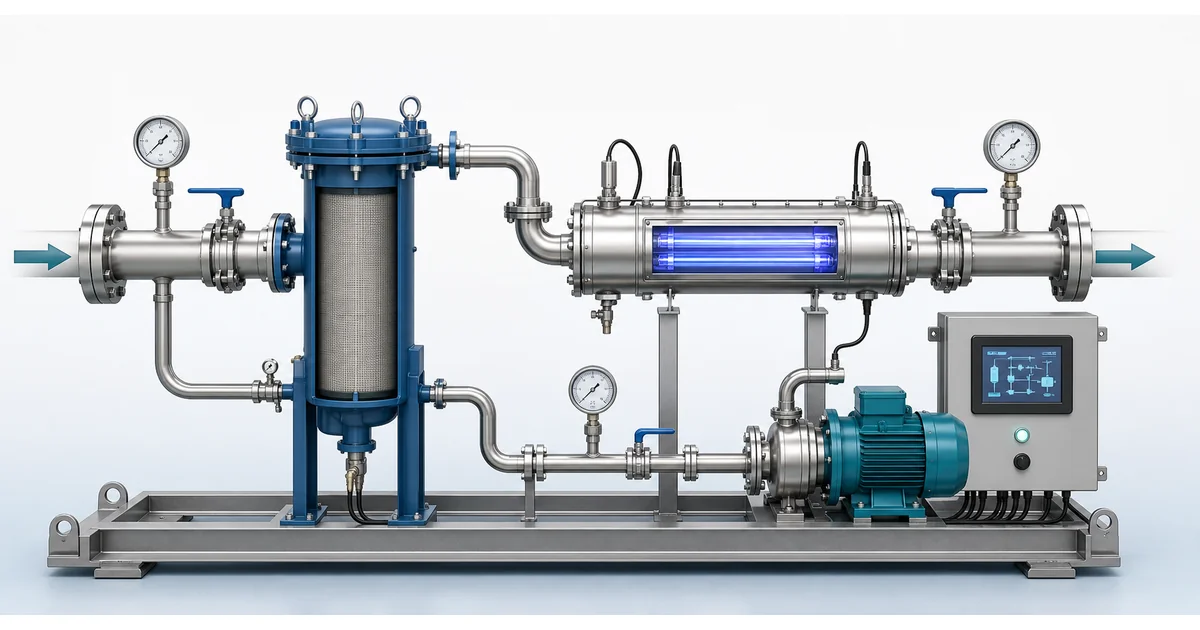
Marine ballast water pressure gauge selection is the process of matching a pressure instrument to seawater exposure, pump duty, filter loading, vibration and maintenance access on a ballast water treatment system. A gauge on this service is not only a dial for operators; it helps verify pump discharge, filter fouling, backwash readiness and abnormal blockage before the treatment skid loses capacity. Because ballast water contains chlorides, suspended solids and biological residue, the selection must start with wetted material, pressure range, isolation valves and installation position rather than price alone.
What marine ballast water pressure gauge selection means
Marine ballast water pressure gauge selection starts with the service definition. Ballast water is seawater taken into tanks to control vessel trim, stability and stress; treatment systems commonly include pumps, strainers or filters, disinfection equipment, valves and sampling points. The pressure gauge has to survive that wet, salty and vibrating environment while giving a reading that is useful for operation.
The IMO Ballast Water Management Convention explains the regulatory background for managing ballast water and sediments. This article does not replace class society approval or shipboard engineering review. It focuses on the instrument specification: where a gauge is useful, what material is defensible, and what data should appear in a purchasing RFQ.
راجع خيارات مقاييس الضغط البحرية الستانلس ←استكشف أكثر من 143 نموذجاً من المقاييس الصناعية→Pressure points on a ballast water treatment skid
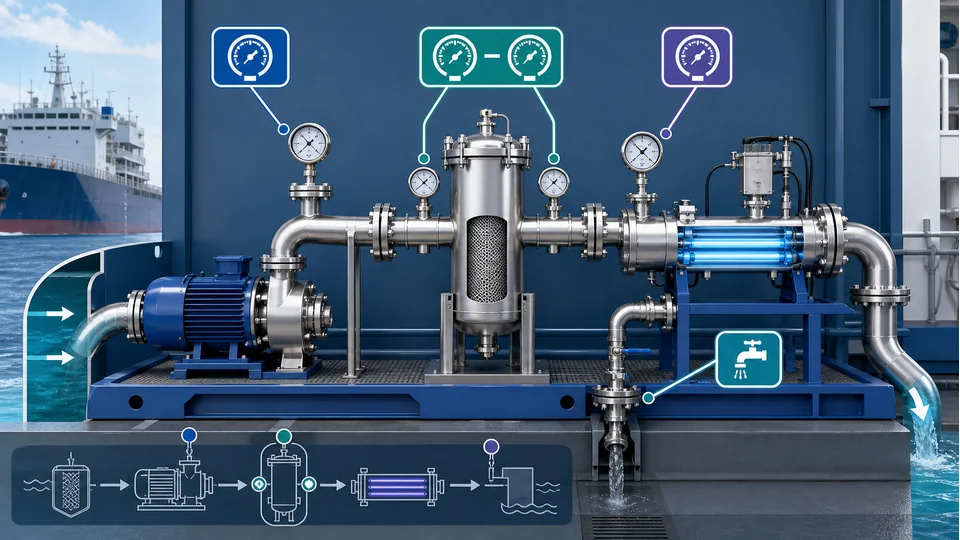
Useful readings normally come from several functions rather than one isolated point. A pump discharge gauge confirms whether the pump is developing enough head. A differential pressure pair across a filter or strainer indicates fouling and backwash timing. A pressure point before a UV reactor or treatment chamber confirms the equipment is fed within the skid supplier's allowable range. A low-pressure drain or backwash line may need a different range and sometimes a larger dial for quick inspection.
| Location | What the reading indicates | Gauge selection note |
|---|---|---|
| Pump discharge | Pump head, blocked valve, abnormal flow restriction. | Use a range with normal operation in the middle third of the dial when possible. |
| Filter inlet / outlet | Filter fouling and backwash trigger. | Consider two gauges or a differential pressure gauge. |
| Treatment chamber inlet | Feed condition for UV or electrochlorination equipment. | Match the treatment skid supplier's pressure limit. |
| Backwash / drain line | Drain flow and residual pressure before maintenance. | Use a low range only when overpressure protection is defined. |
Seawater corrosion and material choices
Chloride exposure is the main reason ordinary low-cost pressure gauges age quickly in ballast water service. The case may corrode from salt atmosphere, while the socket, Bourdon tube or diaphragm seal can contact seawater directly. For direct seawater service, review 316L wetted parts, stainless case construction, compatible elastomers and a process connection that avoids galvanic corrosion with the piping material.
Manogauge catalog data lists stainless steel pressure gauges with 304 / 316L stainless construction, Ø40-100 mm dial sizes, accuracy classes of ±1.0 / 1.6%, 0-100 MPa range options and G/PT/NPT 1/2 connections. For dirty, biological or crystallizing service, an isolating diaphragm gauge can keep solids away from the sensing element; catalog data lists diaphragm-seal style gauges with 0-60 MPa range options, SS / brass material choices and flange or threaded connections. The final material combination should be confirmed against the ship's actual seawater chemistry, cleaning chemicals and class documentation.
جهز طلب عرض لمقياس ضغط مياه الاتزان ←يرد مهندسونا خلال 24 ساعة→Vibration, pulsation, range and readability
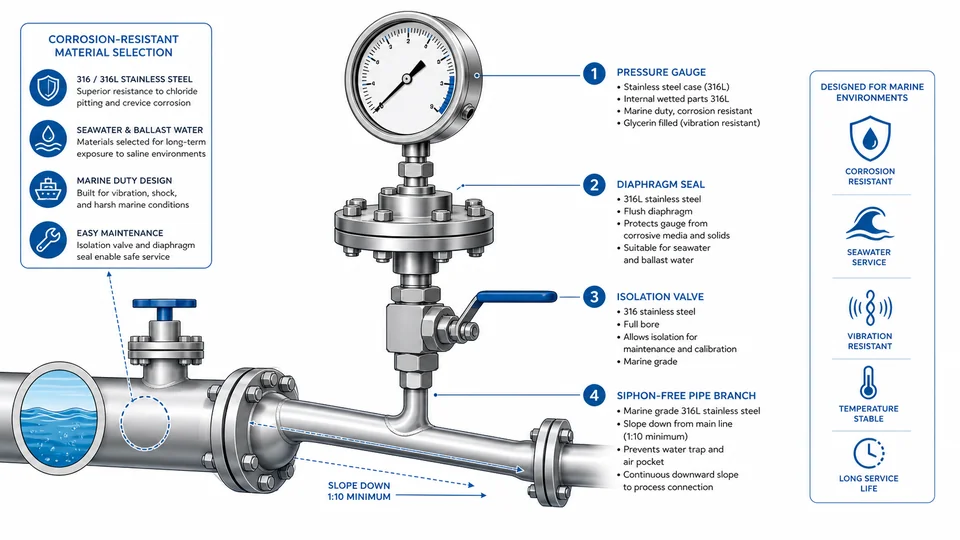
Ballast pumps, engine-room structure and ship motion create vibration that can make a dry pointer blur. A liquid-filled pressure gauge can damp pointer motion, while a snubber or pulsation damper may be needed if the reading pulses from pump discharge or valve cycling. Do not use filling fluid as a substitute for correct overpressure protection or safe isolation.
Range selection should avoid operating at the very bottom of the dial or near full scale. A practical target is to place normal pressure near the middle third of the scale, while allowing enough margin for pump start, backwash and valve transients. Dial size is also a maintenance decision: Ø63 mm may fit compact panels, but Ø100 mm is easier to read in a noisy machinery space or when the gauge is behind piping.
What a gauge cannot prove on its own
A pressure gauge cannot prove that ballast water treatment is compliant, that the filter is clean internally, or that biological discharge criteria are met. It only indicates local pressure at one connection. A blocked gauge cock, clogged impulse port, trapped air pocket or damaged movement can produce a misleading stable reading. For this reason, marine ballast water pressure gauge selection should include test ports, isolation valves, venting practice and periodic comparison with calibrated instruments.
For safety, confirm maximum allowable pressure of the skid, valve pressure class, thread standard, material compatibility, vibration level and whether the operator stands directly in front of the dial. High-pressure, chemical dosing, electrochlorination by-product, hazardous-area or hot-cleaning conditions should be reviewed by the shipyard, class society or system integrator before procurement.
RFQ checklist for marine ballast water pressure gauge selection
A useful RFQ should state the medium as seawater or treated ballast water, expected normal and maximum pressure, temperature, cleaning chemicals, pipe material, connection thread, dial size, accuracy class, case material, wetted parts, filling fluid, mounting orientation and required certificates. Include whether the gauge is for pump discharge, filter differential pressure, treatment chamber inlet or maintenance drain.
As a Zhejiang manufacturer with ISO 9001 quality management, Manogauge can help map these inputs to stainless steel, liquid-filled, diaphragm-seal or differential pressure gauge families. The final choice still belongs to the vessel engineer or system integrator because ballast water pressure gauge selection depends on the installed skid, class requirements and actual operating envelope.
Key takeaways
- Ballast water gauges should be selected by pressure point function: pump discharge, filter differential pressure, treatment chamber inlet or drain line.
- For seawater exposure, 316L wetted parts, stainless case construction, compatible seals and isolation valves matter more than catalog price.
- A pressure gauge supports operation and maintenance, but it does not prove ballast water treatment compliance by itself.
Часто задаваемые вопросы
ما مدى الضغط المناسب؟
اختر مدى يجعل الضغط الطبيعي في الثلث الأوسط من القرص مع هامش لبدء المضخة والغسل العكسي وتغيرات الصمامات.
هل يلزم 316L دائما؟
316L نقطة بداية جيدة مع الكلوريدات، لكن يجب التحقق من كيمياء الماء ومواد التنظيف والأنابيب ومتطلبات التصنيف.
هل يستخدم فلتر الاتزان مقياسين أم مقياس فرق ضغط؟
كلاهما مستخدم؛ المقياسان بسيطان، وفرق الضغط يوضح الانسداد مباشرة.
هل يثبت المقياس الامتثال؟
لا. يعرض الضغط المحلي فقط.
متى يفيد المقياس المملوء بسائل؟
عندما يجعل اهتزاز المضخة أو حركة السفينة المؤشر غير مستقر.